



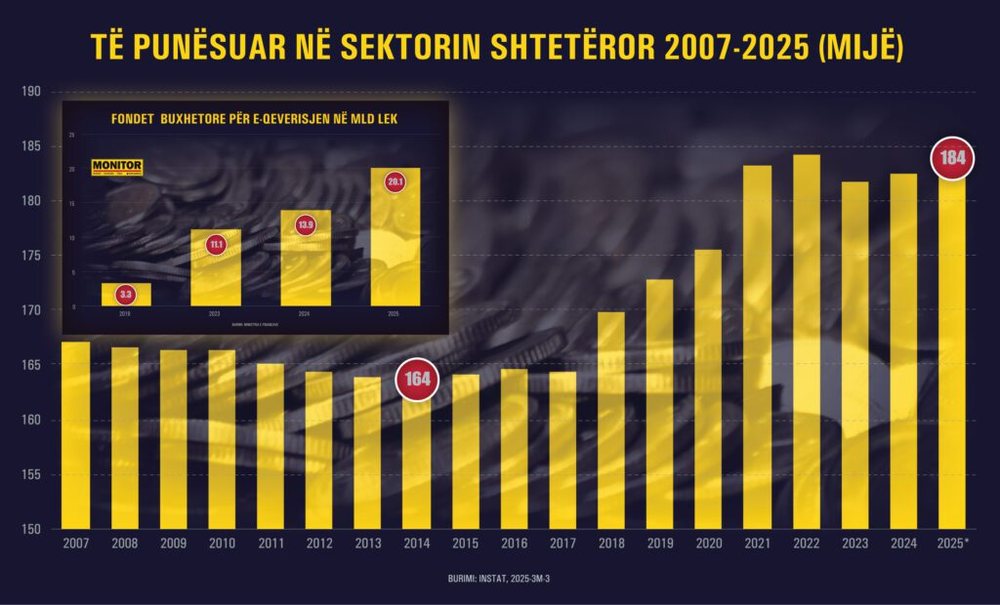
The number of employees and funds for public administration have increased to historic records in 2025. In parallel, the government is rapidly increasing funding for digital governance, but on the other hand, citizens and businesses have been facing more difficulties in accessing public services in recent months.
In 2014, funds for salaries and contributions for state employees were around 71.4 billion lek, while the number of employees in the public sector was around 163 thousand people.
Eleven years later, in 2025, the public administration has about 184 thousand employees and the budget expenditures for personnel have increased to about 129 billion lek. From 2024 to 2025, the number of employees in the state sector has expanded by 12.7 percent, while expenditures on them have increased by 80 percent.
The growth has not only been in the number of employees and salary funds. In parallel, investments in digital governance have increased at a rapid pace in the last 6 years.
In 2025, funding for e-government increased threefold within the year, reaching 20.1 billion lek (over 200 million euros), from about 3.3 billion lek provided in 2019, to a total of 48.4 billion lek in 4 years, or almost 500 million euros.
The government has presented digitalization as one of the main pillars of modernizing the administration and improving services for citizens and businesses.
Despite these investments, digital public services have shown serious operational problems in recent months. The main e-Albania platform for electronic services for citizens and businesses has faced frequent interruptions, delays and inability to access, creating real difficulties in obtaining documents, carrying out administrative procedures and fulfilling legal obligations.
E-Albania has become a nightmare for businesses. Economists have become like police officers who ambush cars. Police officers do this to identify those who commit violations and fine them, economists to identify when the system is working and do some work.
Businesses have repeatedly complained to Monitor that they often fail to access the self-care system through which businesses can view all purchase invoices coming from suppliers, verify purchase and sales invoices at the end of the month, or perform services such as fiscalizing imports, and small businesses without employees can use it to fiscalize sales invoices without purchasing software.
Economists say they don't know where to complain when the system doesn't work. "At the moment, for example, invoices are not being taxed, and employees of a business that sells food products did not leave for Durrës, and drivers are stuck, as they cannot move the goods without a sales invoice or accompanying invoice."
"At least you write that no one accepts that the systems don't work," says the representative of a subject with irony, tired and irritated by this situation and by the fact that they don't know where to complain to find a solution.
The only alternative is to write to the Minister of State for Artificial Intelligence, "Diella", which was presented by Prime Minister Rama as a revolution and innovation in the world. But, even she is not solving their problems, while the public administration is on vacation on weekends, or when holidays fall close to the weekend, it enjoys an extra day off work.
We fail to understand what 20,000 additional employees in public administration in the last 10 years are for, or 500 million euros in investments in e-government in 4 years, when businesses are unable to work, individuals often cannot get the documents they need online, and no one explains to them what they need to do. No one is responsible for the extra working hours, or the lost income because businesses fail to make sales, through no fault of their own.
Who is responsible for the costs?
We fail to understand what 20,000 additional employees in public administration in the last 10 years are for, or 500 million euros in investments in e-government in 4 years, when businesses are unable to work, individuals often cannot get the documents they need online, and no one explains to them what they need to do. No one is responsible for the extra working hours, or the lost income because businesses fail to make sales, through no fault of their own.
According to businesses, this recurring situation constitutes a serious concern for the normal functioning of economic activity and the relationship of businesses with public administration or of professionals with their clients.
Technology experts claim that the rapid growth in technology investments has not always been accompanied by a proportional strengthening of technical and human capacities for the maintenance and security of systems.
Some digital projects are built with fragmented logic, without full integration and without sufficient testing under high usage load.
Recent problems have highlighted the gap between financial investments and the real functioning of public administration.
Last year, administration and e-government received 149 billion lek, about 1.5 billion euros or about 18 percent of the 2025 budget expenditures. This amount was 108% higher than in 2014./Monitor.al