



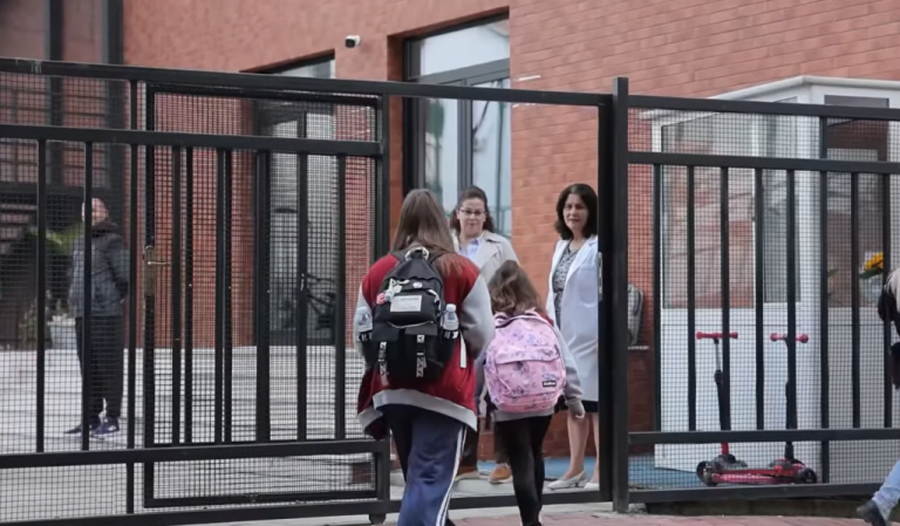
The ALSAI report on school safety raises the alarm about physical and verbal violence and questions the effectiveness of the role of the security officer in these institutions.
The audit findings for the period 2021-2024 show that the most widespread form of problems in schools remains physical violence, with 892 cases referred during the audited period. It is followed by psychological and verbal violence, with 333 cases reported, while bullying, one of the most worrying challenges for the school environment, was identified 186 times in the same period. Likewise, threats, blackmail and harassment result in 178 cases, while the use of drugs, cigarettes or alcohol appears in 133 cases.
The report further reveals that security indicators in pre-university educational institutions have deteriorated significantly in the first four months of the 2024–2025 school year. During this period alone, 528 incidents were recorded, dominated by physical violence, and 8 students were caught carrying weapons.
Failure to refer cases to the State Police, lack of defining criteria
But the audit raises another concern related to the lack of a clear criterion to determine when an event or problem should be reported not only to the head of the educational institution and the ZVAP, but also to the State Police.
This lack of standards has created a chain of consequences. Security officers, as ASCAP points out, often self-censor reports of incidents on the relevant link, not identifying the name of the school and feeling under pressure from the leaders of educational institutions.
This approach directly impacts not only the reporting process at ASCAP, but also poses a risk to the obligation to refer cases to the police, especially when there is a lack of a clear legal criterion to guide the entire process.
Audit questions to Albanian school security officers clearly highlighted this gap. In one interview, the security officer stated that only “extreme violence” could be reported to the police and that more serious cases were not documented as “Case Referrals” but were handled within the school, verbally.
In another institution, it was emphasized that reporting to the police depends on the lack of reconciliation between the parties, but that “there is no fixed criterion”. Meanwhile, another officer stated that he only referred physical violence, but not psychological violence, arguing that in the absence of concrete measures by the police for cases of physical violence, he did not see any benefit from referring psychological violence. Cases of cyberbullying, according to him, are referred to specialized structures of the Tirana Police.
Statements from security officers indicate that the decision to report an incident to the police is based on individual “case-by-case” assessments, with ongoing communication with the SPZ, often only verbally, and without full documentation. Abuse is not referred outside the school, while each situation is subject to the officer’s own interpretation. This fragmented approach highlights the lack of a unified and mandatory criterion for reporting incidents, causing practices to vary from one institution to another and decision-making to be influenced by skepticism about the effectiveness of cooperation with the police. The problem is exacerbated by the fact that the official Work Guide for Security Officers does not address this gap.
The officers themselves have admitted that they have felt pressured to report or not report various cases, which turns the process into a fragile mechanism, where avoiding conflict with parents or school administrators leads to non-implementation of obligations clearly stipulated in the bylaws.
This raises a fundamental question: how can the discretion allowed by the manual be exercised objectively, when the officers themselves are hesitant to implement even the most basic obligations due to external pressures? How prepared are they to make such decisions, when out of 120 hours of training, only about 60 are dedicated to theoretical knowledge?
In the absence of this criterion, the risk that incidents will not be referred, minimized or handled within the school in an incorrect and unprofessional manner remains real and with direct consequences for the safety of students and the efficiency of supervision mechanisms, the report concludes./ekofin.al/