


In a time when love is declared on Instagram, wealth is measured in square footage, and divorce has ceased to be the end of the world, couples are discovering that romance does not preclude planning. On the contrary. The prenuptial agreement, once considered an affront to feelings, is emerging today as a new aspect of modern marriage. Not to anticipate separation, but to make the union more manageable.
In Albania, prenuptial agreements are slowly entering the vocabulary of modern couples, not as a sign of coldness or distrust, but as a reflection of an era that has learned that love does not replace the need for clarity.
What once seemed like a custom typical of Western elites or celebrity marriages that end in court is now increasingly seen as an act of rationality, a way to negotiate the future before emotions make reason impossible.
In our country, the idea of a prenuptial agreement still clashes with a culture that sees marriage as a moral rather than a legal agreement. However, the reality is starting to change. Couples are marrying later, often after they have built wealth, businesses, properties, or independent careers.
Women are more economically integrated, men more exposed to financial risk, and divorce has lost its status as an absolute taboo. In this context, the prenuptial agreement is no longer seen as a prediction of failure, but as a form of emotional and economic security.
Legally, Albania recognizes this instrument. The Family Code allows couples to choose the property regime through a contract concluded before or during marriage, departing from the standard model of legal community of property.
Despite this legal space, the practice remains limited. Prenuptial agreements are still the exception, not the rule, and are used mainly by individuals with clear economic interests, such as entrepreneurs, returning emigrants with assets created abroad, or people entering into a second marriage.
What is changing is not just the number of contracts, but the discourse around them. In private conversations and in lawyers’ offices, the idea of “getting things right from the start” is gaining ground. The fear that such a contract undermines romance is being replaced by the conviction that ambiguity is far more dangerous than transparency.
In a society where post-divorce conflicts often last for years and involve entire families, property, businesses, and children, the prenuptial agreement is being seen as a way to limit the damage, not to institutionalize the separation.
Who is using them and why?
In Albania, marriage is gradually losing its status as an untouchable territory by legal logic and is increasingly transforming into a relationship that requires clarity even beyond emotions.
The increase in divorces, the economic empowerment of women, the wealth created before marriage and the increasingly frequent experience of second marriages are pushing some Albanian couples to think before getting married not only about the ceremony, but also about the legal consequences of cohabitation. In this context, prenuptial agreements, once considered almost social blasphemy, are slowly finding their place in the Albanian urban reality.
"A gradual change is being observed, especially in large cities," says lawyer Greta Smoqi, emphasizing that, however, prenuptial agreements continue to remain taboo for a part of society. According to her, this is directly related to tradition and the way in which marriage is still perceived as a deeply emotional act, where any attempt to regulate it legally is seen as a lack of trust.
The tension between love and the law is perhaps the main reason why prenuptial agreements are moving faster in Tirana and large cities than in more traditional areas of the country.
The profile of couples seeking a prenuptial agreement is quite clear. “They are mostly couples with higher levels of education, active businesses, assets created before marriage, or second marriages,” says Ms. Smoqi.
In many cases, these are individuals who have built an economic base before marriage and are seeking to protect it, not necessarily from their partner, but from the uncertainties that the future may bring. Second marriages, in particular, are more pragmatic: the previous experience of separation makes legal planning seem less like cynicism and more like a necessity.
Although there are no detailed official statistics on the number of prenuptial agreements signed each year, the perception in legal practice is clear. “There is a noticeable increase compared to a decade ago,” the lawyer claims, adding that greater legal information and direct confrontation with the consequences of divorce have significantly influenced this trend.
Couples today are more aware of wealth, debts, responsibilities, and the fact that separation is no longer a rare exception, but a common social reality.
However, the prenuptial agreement continues to suffer from a number of misconceptions. “The main misconception is that the prenuptial agreement implies a lack of love or trust,” explains Ms. Smoqi. Another misconception, she says, is that this agreement only applies to very wealthy people.
In reality, it is a legal instrument that can serve any couple who wants to have clarity on their property regime, regardless of their income level. The Albanian paradox lies in the fact that couples often enter into much more complex financial relationships without any documents, while a simple contract is seen as a sign of coldness.
In the event of a divorce, the real weight of the prenuptial agreement becomes apparent. "Contracts are legally valid if they are drafted according to the law, with transparency and without violating fundamental rights," the lawyer emphasizes.
Problems usually arise not from the existence of the contract itself, but from unclear wording or lack of complete information at the time of signing. In some cases, emotional pressure or the desire to quickly conclude the marriage process leads to signatures that are later contested.
In a legal reality that is gradually modernizing, the prenuptial agreement is trying to shed its moral stigma. “In the modern Albanian legal context, it should be seen as a normal financial and legal planning instrument,” concludes Ms. Smoqi, emphasizing that its aim is to guarantee security for both spouses and reduce conflicts in the event of separation.
The question that remains open is whether Albanian society is ready to accept this approach as a sign of maturity and not as a lack of feelings, or whether the prenuptial contract will remain for a long time the privilege of a more informed urban elite.
Love in the era of personal capital
Marriage is no longer an entrance into life, but an intermediate chapter, which comes after individuals have gone through a long phase of personal and professional development.
Family law attorneys note that couples are increasingly marrying at a later age than before, usually after they have completed their studies, built a career, taken out long-term loans, opened businesses, or established a stable wealth base. Marriage, in this sense, no longer serves as an economic starting point, but as a union of two individuals who already have separate financial histories.
This trend profoundly alters the balances within relationships. Partners enter into marriage not out of economic necessity, but out of choice, maintaining a level of autonomy that was unusual in previous generations. Assets created before marriage, whether an apartment, a business, savings or financial obligations, also bring with them the need for legal clarity.
In this context, the prenuptial agreement is no longer seen as a sign of distrust or a prelude to separation, but as a rational instrument to define financial boundaries and protect individual investments made before the relationship.
According to the practice of lawyers, these contracts reflect a change that has shifted the idea of a partnership built on dependence, but on two autonomies that choose to coexist.
Lawyer Nexhi Beqiraj says that interest in prenuptial agreements has increased, although we are not yet talking about massive figures.
"I have also communicated with notaries, in recent years the demands have increased especially in large cities and in couples where both partners are economically active. This interest is related to several factors. First, the increase in private wealth and individual entrepreneurship.
"Second, the increase in divorces that has created more awareness of the financial consequences of separation. And third, the cultural change where wealth is being seen less as an emotional taboo and more as an issue that requires rational regulation from the beginning of the marriage," says the lawyer.
When it comes to divorce settlement, lawyers are almost unanimous that prenuptial agreements make the process much clearer and less conflictual. When there is a written agreement that defines what is personal property and what is joint property, lengthy court battles and subjective interpretations are avoided. In this sense, the agreement does not encourage divorce, but rather manages it if it occurs.
It's not just VIPs who resort to these contracts. Of course, public figures, entrepreneurs, people with businesses or inherited wealth are more exposed and tend to use them.
But lawyers are increasingly also seeing young professionals, women who have built their own careers and wealth, or couples where one partner has loans, businesses, or financial obligations that require legal clarity.
From emotional taboo to rational instrument
For too long, prenuptial agreements have been seen as an invitation to failure, an act that undermines romance before it even begins. But the narrative is gradually changing. They are talking less about mistrust and more about transparency, reflecting a society that is learning to articulate conflict before it erupts.
Instead of issues of wealth, obligations, and responsibilities being left in silence, they are being discussed openly, as part of a conscious agreement between two individuals.
Sociologist Marsida Simo sees this shift as an indicator of growing social maturity. “The prenuptial agreement is not the end of love, but a sign that the relationship is being built on dialogue and not on emotional assumptions,” she says. According to Ms. Simo, younger generations are seeing marriage not as a total sacrifice of self, but as a coexistence between two complete identities, including in economic terms.
In a society where divorce is increasingly common and less dramatic, logic is entering relationships not as the enemy of love, but as its protector.
"When the rules are clear from the beginning, even separations, if they occur, are less traumatic and less destructive, especially for women," emphasizes Ms. Simo, also linking this instrument to the dimension of gender justice and the balance of power within the couple.
However, obstacles remain strong. The lack of legal culture, the perception that such a contract is offensive to the partner, and uncertainty about how it would be interpreted by the courts, keep this practice still on the periphery.
Albania does not yet have a consolidated jurisprudence on prenuptial agreements, making them more of an act of trust than an absolute guarantee. This, too, according to Ms. Simo, is part of the social transition. “Societies do not embrace emotional rationality immediately. It comes gradually, through debate and normalization,” she concludes.
How did it start?
Prenuptial agreements have been around for ages, dating back to the earliest times of ancient Egypt. The Ketubah, an ancient Jewish marriage contract, dates back over 2,000 years and was one of the first legal documents to provide protection and legal rights to newly married women. Prenuptial agreements were primarily used as a way to ensure that women would receive a share of the property in the event of a divorce or the death of their husband.
But as society changes, the wealthy have become the advocates of modern prenuptial agreements as a way to fairly distribute assets in the event of a divorce. However, recently, there has been a surge in the signing of prenuptial agreements by the millennial generation.
Financial decisions
In the Albanian context, where there is still a tradition where assets are often managed or controlled by one party and financial decisions can be influenced by social norms and cultural pressure, prenuptial contracts serve as a protective layer that increases the economic autonomy of individuals.
Furthermore, they can play a role in preventing potential conflicts after separation or divorce, by providing a clear framework for the division of assets. In this way, these agreements are not simply legal documents, but instruments that directly impact on improving social justice and promoting gender equality in a society where traditional practices often favor one party over the other.
Facts
Today in Albania, about 1 in 3 marriages end in divorce. This means that marriage is no longer just an emotional promise, but also a financial risk.
In most conflictual divorces, the main dispute is not infidelity, but wealth: home, business, loans.
Lawyers say that a prenuptial agreement can shorten a divorce process from years to months, because what belongs to whom is not negotiated in advance.
Prenuptial agreements are increasingly being used by economically independent women, not just wealthy men.
A record one in three couples are breaking up
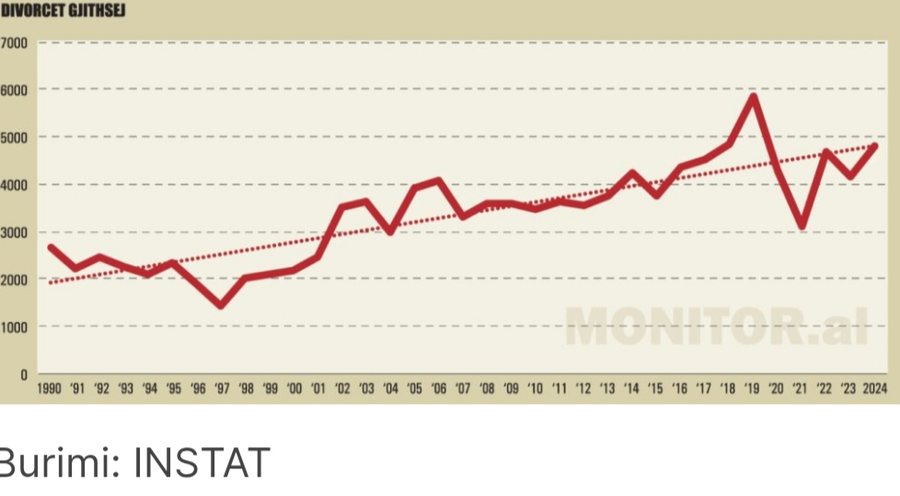
Albanians are getting married less and getting divorced more. The latest INSTAT figures show that the number of marriages has fallen to a historic low, while divorces have taken the opposite direction, reaching peaks never seen before.
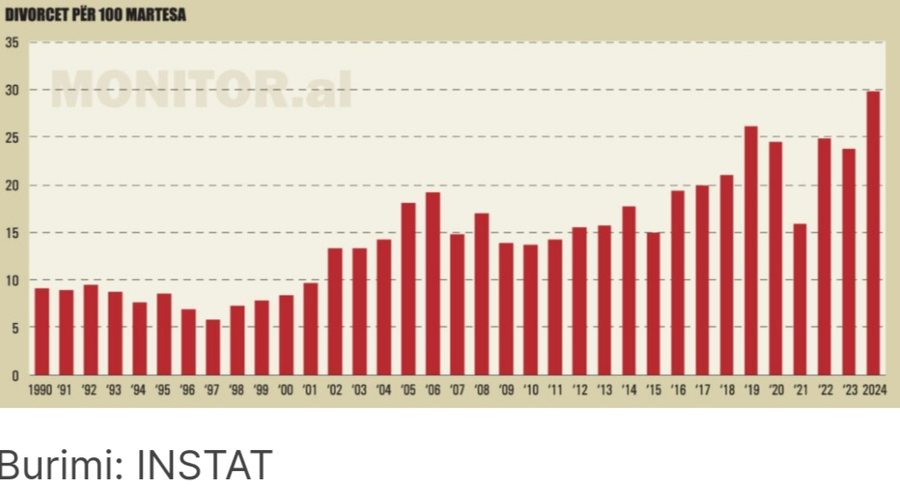
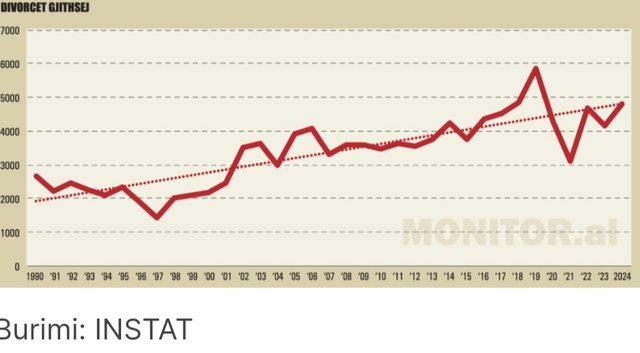
One in three marriages ended in divorce in 2024, according to figures from the General Directorate of Civil Status.
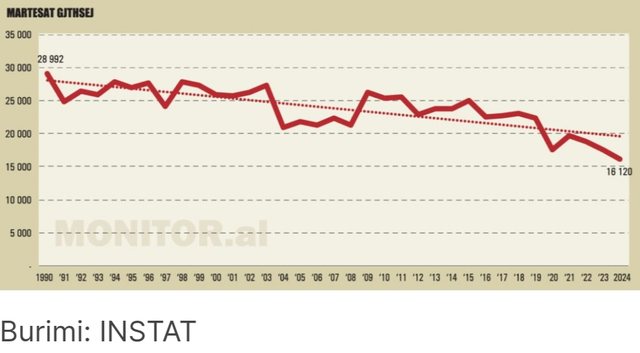
Marriage data confirms that Albania is not only facing a wave of divorces, but also a strong contraction of the institution of marriage itself.
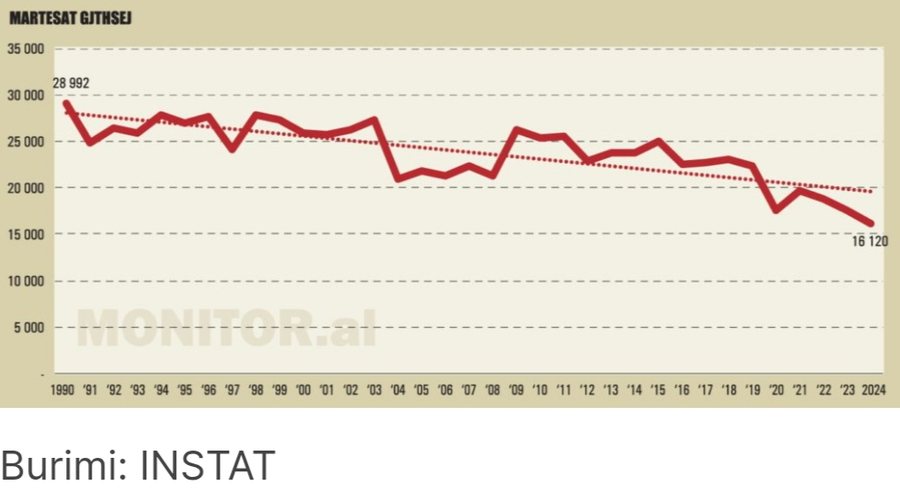
From around 29 thousand marriages in 1990, the level remained relatively stable throughout the 1990s and early 2000s, fluctuating around 25–27 thousand per year, before starting a structural decline after 2004.
A strong interruption is observed since the mid-2000s, when marriages fall below 22 thousand and fail to recover previous levels, despite some temporary rebounds.
After 2015, the trend becomes clearly negative, with an acceleration of the decline after 2019. The pandemic further deepens this trend, but the decline does not stop even after it.
The year 2024 marks a historic low with only 16,120 marriages, almost half the level of the early 1990s, reflecting not simply a demographic or economic effect, but a profound change in social choices, youth emigration, and the increasing reluctance to formalize ties in marriage.
Meanwhile, the divorce rate per 1,000 marriages, which in 1990 was 9.2, has followed an upward trajectory for more than three decades, but recent years have broken every previous record.
From the late 1990s, when the indicator dropped to a historic low of 5.9 in 1997, divorce began an unstoppable climb during the 2000s and 2010s, exceeding 20 separations per 1,000 marriages as early as 2018. The latest report shows that 2024 marks an absolute record of 29.8 divorces per 1,000 marriages, the highest level ever recorded in the country.
Analysts in the socio-demographic field see in these figures not just a statistical change, but a profound transformation of social structures.
Gëzim Tushi, a sociologist, states that, in the years after the transition, when the lack of perspective and economic crises kept entire families together, divorce was often seen as a luxury or failure.
According to him, today, Albanians, exposed to international influences, more economically independent and more aware of personal well-being standards, are making new choices for married life.
Family and social policy experts estimate that the increase in divorces is a direct impact of several main factors: rapid urbanization, mass emigration of younger generations, economic pressure on young families, and a social norm that has evolved toward individual well-being over collective survival.
On the other hand, the judicial system and social services are facing an increasing volume of family cases, which require political response and institutional support, according to communications received from social psychologists in the courts.
Mr. Tusha emphasizes that an increase in divorces brings new challenges for childcare, property issues, and social support for single parents.
Lawyer Nexhi Beqiri adds that divorces in recent years come mainly from couples in their 40s, who do not compromise like they used to. The problems that follow these divorces, according to the lawyer, are the division of assets and child custody, which take months and years in the courts./Monitor