


Great and important events for peoples and nations always produce history, analysis, conversations and debate. The reconsideration or recycling of these events remains current when the event comes back to the attention of the peoples cyclically, due to their celebration as important for the community. Such have been and are the two important dates of modern history for Albanians, November 28 and 29. In the case of November 28, the declaration of independence of Albania, three discussions are taking place, despite the fact that we do not have their subjects in private or public possession: the issue of the independence flag, who brought it or who embroidered it; the issue of the independence document, who preserved it and how it was lost; the issue of the complete original acts of the Vlora assembly, of which we have no trace, since Lef Nosi published them in the years after independence. These three elements, artifacts and documents, are not owned by any Albanian institution today and it is not known whether they are located somewhere, or if we should consider them lost.
Taking inspiration from a document that has not previously been widely circulated in the hands of historians or in the eyes of the public, we bring here a chronicle of the origin of the independence flag. But first, a little history.
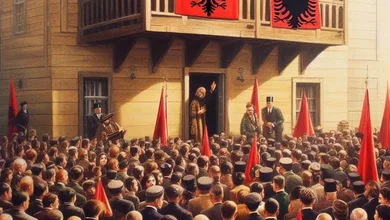
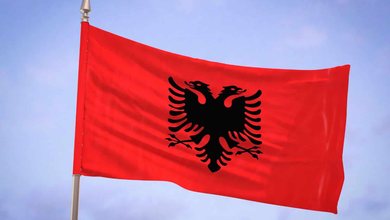
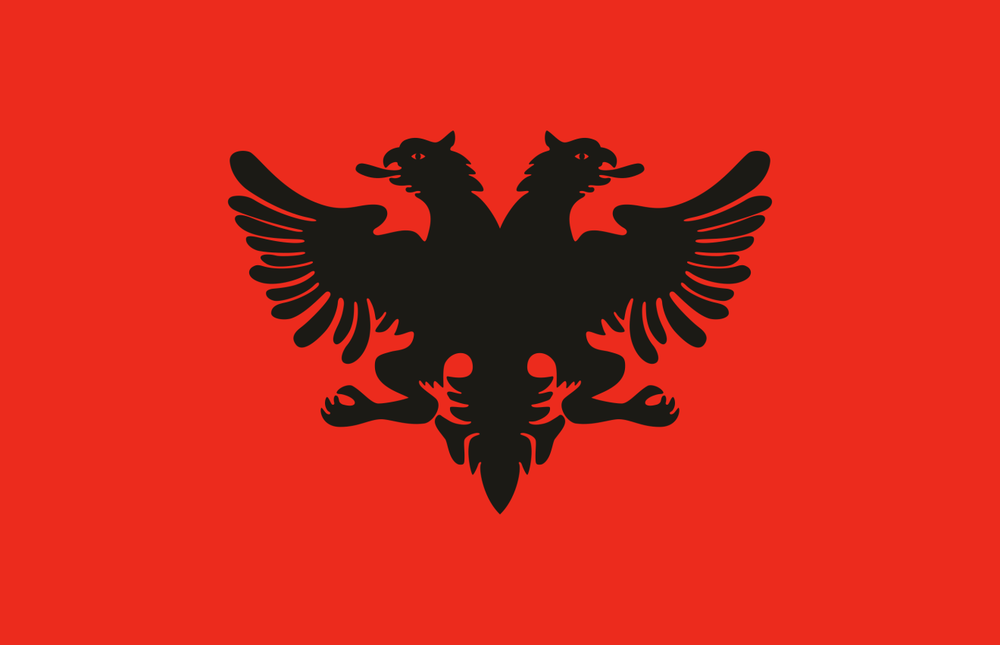
Studies to date give us four origins of the flag that was raised on the afternoon of November 28, 1912 by the hands of Ismail Qemali on the balcony of his house in Vlora. According to the first version, the flag was embroidered or printed by Marigo Pozio and, later, according to the same model, he produced other flags that were raised in other government buildings. According to the second version, the independence flag had been kept at the head of Eqrem Bey Vlora's bed since 1909, when it was given to him by Aladro Kastrioti, an adventurer who claimed to be a descendant of Skanderbeg and a claimant to the throne of Albania in 1914. This flag was removed from the frame above the bed by Amalie von Godin, a friend of Eqrem Bey Vlora at the time. According to the third variant, the independence flag was brought to Vlora, from America and through Bucharest, by the patriot Spiridon Ilo, one of the signatories of the act of independence. [For these, see: Ledia Dushku , “Lef Nosi and the history of the independence flag ” , in: Historical Studies, no. 1-2, 2013, pp. 239-246.] The fourth variant is brought to us by Prof. Frederik Stamati in an article published on April 29 , 2018 in Shqiptarja . com. This article quotes a reaction by Leonidha Naçi, published in the newspaper “Vatra” on December 2, 1934, similar in content to what we bring here, but completely telegraphic.
The version of the history of the flag according to the patriot Leonidha Naçi, which we present, is found in a manuscript that contains his own memories. Naçi wrote these memories during or after 1939, as he says on their first page, and aims to describe his patriotic activity from 1895 to 1939. As he himself says, he does this to leave a memory to his son, not to be published. The memories are preserved in manuscript, on simple notebook pages, detached from each other, written in black ink. After describing the time of his studies, the years when he taught in various schools, his imprisonment and wanderings through the Balkans as a teacher and journalist, the efforts to open an Albanian language course in Athens and the opening for a short time of an Albanian course in Corfu, Naçi informs us about the issue of the flag (we present the diplomatic transcription, without interfering with the text):
"Some of our patriots formed a rebel group for Albania, which was suffering so much from the persecutions of John the Turk and the Albanian Xhavid Pasha. This group, consisting of 11 people with many Korçars, was placed under the leadership of Colonel Rodhe and brought with him a silk flag donated by the Albanians of America. In Brindisi, the bitter news of the murder in Korça of 6 martyrs and the imprisonment of Themistocles was received. The colonel with 8 friends arrived in Corfu, and two of his friends had left with the loot and the flag in Brindisi. He met me and talked to me at length and told me that he had come from America to enter Albania as an insurgent, and that he would not stop at the obstacles that presented themselves. I told him to write to his friends in Brindisi to come to Corfu and bring the flag, and I agreed with the authorities of the country not to open their clothes at the customs of Corfu, so as not to cause a stir among the Himaryots there. So it was done, I came, I went ahead of them, I took the box with the flag from them, but since my family was and lived outside Corfu, in Pontikonisi, and since I was young in Corfu with my brothers-in-law, I advised them to give the box with the flag to Marigo Pozhjos (Papakosta Poçi) who was in Corfu for a vacation [vacation, S. Ç.]. About this flag that was found on November 28, 1912 and was raised that day and was used for embroidering and other flags, it was said much later that Marigo had the ambition to say that the flag that was raised for the first time that day was embroidered by her own hands!! Marigo was a patriot, she wanted to monopolize patriotism Albanian, and if it were possible to stick your nose in everywhere, even in politics!!” [AQSH of the Republic of Albania, Fund: “Leonidha Naçi”, File: 5, page 46.]
As it appears from Naçi's account, the event occurred a few days after the murder of the 6 martyrs of Orman Çiflig on July 17, 1911 in Korça. Despite the dangerous circumstances, the American patriots' group, led by Col. Rodhen, had traveled in two groups from Brindisi to Corfu, with the aim of crossing from there to the coast of Albania. Having the flag in the luggage of the partisans leaving for war is quite natural: this was the symbol around which they united in their effort to win the freedom of Albania. So, they had not taken the flag with them to take to Vlora, this was the flag that would lead them in the battles they were heading for. The flag went to Vlora quite by chance, on the safest route, through the hands of the trusted patriot, Marigo Pozios. Did the flag remain in Mrs. Pozio until almost a year and a half later, on November 28, 1912? Of course we cannot say, as the only person who would specify this was Marigo Pozio herself. However, Mrs. Pozio remained a supporter of the version that prevails even today, that she embroidered the flag. In her favor, this is also claimed, a few years later, by Kristo Floqi [“Gazeta e Re”, December 9, 1928].
It is precisely this version of M. Pozios and K. Floqi that Leonidha Naçi seeks to oppose with his version of history, as he tells us in the preface to his memoirs: “In the continuation of the notes that I decided to compile in this brochure, […] will be presented on the issue of the flag of the Albanians of America, on which Floqi and Koli Rodhja have written […].” [AQSH of the Republic of Albania, Fund: “Leonidha Naçi”, File: 5, folio 3.]. Of the above variants that narrate the history of the origin of the flag of November 28, only two of them do not claim authorship or ownership of that flag. These are Kristo Floqi and Leonidha Naçi. But they are opposite variants and do not help us to determine at least the correct one, the one that prevails and is closer to the truth. One thing remains certain: that the flag of November 28 passed through the hands of Marigo Pozio, before being hung on a pole and waved by the hands of Ismail Qemali.
Thus, we cannot say again what the truth is, whether Marigo Pozioja is the bearer of the flag and the producer of its copies, or even the author of the first Independence Day flag. It remains to be seen with this rich production of variants about the authorship of the flag, and to wish that the double-headed eagle will always fly proudly in the lands of the Albanians.
Happy Independence Day!
Taken from Reporter.al