


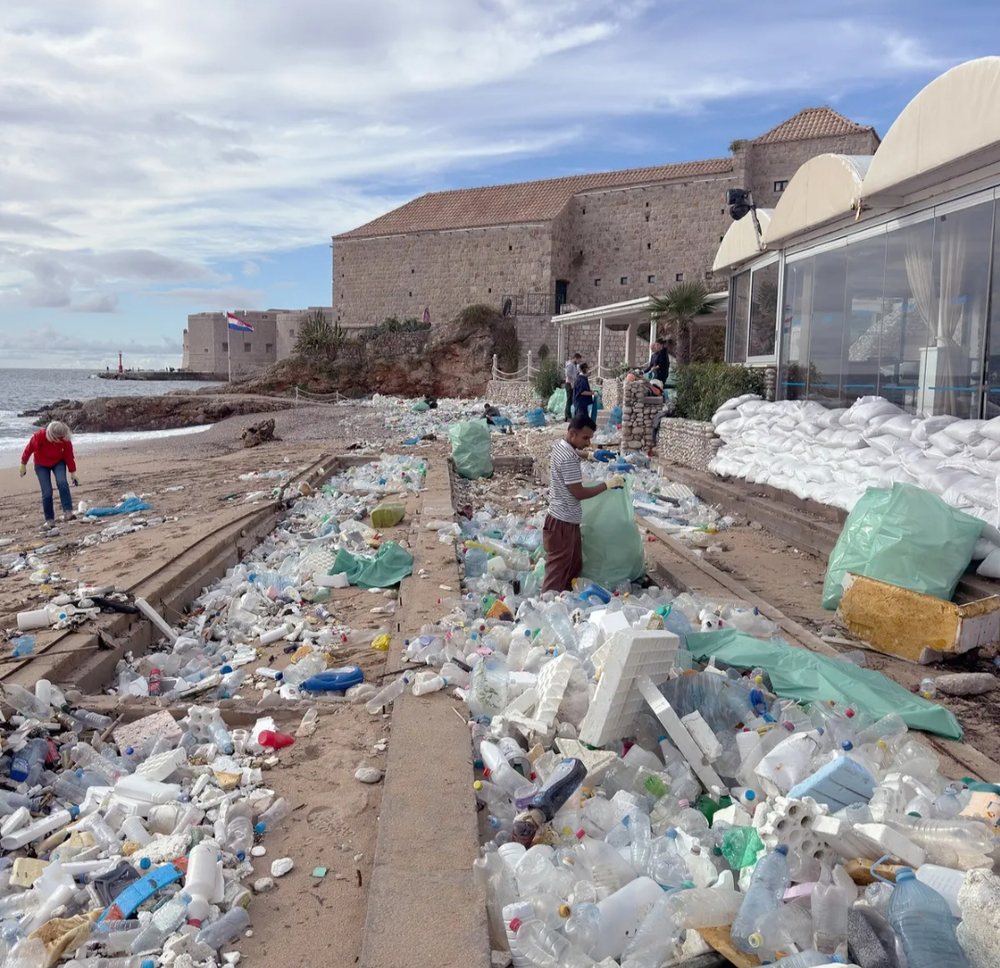
Officials in Dubrovnik, Croatia, say strong currents in the Adriatic Sea brought a large amount of trash, mostly from Albania, to shore during a recent storm.
One country's waste may, in fact, be another country's waste.
Officials in Dubrovnik, Croatia, have been unable to find any “treasure” in the colossal amount of trash that washed ashore this week in the city often called the Pearl of the Adriatic and usually packed with tourists. They said the trash came mostly from Albania.
A storm in the Adriatic Sea churned up the water and strong southern currents deposited tons of trash, a city official said, on two of the biggest tourist attractions: Banje beach and the old town.
“Based on the labels and materials found, the vast majority of the waste appears to originate from Albania,” Marija Pajic Bacic, a representative of Dubrovnik, said on Wednesday.
Dubrovnik Mayor Mato Frankovic said that all city services, including cleaning and port workers, were involved in the cleanup operation.
Cleanup crews began work early in the morning, Denis Raos, the head of the team in the city's historic center, told public broadcaster HRT.
Ms. Bacic said that truckloads of debris removal were scheduled for the next two or three days, and that the coastline would be cleared quickly — mostly of plastic, but also of metals and medical waste.
While members of a recycling organization said they would try to reuse some of the plastic items into useful objects, it remained unclear what could be salvaged.
Recyclers and cleanup crews have gained a lot of experience, as the Adriatic has been washing up tons of trash on the shores of Dubrovnik for years.
The Adriatic Sea is closed, except for a narrow inlet at the heel of Italy's boot, so its predictable currents have made it easy to map the direction of the debris.
"Dubrovnik has had a garbage problem for decades during the winter months," a local tour guide, Ivan Vukovic, said on Wednesday.
It's not just the garbage, he added, saying he had also seen animals that had been brought by currents to the southern shores of Mljet, a nearby island.
Plastic is a particularly sensitive issue in Dubrovnik, a city of 42,000 people, which in 2020 signed a pledge to reduce plastic waste. While the city itself is small, it hosts 4.5 million overnight stays from tourists each year, which generates a lot of plastic waste.
Every year, tens of millions of tons of plastic enter the Earth's seas and oceans. Overall, less than 10 percent of the world's plastic waste is estimated to be recycled, with the rest ending up in landfills, incinerated or released into the environment. These plastics have become a major threat to marine life, according to scientists.
President Frankovic said that Croatia's foreign ministry has long been in talks with Albania, because "we know where the waste comes from."
He said the ministry had offered financial assistance to Albania to help it manage the country's waste.
“We only see the waste that reaches the surface, but a worrying amount sinks and remains at the bottom of the sea,” he said.
The Albanian Embassy in Washington did not immediately respond to a request for comment on Wednesday.
The governor of Dubrovnik-Neretva County, Blaz Pezo, told HRT that only cross-border cooperation would solve the problem.
But one solution he suggested was satellite monitoring “to try to catch this debris while it’s still out at sea.”/New York Times