


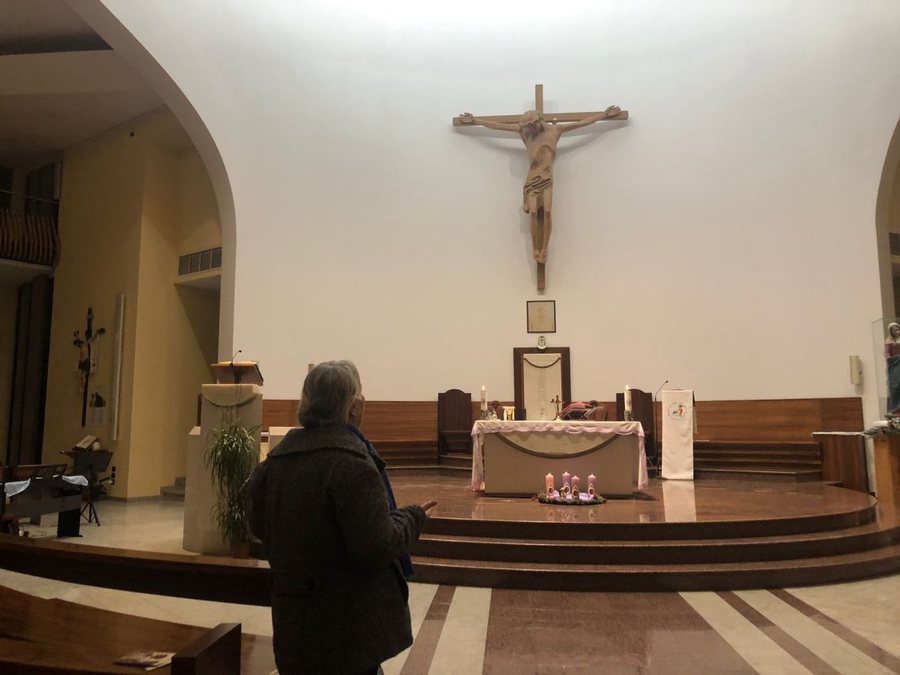
During the communist regime, Christian believers celebrated the birth of Christ secretly, within the walls of their homes, under fear of a government that banned freedom of religion, destroyed or alienated churches, and targeted the faith and the clergy through executions, imprisonments, and exiles.
In the courtyard of St. Paul's Cathedral in Tirana, on the Monday evening of Christmas Eve, a few Catholic faithful gather for afternoon mass. Near the entrance, a simple installation of wood and straw recreates in miniature the scene of Christ's birth, a quiet reminder of a story repeated generation after generation.
Among them is Prena Frroku, 63, who never misses a single day of mass. She grew up amidst religious rituals that her parents fanatically observed, first in Spaç, Mirdita, where she was born, and then in Shënkoll, Lezha, where she spent her youth.
“We had the cross and the images of Our Lady at home,” Prena recalls, her voice trembling. “My father kept them in a box so we wouldn’t see them and only took them out for holidays, and together with my mother, they would pray near the altar.”
In the Prenës family, Christmas Eve began with the ritual of Buzmi – an ancient pagan custom that marked the beginning of a new life through the burning of wood from various trees in the hearth and that, over time, became intertwined with the celebration of the birth of Christ.
Then, his mother would set the table with the best she had—usually a dessert and pumpkin and walnut pie. His father would kneel by a lit candle and pray, rosary in hand and icon of the Virgin Mary in front of him.
“I was little and I didn't understand,” she adds, “but when they asked us at school, we didn't tell, because I knew that if we celebrated religious holidays, our parents could be sentenced to prison.”
In Prena's family, Christmas has always been celebrated. For 33 years, during the communist regime, away from the eyes of others.
"With fear," she recalls, recalling Christmas Eves - as the holiday is called in the North, marked by poverty and the anxiety of punishment in a government that had outlawed religious belief.
The first atheist country in the world
The Christian religion in Albania is believed to date back to the first century AD, while the earliest document written in the Albanian language is a liturgical work, the Meshari of Gjon Buzukut, published in 1555, at a time when Albanian lands were under the rule of the Ottoman Empire.
Although during the centuries of Ottoman occupation, Islam became the dominant faith, some areas managed to preserve the Catholic faith, mainly in the north of the country – in Mirdita, Shkodra, Dukagjin, Mat, Lura and Malësi e Madhe.
These rites, preserved for centuries, were targeted for erasure through terror and fear by the totalitarian communist regime led by Enver Hoxha, which was established in Albania after World War II. From the very beginning, the regime fiercely attacked the Catholic Church, imprisoning, torturing, and shooting dozens of priests.
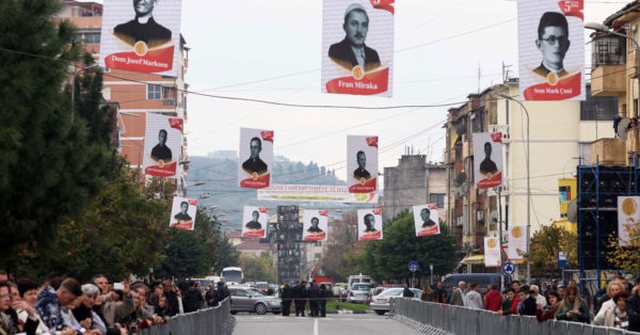
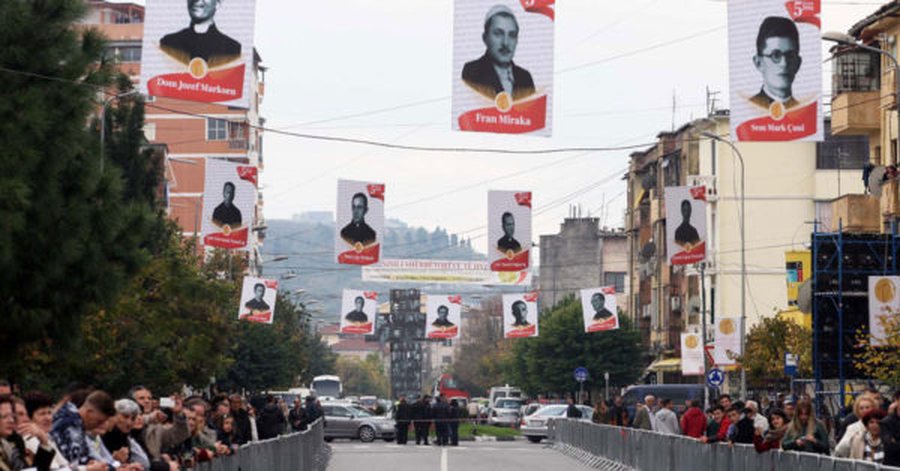
Records show that throughout the dictatorship, 58 priests were shot or died under torture by former State Security investigators, while over 160 others were imprisoned, exiled or persecuted. In 2016, the Vatican began the process of beatifying 38 martyrs of the Catholic Church, killed by the communist regime, most of whom still have no graves.
The Mass at St. Paul's Cathedral was celebrated by Father Konrad, a Belgian priest who has been serving in Albania since 1993.
"I was in Germany where I was ordained a priest when I first heard about Albanian priests killed by communism, that's the reason I came here," he says in pure Albanian.
A similar repressive policy was followed against other religious faiths. Dozens of Muslim, Orthodox, and Bektashi clerics were imprisoned and persecuted.
Communist propaganda was anti-religious from the beginning of the dictatorship, but it reached its peak in 1967, following a speech by Enver Hoxha in February of that year and the decision to close churches and mosques in November. This decision led to the demolition of thousands of places of worship or their conversion into institutions with cultural and entertainment functions.
Albania was declared the first atheist state in the world when the 1976 Constitution sanctioned that "The State does not recognize any religion and supports and develops atheist propaganda to instill in people the scientific materialist worldview" and a year later, the Criminal Code punished religious propaganda with imprisonment from 3 to 10 years.
Prena was still a child when all this happened, but she remembers with pride an act that her father, Ndue, committed on Christmas Eve of that wicked year, when Christ was declared an "enemy" by the communist regime.
"He left the mine at 12 o'clock at night and went and picked up the church bell that the communists had taken away and rang it several times; people in the houses were brought to their feet to praise Christ," says Prena, recalling the story that his father told him and is still discussed in the village where he was born today.
Another memory that connects him to Christmas is the journey through the night with his parents and a sick sister to go to the Church of St. Anthony of Padua - a holy place for Christian believers, which was destroyed during communism.
"At night we walked through the stream and mountains to reach Shëna Ndu', where we would cross the bridges, leaving something on the stones - because no church had been built there," Prena recalls.
Although strongly connected to the Catholic faith, Prena experienced mass in church for the first time only in December 1990.
"A day that I don't attend mass, I don't receive the cross of Christ, it seems like I'm missing everything, it's spiritual nourishment," she says with a smile.
"Silent Night" in Hell
A few meters above the national road near Tepelena, the ruins of former Italian army barracks from World War II surround dozens of cypress trees planted in recent years. The trees commemorate the children who lost their lives to disease and malnutrition in this place, which served as an internment camp for thousands of families declared opponents of the communist regime between 1949 and 1954 and has since been described by survivors as “hell on earth.”
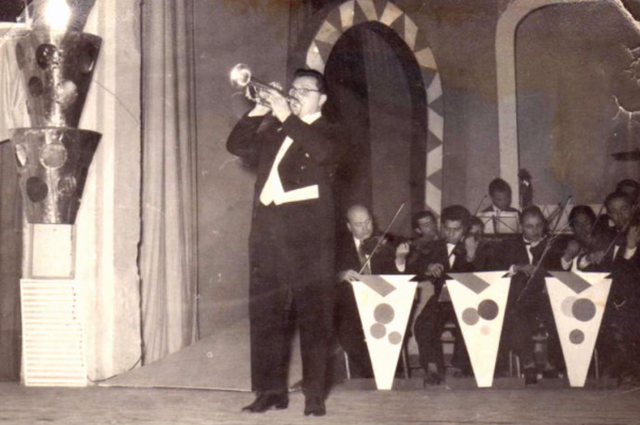
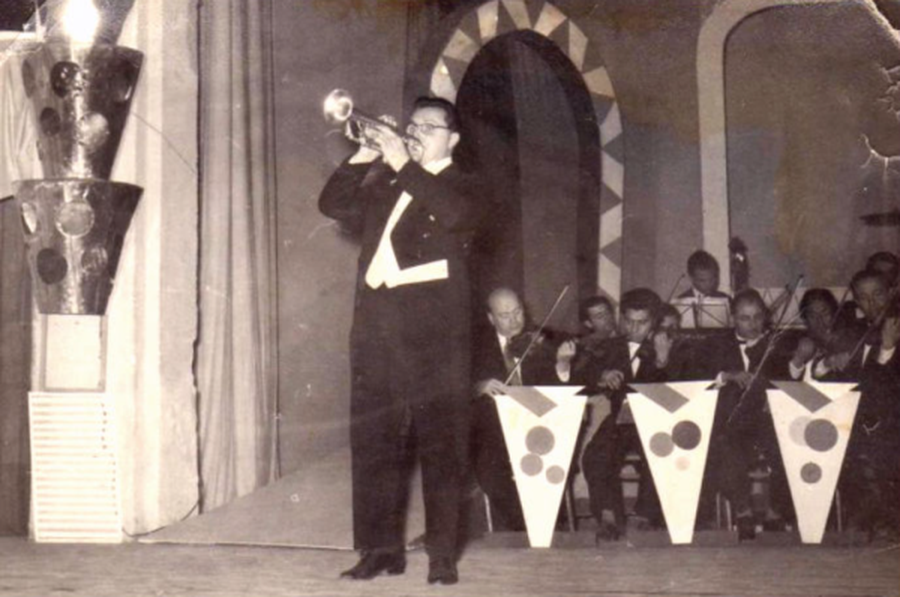
Yet, even in this dark corner of the communist regime, at midnight on Christmas Eve 1953, the sounds of “Stille Nacht” (Silent Night!) – the Christmas hymn, composed by an Austrian priest two centuries earlier, came on the cold winter wind from a trumpet playing somewhere near the camp.
Gjosho Vasija was interned in this infamous camp at the age of 18, as punishment for his brother’s escape from the country. Vasija, who is no longer alive, writes in his memoirs that those divine sounds came from the trumpet of Gaspër Çurçië, a virtuoso Shkodran artist, instrumentalist and conductor of the Albanian Radio Television Orchestra.
It is believed that Çurçija was on a tour with the orchestra, on his way to Gjirokastra, when he decided to stop by the camp, where he knew there were many families from Shkodra who were interned, to give them some "light" in the unusual silence of the night, in the barracks where the fear of death prevailed.
“Dad used to tell us that when he heard the sound of Gasper Çurçi's trumpet, there was a commotion in the camp; all the internees started singing,” says Angjela Vasija, his daughter, who grew up hearing this story from her father, who had a brilliant career as a comedian.
Angjela remembers that her father often told this story, at every celebration and in every environment he was in, as that night had marked his life because of the act of humanity that Çurçi's gesture represented.
"I don't know if my father met Gasper after he came out of internment, but I know that moment was very important to him," she says in a video chat from Italy, where she has lived for 35 years.
Gasper Curci was shot in 1985, along with Shkelzen Doci and Gjon Jaku, after a staged trial on charges of forging several train tickets.
His son, Alfred Çurçija, was only 19 years old and never had the opportunity to hear from his father the story of that melody that threw a ray of hope into the darkness of the Tepelena camp. He says in a telephone conversation that he felt very proud of his father when he learned the story from Gjosho Vasija.
“Christmas music brings back bitter memories of his premature and innocent loss, but it also gives me a sense of pride when I think that my father, with his sounds, wanted to give hope to those people in that misery,” says Alfred.
In the Vasija family, the memory of those sounds has been kept alive along with faith. Angjela remembers that Christmas Eve was a special night, when her grandmother would take out the hidden cross and make the sign of the cross on the children's foreheads with her finger.
"We celebrated it with fear, because there were spies everywhere, and our grandmother would tell us: when you go to school, they're cursing Christ now, so you stay quiet."/BIRN/