

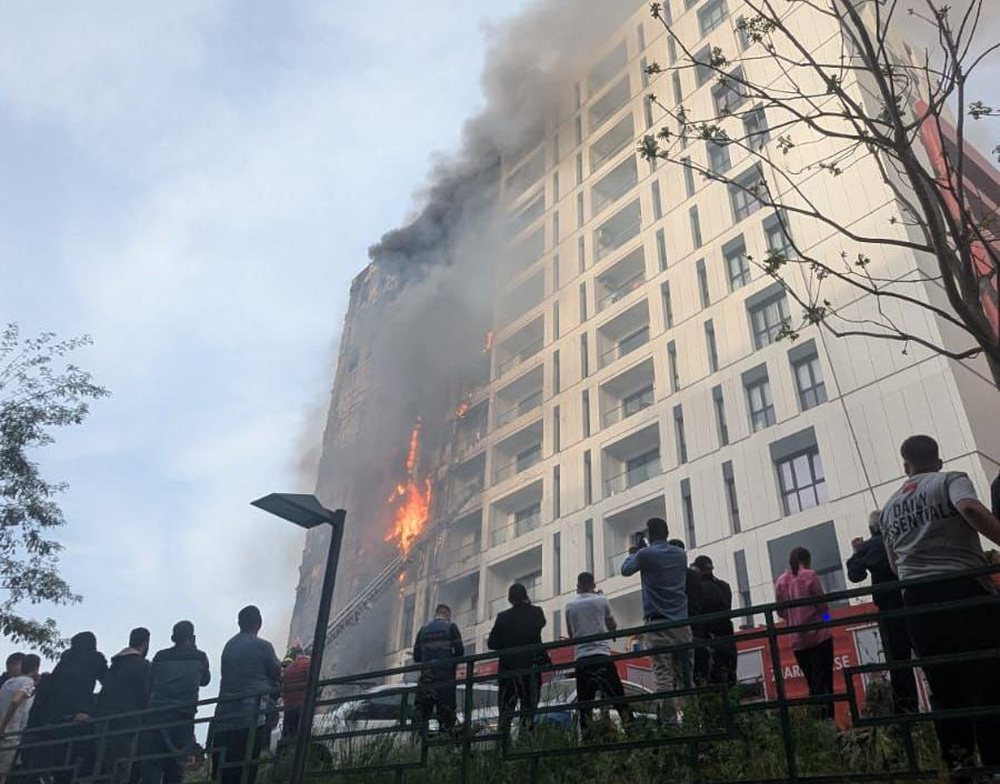
The cause of the fire and the potential civil liabilities that may arise for the builder of the building that burned down in Tirana on Tuesday are not yet known and will likely require professional investigations to identify them. And if these investigations find the company guilty, in a normal country, the owners of the burned apartments will have to seek compensation for non-contractual damage from the company in court. In a hypothetical situation, the company could be ordered to pay compensation by court orders, in a bankruptcy situation, leaving the claimants of the damage at least partially unpaid. It is also possible that the fire was accidental, the company could be found innocent and the injured parties could be left with the bill for the enormous costs caused by the fire. These are all "maybes", while the concrete question that arises is whether the taxpayer, through the state budget, should help the families affected by the disaster. Prime Minister Edi Rama believes that taxpayers should not contribute because, according to him, it is the insurance companies that should pay.
Rama, a man who seems to be completely unimpressed by the damage of tens of millions of euros in the pre-determination of the winners of the tenders by his officials, not only expressed his great concern over the few million euros that taxpayers may or may not be willing to help those affected by the tragedy, but he immediately appeared as both a criminal and a civil judge, initially declaring that the company was not to blame for the fire and at the same time, charging it with the responsibility to pay for the damages.
As citizens, perhaps we should consider whether we should buy an insurance policy from the private market or ask the government to draft a protocol for such tragedies, pre-written rules in which we as taxpayers undertake to help those affected by such tragedies. We can also think about whether it is reasonable to help the injured at, say, 100 percent of the damage, or at a lower rate. Before considering this, we should first see what these insurances are, which, according to Rama, should exist for such situations.
Insurance in logic is a collective scheme in which all citizens at risk from a phenomenon pay the cost of all accidental damages, plus the cost of managing the scheme and a profit rate for the organizer, or owner of the insurance company.
If there are 1,000 ships at sea and one of them sinks in a storm, causing, say, 1 million euros in damage, all 1,000 ships will have to pay 1 million euros in damage plus the cost of administration, plus the profit rate.
The problem is that in Albania, the cost of administration and the profits of insurance companies are at not very logical levels. If you look at the data of the Financial Supervisory Authority, the institution that regulates this market, you can see that Albanians paid 270 million euros together for the insurance market during the past year. And during 2025, insurance companies paid 86 million euros in damages.
In short, for a “good” that cost insurance companies 86 million euros, Albanians paid 270 million euros or 314 percent more. In short, the cost of administration and the profits of insurance companies took up two-thirds of all the money that citizens paid.
Such high profit margins of insurance companies are clearly related to the oligopoly situation that has been going on for ages. In some segments, profit margins are even higher than that.
For example, look at the product segment “creditor life insurance”. This is an insurance policy that banks forcefully sell to citizens who have taken out home loans. Last year, Albanians who are in this situation, that is, have taken out home loans, paid a total of 19 million euros for life insurance policies. But the claims paid were only 1.5 million, so the insurance policy cost buyers approximately 13 times or 1300% of the value of the “product” they received.
Even with the product “Fire and other property damage”, the situation is similar. Insurance companies had 63 thousand such active contracts in 2025, which collectively paid out 2.8 billion lek. The damages paid by insurance companies were only 576 million lek or 20% of all premiums, or with a profit rate five times higher.
In this situation, if citizens were to purchase fire insurance policies to claim compensation for the burned building, assuming that the damages from Tuesday's fire are 10 million euros, the insurance policy would cost us 30 million euros at best, or 130 million euros at worst.
Payment of damages by taxpayers through the common budget of Albanians, which is normally the largest insurance policy that can exist, likely costs less than policies sold on the private market, but this, the owners of insurance companies may cynically say, is by no means guaranteed.
Because, while there are clearly extortionate monopolistic profits in the private insurance market, which carry unimaginable costs for us all, such costs, in the form of corruption, misgovernance and "violation of equality in tenders", including that violation of equality that Rama insists "is not corruption", are of course also found in the second scheme.
Corruption is the additional cost that leaves the taxpayer's pocket and ends up in the pocket of the corrupt. Malgovernance is the additional cost that is caused, not necessarily by corruption, but is caused to a large extent by incompetence. For example, if we assume that there is no corruption in the procurement procedures for the reconstruction of buildings from the 2019 earthquake, the fact that seven years after the earthquake, in cities like Kruja there are perhaps twenty buildings built with taxpayer money where no one lives, this is of course a cost.
The buildings were finished two or three years ago and have clearly been overbuilt. There are not enough people who want to live in them and they have currently been empty for two years, a waste of millions of euros of taxpayers' money. But even the "violation of equality in tenders" for which Balluku is accused and which Rama insists "is not corruption", of course causes losses for taxpayers since the lowest bid for a public job is disqualified and the highest bid is qualified, taking money from the taxpayer's pocket to be transferred to the pocket of the owner of the winning company.
In short, the question cannot simply be asked whether it is more profitable for us as taxpayers to pay through the budget, or as clients through private insurance companies, but the question is whether or not the extortionate profit rate of private companies is lower than the rate of government corruption and malfeasance.
It is not an easy task to judge because, while we have fairly accurate statistics for the insurance market, we only have guesses or fragmentary information about the cost of corruption. We have fragmentary data that suggests that corruption can range from 20 to 40% in the case of public procurement and we also know that in the AKSH scandal, the level of corruption, that is, the money that ended up as profits thanks to the manipulation of tenders, is estimated to be even higher, at 60%. The cost of malpractice is even more difficult to estimate.
In order for the insurance market to be “competitive” with that of corruption and state mismanagement, four out of every five taxpayers’ lek would have to be lost as a result of corruption or mismanagement, and this is reflected in the fact that in “property insurance against fire”, insurance companies pay only 20% of their income for claims. But between the two “markets”, that of private insurance and that of political corruption, the fundamental difference is that, we talk about political corruption every day and, compared to the past, some punishments are being given.
While political corruption is clearly a criminal offense, the extortionate profits of insurance companies are legitimate today and all day long. In these conditions, it is very likely that covering tragedies such as Tuesday's fire, but also the damages that Rama has undertaken to pay to villagers affected by last summer's massive fires, would be cheaper to do through general taxation./BIRN