


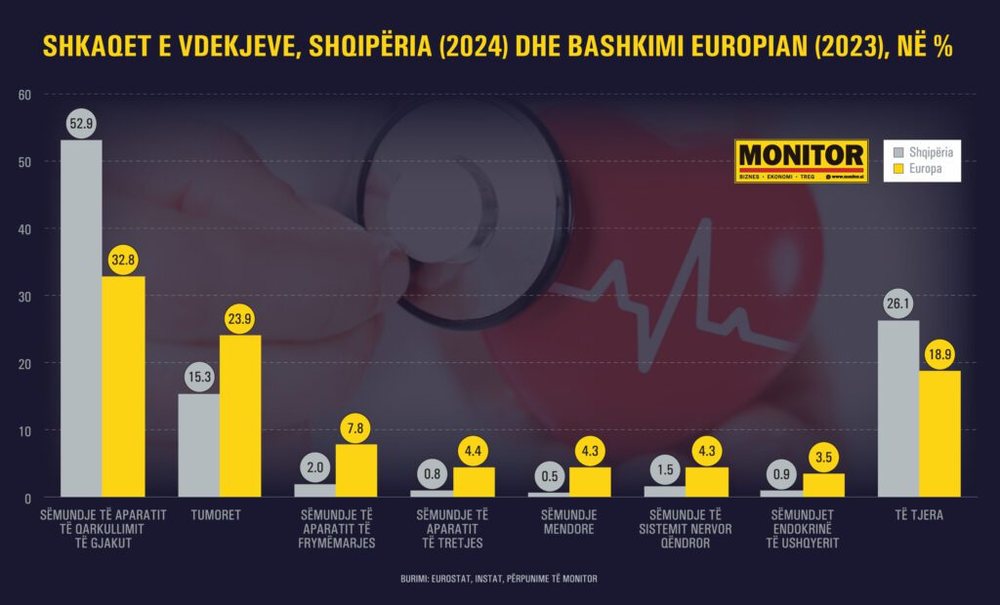
Heart diseases dominate the structure of deaths in Albania much more than in European Union countries.
Comparative data from INSTAT and Eurostat show that 52.9% of deaths in Albania are related to diseases of the circulatory system, while in the European Union this category accounts for 32.8% of total deaths.
The difference is significant and shows that Albanians lose their lives from heart disease at a rate almost twice as high as the European average.
In Europe, in addition to heart disease, tumors also have a large share in deaths, accounting for 23.9% of deaths, while in Albania this category accounts for 15.3% of the total. Respiratory diseases also have a significantly greater share in the EU, with 7.8% of deaths, while in Albania they account for only 2%.
Large differences also appear in other disease categories. Digestive system diseases account for 4.4% of deaths in the EU, while in Albania only 0.8%.
Mental illnesses account for 4.3% of deaths in Europe, compared to 0.5% in Albania, while diseases of the nervous system account for 4.3% in the EU and only 1.5% in the country. Likewise, endocrine and nutritional diseases account for 3.5% of deaths in the European Union, while in Albania only 0.9%.
Patients with heart problems are increasing
Recent data shows that cases of cardiac problems are also on the rise in the hospital system. For the period January-August 2025, 7,543 patients were treated in cardiology departments, up from 6,419 patients a year earlier, an increase of 17.5%.
Mental health problems have also increased. In the same period, 1,129 patients were treated in psychiatric hospitals, or 36% more than a year earlier. Health experts attribute this trend to a combination of lifestyle factors. Air pollution, lack of physical activity, unhealthy nutrition and daily stress are considered among the main reasons that are increasing cardiac and neurological symptoms in the population.
The hidden impacts of stress and sedentary work have become a major concern for the physical and mental health of employees in corporations and businesses.
Psychiatrist Dr. Arjana Rreli previously told Monitor that chronic stress at work can cause serious consequences on mental and physical health.
"Continuous exposure to stress in the work environment can lead to emotional exhaustion, sleep disturbances, and even cardiovascular problems," she explains.
According to cardiologist Dr. Endri Hasimi, the impact of chronic stress on cardiovascular health is often underestimated. “When an individual is constantly exposed to stress at work, the body produces high amounts of cortisol, which increases blood pressure and accelerates the development of heart disease,” he explains. “Furthermore, lack of exercise and an unhealthy diet can lead to the formation of plaque in the arteries, increasing the risk of stroke.”
Even the Institute of Public Health (ISHP), in an analysis of the progress of heart disease in recent years, found that cardiovascular diseases have progressed rapidly in the last decade.
The number of cases diagnosed each year at the hospital is also increasing along with the volume of diagnostic and surgical services. By-pass interventions to restore blood circulation to the heart muscle performed by the QSUT have almost increased exponentially in the last 10 years.
The risk of heart disease in Albania increases with age and is higher in men than in women. In the age group 30-69 years, mortality and morbidity are about 2 times higher in men, while after this age the difference decreases to only about 20%.
The differences between women and men are even greater when comparing morbidity. Reasons for the difference include hormonal protection in women before menopause, as well as higher exposure to smoking and alcohol abuse.
WHO recommends that attention be paid to the overall assessment of a number of risk factors for heart disease and cerebrovascular accidents, rather than just one, with the aim of reducing the total risk.
Albania is currently ranked among the countries with the highest levels of obesity, which is another risk factor for heart disease and mortality. According to Eurostat, 56.5% of Albanians over 16 years old are considered overweight, ranking in the risk zone.
Albanian women seem to be much more careful than men. According to Eurostat, 62.3% of Albanian men over 16 are considered overweight, among the highest in Europe.
Half of Albanian women (50.9%) are considered overweight, according to Eurostat data./Monitor