


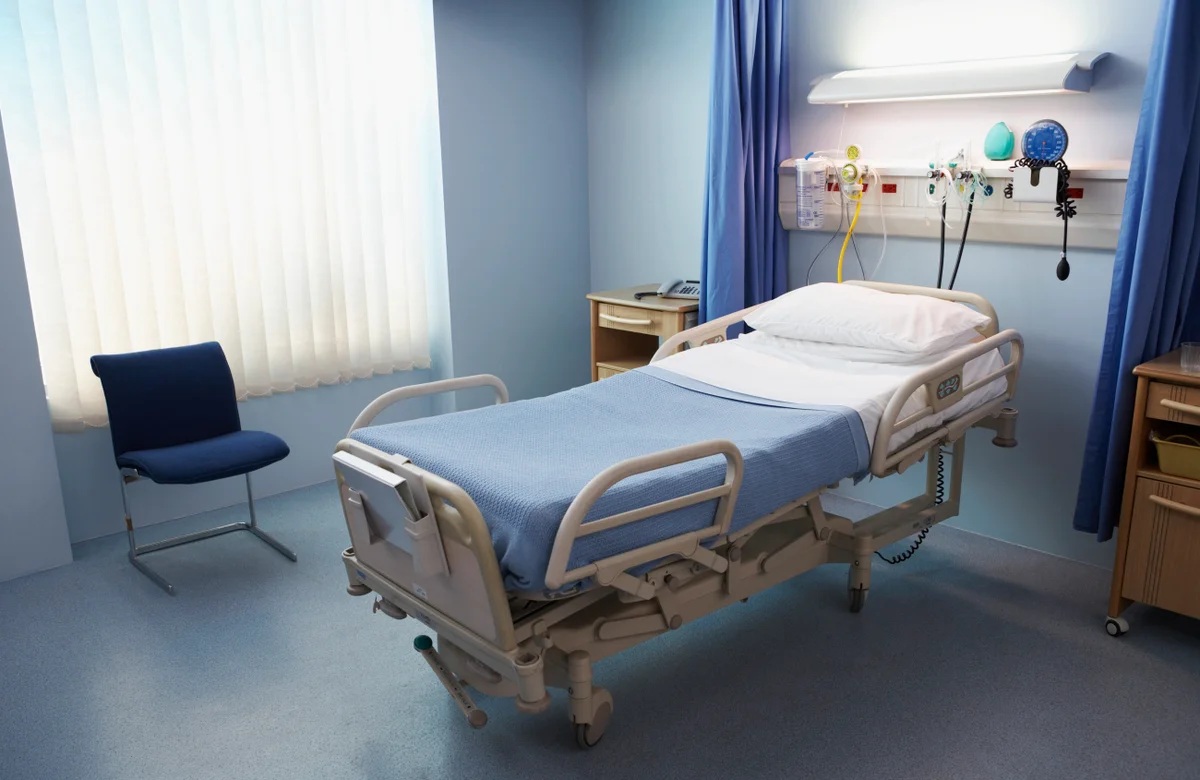
In Albania, in 2024, 8,911 beds were available in public hospital service institutions, according to data made public by INSTAT.
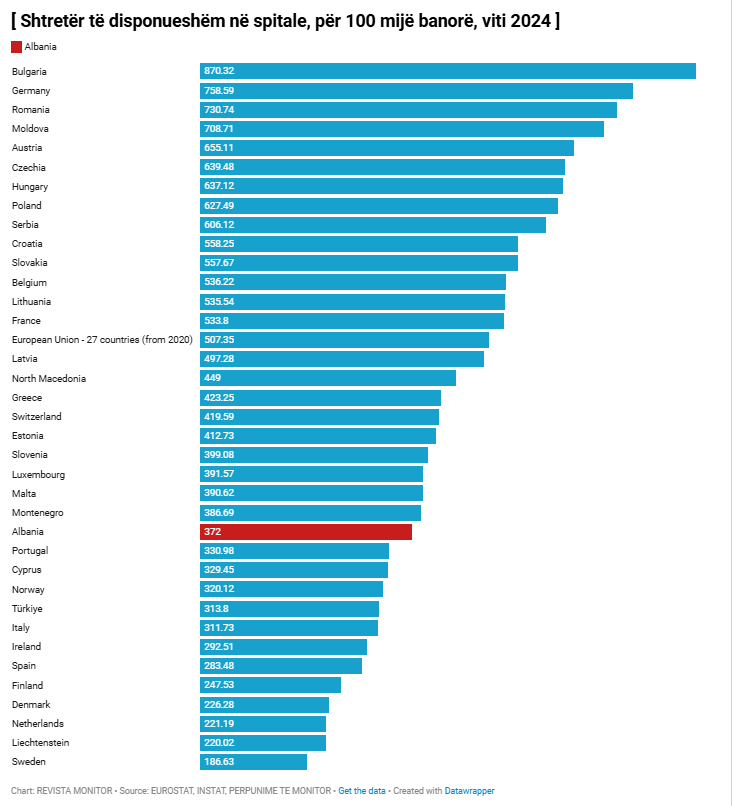
Compared to that year's population of 2.39 million, the country has 372 beds per 100,000 inhabitants.
Comparing these data with the latest figures published by Eurostat, which do not include Albania, it results that in relation to other European countries, or even the region, the country has fewer beds in relation to population than the European Union average of 507 beds per 100 thousand inhabitants and lags behind many countries, including those in the region, for which there is data.
The record in the region is held by Serbia (606 beds), followed by North Macedonia, with 4,520 (2021 data) and Montenegro (387).
Despite the fact that Albania's population has shrunk in recent decades, "easing" the burden on hospitals, and the bed-to-population ratio has improved compared to 2014, when it was 296 beds per 100,000 inhabitants, the country still remains near the bottom of Europe.
In 2014, there were 8,295 beds in public institutions, according to INSTAT, and a decade later their number has increased slightly by 7.4%, but the improvement in the indicator has come more from the decline in the population by 400 thousand inhabitants in the same period.
While the population is declining, the burden of disease has actually increased as a result of the population, adding to the pressure on Albanian hospitals, which in addition to having fewer beds than many countries in Europe, are also suffering from the emigration of doctors.
Moreover, many regional hospitals have been turned into ambulances and difficult interventions are performed in Tirana hospitals, overcrowding the latter.
Europe, big differences between north and east
According to Eurostat, in 2024 there were an average of 507 hospital beds per 100,000 inhabitants in the European Union. However, capacities vary considerably from one country to another, reflecting the organisation, financing and history of national healthcare systems.
Bulgaria had the highest indicator, with 870 beds per 100,000 inhabitants, followed by Germany with 759, Romania with 731, Moldova with 709 and Austria with 655 beds.
The Czech Republic, Hungary, Poland, Belgium, Lithuania and France also ranked above the EU average. These countries have maintained relatively large hospital capacities, while their health systems continue to rely to a higher extent on hospital treatment.
At the other end of the ranking was Sweden, with only 187 beds per 100,000 inhabitants, followed by Liechtenstein with 220, the Netherlands with 221, Denmark with 226 and Finland with 248 beds.
The low number of beds in some of the most developed countries does not necessarily mean a weaker health system.
Northern European countries have shifted some treatment to outpatient care, home care, and interventions that do not require a long hospital stay. As a result, patients are admitted less frequently and stay for shorter periods.
But this logic cannot be automatically applied to Albania. The country has only 372 beds per 100,000 inhabitants, without a comparable network of outpatient care, home services and decentralized treatments. On the contrary, for the most difficult interventions, patients are mainly directed to Tirana hospitals, increasing the pressure on the few central institutions.
Albania had more beds per capita than Portugal, Cyprus, Norway, Turkey, Italy, Ireland, Spain, Finland, Denmark, the Netherlands, Liechtenstein and Sweden. But most of these countries have more developed systems of diagnosis, prevention and treatment outside the hospital, as well as much greater human and financial resources.
The comparison should be read with caution, also due to the methodology. Albania's figure of 8,911 beds refers to public hospital service institutions, while Eurostat data may include broader categories of institutions, according to each country's reporting. However, the indicator highlights the limited capacities of the Albanian public system, where the main part of severe and urgent services is provided./Monitor.al/