

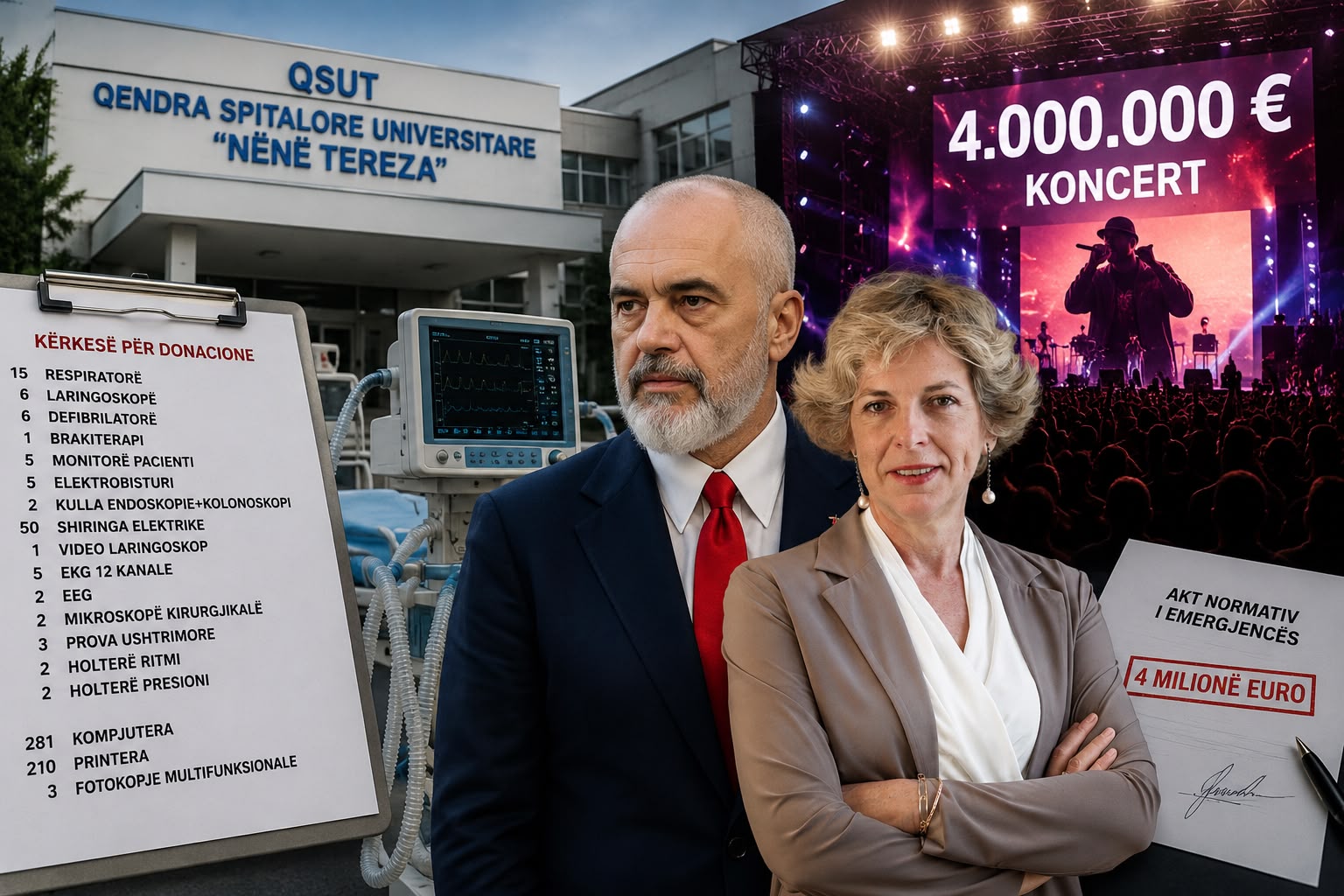
The "Mother Teresa" University Hospital Center has decided to address citizens with a long list of needs, requesting donations for equipment that in a normal country should be the minimum standard of a hospital. According to the official request, the largest hospital in the country lacks a full 15 respirators, 6 laryngoscopes, 6 defibrillators, 1 brachytherapy, 5 patient monitors with invasive measurements, 5 electrocautery, 2 endoscopy + colonoscopy towers, 50 electric syringes, 1 video laryngoscope, 5 12-channel ECGs, 2 EEGs, 2 surgical microscopes, 3 exercise tests, 2 rhythm Holters and 2 blood pressure Holters.
As if life-saving medical technology weren't enough, the list extends to offices as well, with the University Hospital in need of 281 computers, 210 printers and 3 multifunctional photocopiers. This list of needs has exposed the failure of the Ministry of Health to guarantee the normal functioning of the institution where thousands of Albanians come every day.
Instead of this revelation being accompanied by a lowering of the head and accountability, the propaganda machine was immediately set in motion to embellish reality. Through a video edited in the usual government style, where on one side is the denunciation and on the other their "truth", the QSUT attempted to make a refutation, the institution chose to give citizens a legal lecture. In the response distributed by the Ministry of Health, the hospital explains in wooden language that the publication of the list is simply a "legal obligation for transparency" and that this drafts internal needs according to the law on the right to information.
“Publication of donations is not a matter of choice, but a legal obligation that stems from the applicable framework for transparency, the right to information and the administration of public assets. In accordance with Law No. 119/2014 “On the Right to Information”, the Transparency Program, as well as the legislation regulating the administration of public funds and assets, the University of Health Sciences, as a public institution, has the obligation to make public information on its activities, including donations received. This is a mandatory standard of transparency and accountability for all public institutions. The published list of donations has been drafted within the framework of institutional correspondence with the University of Health Sciences services, based on the needs they present to the General Directorate through the Directorate of Clinical Engineering. The publication of this list aims to ensure the recording, coordination and transparent administration of service requests, in full compliance with institutional procedures and applicable legislation. This publication does not create rights or advantages for the benefit of donations, but "guarantees transparency on the needs identified by the services and on the institutional process of their administration," the QSUT response distributed by the Ministry of Health states.
In fact, no one suspected that the request for donations was illegal. The irony lies elsewhere, as the forced reaction cannot deny the simple fact that the hospital lacks basic working tools. This stark reality brings to the ground the entire facade of imaginary success propagated by Minister Evis Sala. Just a week ago, the minister proudly boasted that a full 8.9 billion lek more than the initial forecast had been added to the health budget for 2026.
The question that naturally arises is: how is it possible that with all these billions added, doctors still have to wait for charity or the mercy of donors to have a respirator or an electric syringe?
The paradox becomes even more striking when you see how Albanian taxpayers' money is managed by the same government. While someone is expected to become a benefactor for the vital equipment of the QSUT, just a few days ago, through an emergency normative act, 4 million euros were signed with complete ease for the organization of a private concert by a foreign rapper. The division of priorities is now clear, the luxury and noise of the stage are financed with state emergency, while the health of citizens and the working tools of doctors are left in the hands of fate and the generosity of citizens.
This case proves that the crisis in our healthcare system does not stem from a lack of money, but from a profound lack of human sensitivity and accountability in management. When patients' lives are worth less than a night of spectacle and when shortages of basic equipment are widespread, the system has failed in its primary mission.