

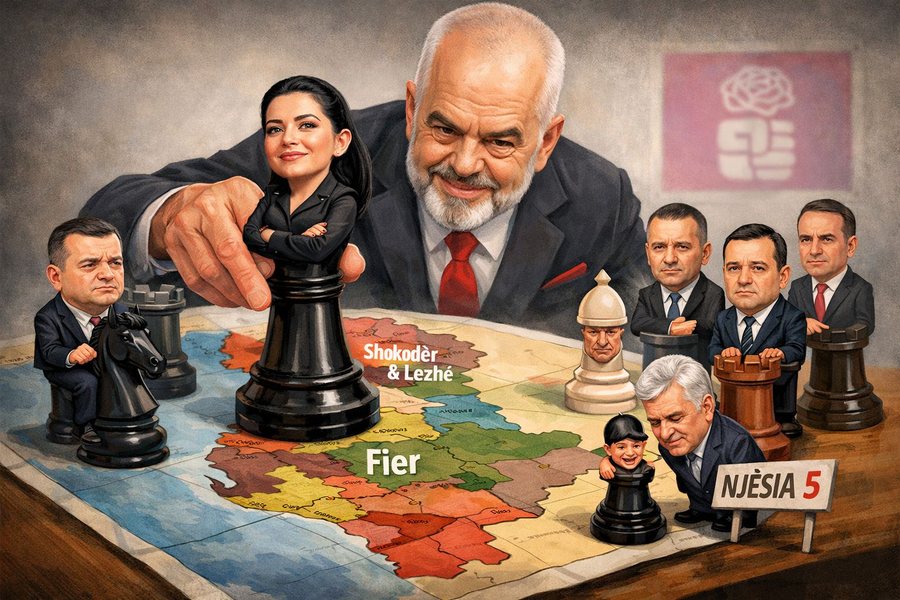
The reorganization of the political leadership of the regions by Edi Rama has produced more than an organizational redistribution. It looks like a new map of the balances within the Socialist Party of Albania, where some figures are significantly strengthened, some are moved to the periphery, and some others disappear from the decision-making centers.
The clearest winner of this reorganization seems to be Belinda Balluku, who not only maintains the political leadership of the Fier region, but in practice consolidates a network of trusted people in the north of the country as well. She practically takes control of the two largest regions of the North, Lezha and Shkodra, through her two puppets that a few days ago, out of nothing, she made ministers at the height of her crisis. Names associated with her political line such as Ermal Nufi and Enea Karakaci are already appearing in Shkodra and Lezha.
Meanwhile, several other figures appear to have taken a "break" from the main centers of influence.
One of the most notable moves is the departure of Elisa Spiropali from the political leadership of Tirana. The most important electoral district now passes into the hands of Taulant Balla, while the capital's municipality is entrusted to Ogerta Manastirliu.
Here too, the influence of Balluk is felt, to whom the political suppression of Spiropali is attributed, while Balla has recently been read as a partner in Balluk and Rama's strategy against SPAK movements.
In Durrës, Blendi Klosi takes over the political leadership, replacing Emirjana Sako.
In Lezha, the leadership passes to Ermal Nufi, Balluk's man, who replaces Ulsi Manjë, while the latter moves to lead the Dibër region, taking Klos' place.
In Shkodra, political leadership is entrusted to Enea Karakaci, replacing Benet Beci.
Eduard Shalsi also leaves the leadership of Kukës, where Erjon Malaj is now based. He returns to his hometown, after being elected as a deputy in Tirana on May 11.
In several other districts, Rama has chosen not to change the existing balances.
In Elbasan, Arbian Mazniku is confirmed, in Berat, Ervin Demo, in Fier, Belinda Balluku, in Vlora, Bledi Çuçi, in Gjirokastër, Mirela Kumbaro, and in Korça, Niko Peleshi.
One of the most ironic moves in this new map is the relocation of Fatmir Xhafaj, who ends up in Unit 5 in Tirana, where he will share political ground with Erion Braçe. For one of the oldest and most influential figures of the socialists, this seems more like a temporary parking lot than a promotion, when he has historically worked in Unit 10 in Tirana.
Essentially, the new reorganization of the districts indicates more about the internal balance of power in the SP than about a territorial strategy. Some figures consolidate positions, some move to the periphery, while others learn that in Rama's politics, geography is often an elegant way to rewrite the hierarchy.