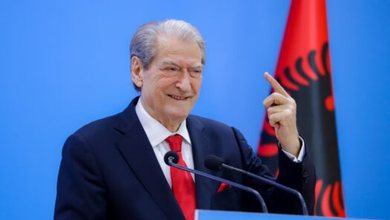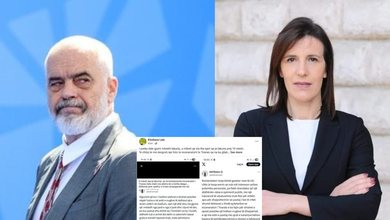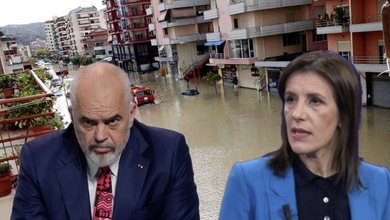



Prime Minister Edi Rama used a comment by journalist Klodiana Lala on her Facebook profile on Wednesday to publicly attack her with insulting and intimidating language.
While Lala, commenting on Rama's stance on the floods, where she blamed citizens for throwing garbage on the streets, asked why the Tirana incinerator, a project promoted by Rama and which is under investigation as a corruption affair, had not functioned, the prime minister called her comment "blatant ignorance", slander and disinformation.
The prime minister's attack on Lala does not mark an isolated incident, but is part of his ongoing behavior towards the media in the country, using derogatory labels and attacks, while refusing to respond to the accusations his government is facing.
In recent days, he also became involved in public controversy with the host of the "Opinion" show, Blendi Fevziu, using edited photos and unethical language, in response to Fevziu's concern about government propaganda during the floods in the absence of public accountability.
The prime minister's public stances were unanimously condemned by media freedom organizations in the country as direct pressure on journalists.
"Such language does not contribute to clarifying public opinion, but rather fuels polarization, trivializes the debate and creates a dangerous precedent of verbal pressure on journalists," the AGSH statement states, calling on the prime minister and public officials "not to turn power into an instrument of verbal pressure," but to use arguments and transparency to provide public accountability.
"Democracy is not harmed by journalists' questions, but by arrogance towards them," the statement emphasizes.
The Network for Safe Journalism also condemned the prime minister's behavior as an attempt to shift the public debate from accountability to personal attacks on journalists.
"When the prime minister, from his position of power, generalizes and discredits the role of journalism instead of holding it accountable, attention shifts from real issues of public interest to attacking those who ask questions. This weakens public debate and risks normalizing pressure on journalists, especially women in journalism," the organization said in a statement.
For journalists and political analysts, the prime minister's behavior towards the media constitutes a violation of democratic standards of media freedom and an attempt to shift public opinion's attention and avoid accountability for the corrupt affairs his government is facing.
"When silence towards oppression is accompanied by clashes with journalists and the justice system that investigates oppression, the problem is not journalism. The problem is not the questions, but the missing answers," journalist Lutfi Dervishi told BIRN.
Despite the problems and mistakes that the media and journalists may have, the duty of a public official, according to Dervishi, "is not to educate the media, but to hold them accountable."
In this context, the attacks on Blendi Fevziu and Klodiana Lala, he says, "seem more like an attempt to shift attention away from the scandals."
On the other hand, he does not see the prime minister's reactions as an "episode of nervousness", but part of a continuous communication pattern where "the narrative is controlled through overwhelming propaganda on social networks, monologues and personal 'attacks'" and the avoidance of accountability and journalists' questions.
"For years, the government has disappeared from traditional media, it does not face questions, it does not publicly discuss hot issues such as SPAK's denunciations, the floods, the denunciations of former Deputy Prime Minister Ahmetaj, or the accusations that directly affect key institutions such as AKSHI," says Dervishi.
For Armand Shkullaku, journalist and director of the media outlet Lapsi.al, Rama's behavior shows an attempt to evade the real answers that the public expects for the accusations that have been raised against his government, but also a state of affairs where democracy is today, where a single man attacks the media and justice whenever he finds himself in difficulty.
"The prime minister of a country that claims to be in a democracy addresses certain journalists by name and uses bullying language, which is unacceptable," he told BIRN.
The other side of the coin, according to Shkullaku, has to do with Rama's "crisis" as an individual.
"He entered politics as a Renaissance man and is ending his history as a gravedigger of the economy, democracy and the political notion, because he turned politics into an infrastructure for corruption and organized crime," says Shkullaku.
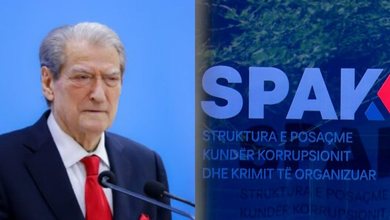
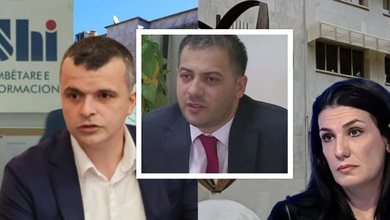
"Rama is the only one of his kind who has caught the government stealing and, most terrifyingly, who has handed over Albanian data to crime and, in order not to open this debate, deals with photomontages of Blendi Fevziu" - he adds, referring to the latest investigative files of the Special Prosecution Office, SPAK, for Deputy Prime Minister Belinda Balluku, accused of "violation of equality in tenders" worth hundreds of millions of euros, and the leaders of the National Information Agency, for involvement in a structured criminal group.
Analyst Neritan Sejamini believes that the less there is of echo, even as criticism, of the pseudo-debate that the prime minister is trying to create, the better.
"Rama is trying to distract public opinion from the issues of AKSHI, Balluk, floods and other scandals and, at the same time, wants to trivialize the criticisms made against him, trying to present those who criticize him as ridiculous," he told BIRN./Reporter.al