


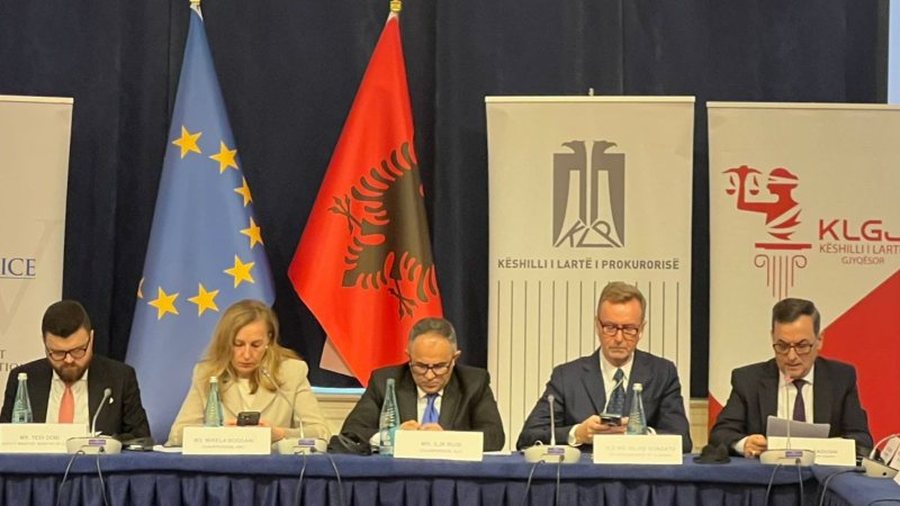
Today, the President of the Supreme Court spoke about what is usually not mentioned in official statements: about fatigue, about fear, about overload and about the loneliness of the person who carries life-changing decisions on his shoulders. Alongside EU Ambassador Gonzato, Sokol Sadushi did not talk about figures, did not mention budgets and salaries. He spoke about the “well-being of the magistrate”, as the foundation of a justice system that is still struggling to stand on its feet, calling it “the functional condition of any modern justice system”.
He spoke about judges who are faced with hundreds of files every day, about courtrooms where security is not guaranteed, about depreciated buildings, about permanent professional stress, about lack of psychological support, about blocked careers and about a system that, according to him, is functioning not on state policies, but on the individual sacrifice of magistrates. “The system is surviving thanks to us, but it cannot continue like this,” was one of the strongest sentences of the day.
Sadushi spoke about burnout, about the fear of making mistakes under pressure, about the independence that cannot be maintained with words alone, about professional dignity that is not only related to salary, but also to conditions, security, support and stability. There was neither triumph nor propaganda in his speech. There was concern and an open alarm about a system that is consuming its own people.
Just the day before, from a different podium, it was Edi Rama who had spoken. The Prime Minister announced the increase in the salaries of judges and prosecutors, presenting it as a guarantee of their independence and as proof that the state is seriously investing in justice. The message was clear: salary as a solution, money as motivation, numbers as an argument.
Yesterday we talked about money.
Today we talked about people.
Yesterday, the idea was given that the problem would be solved with a salary increase.
Today, it was said that the problem is much deeper: it is a lack of security, a lack of people, a lack of infrastructure, a lack of institutional and psychological support.
Yesterday we talked about standards on paper.
Today we talked about reality in practice.
Between these two words, one yesterday from the government and one today from the judiciary, lies the same system: overloaded, tired, vulnerable, still standing not because it is healthy, but because those who maintain it continue to push beyond human limits.
A salary increase may make a judge's life easier. But it does not reduce the number of cases, does not strengthen security in courtrooms, does not stop chronic fatigue, and does not replace the absence of the state where it should be first.
At the end of his speech, Sadushi left a sentence that sounds more like a warning than a declaration: “There is no strong justice with tired magistrates; there is no independent justice with unprotected magistrates; there is no reliable justice with magistrates left alone.”
Today, the President of the Supreme Court did not ask for privileges. He spoke about conditions. About dignity. About protection. He spoke about justice not as a concept, but as daily work under pressure. And between his speech and Edi Rama's speech yesterday, the contrast is clear: one speaks about the figure, the other about the person. One speaks about the effect, the other about the cause.
At the end of his speech, Sokol Sadushi said it without any embellishment, as a summary of all that weighs on the system today:
"There is no strong justice with tired magistrates; there is no independent justice with unprotected magistrates; there is no reliable justice with magistrates left alone."