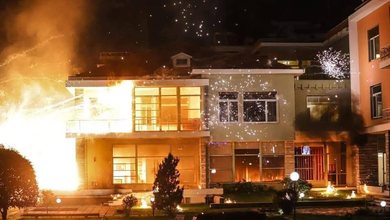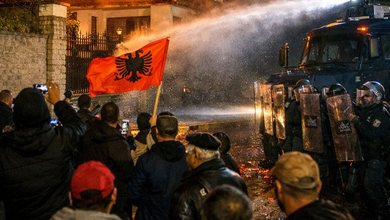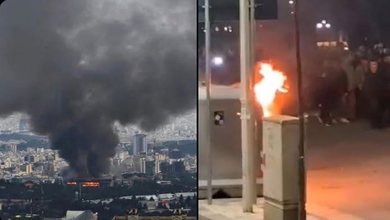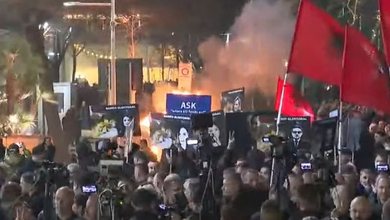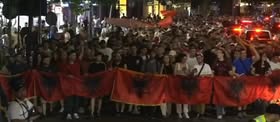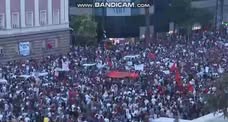




DP MP Elda Hoti reacted on Facebook to the attack on dictator Enver Hoxha's villa, describing the act as a "reminder of the suffering, imprisonment and injustices" of the regime and calling on young people to stand "against any form of regime that violates the future."
But it seems that in this symbolic enthusiasm, a small detail has been lost: the statement of its own president.
Sali Berisha stated that the villa was attacked because the protesters were misinformed by government agents. So, according to him, we are not dealing with a conscious symbolic act, but the result of manipulation.
At this point a contradiction arises: if it was manipulation, then it cannot be presented as a conscious act of memory. If it was an act of memory and resistance, then the “agents” thesis falls apart.
Meanwhile, another fact worth remembering: the villa has been standing there for 35 years in pluralism. And Elda should know that during these 35 years, the current leader of the DP has been prime minister twice and president once. Enough to turn the villa into a museum, memorial or any other symbolic form that is being mentioned on social networks today.
The irony is that after three decades of alternating power, the villa was only remembered as a problem at the moment of a protest. And within the same party, it was interpreted in two completely different ways.
In the end, a simple question remains: is the villa a symbol to be treated institutionally, or simply a tool for the rhetoric of the day?