

In a document that should have been a strategy for the future, the Albanian government has submitted to the Assembly its "capitulation" to the education system. The report on the creation of the National Agency for Educational Services (AKSHA) is not simply a legal initiative; it is a certificate of failure for the Center for Educational Services (QSHA) and an open invitation for the Albanian-American Development Foundation (AADF) to take over the "keys" of the state matura and exams.
The report provided by VNA is filled with shocking admissions about the way education has been administered to date. For the first time, the government admits "in black and white" that:
The document acknowledges that the process of recognizing diplomas is an ordeal of delays that severely harms students, leaving them hostage to a system that does not work.
The report acknowledges that supervisors and exam administrators have often distributed incorrect or inconsistent theses, undermining any principle of meritocracy in the State Matura.
It is acknowledged that questions for professional licensing and matura exams have never undergone rigorous psychometric evaluation processes, which means that to date, young people's knowledge has been measured by "pass and go".
THE GOVERNMENT SAYS:
· "The current processes for assessing the achievements of students in the State Matura and candidates for the exercise of regulated professions do not provide the necessary guarantees for an objective, valid and reliable assessment."
· "Cases of inconsistency of test variants, errors in the design of questions or lack of psychometric standards have been identified, which has led to numerous disputes by high school graduates and candidates."
· "The current system of recognition of diplomas and certificates obtained abroad presents bureaucratic barriers and unjustified delays, becoming an obstacle to the rapid integration of young people into the labor market."
· "The existing technological infrastructure is outdated and insecure, preventing the transition to fully digital exams (Computer Based Testing), which exposes the process to manipulation and copying."
· "The Center for Educational Services (QSHA) finds it impossible, under current legal and financial conditions, to recruit and retain genuine assessment experts, making do with an often mechanical and unscientific administration."
· "The state budget finds it unaffordable to invest in the latest assessment technology, therefore a new model is needed that ensures self-financing through fees and support from strategic partners (AADF)."
· "The licensing process for teachers and other professions does not reflect the real abilities of candidates, as test questions do not pass the process of piloting and scientific analysis, being based on archaic methods."
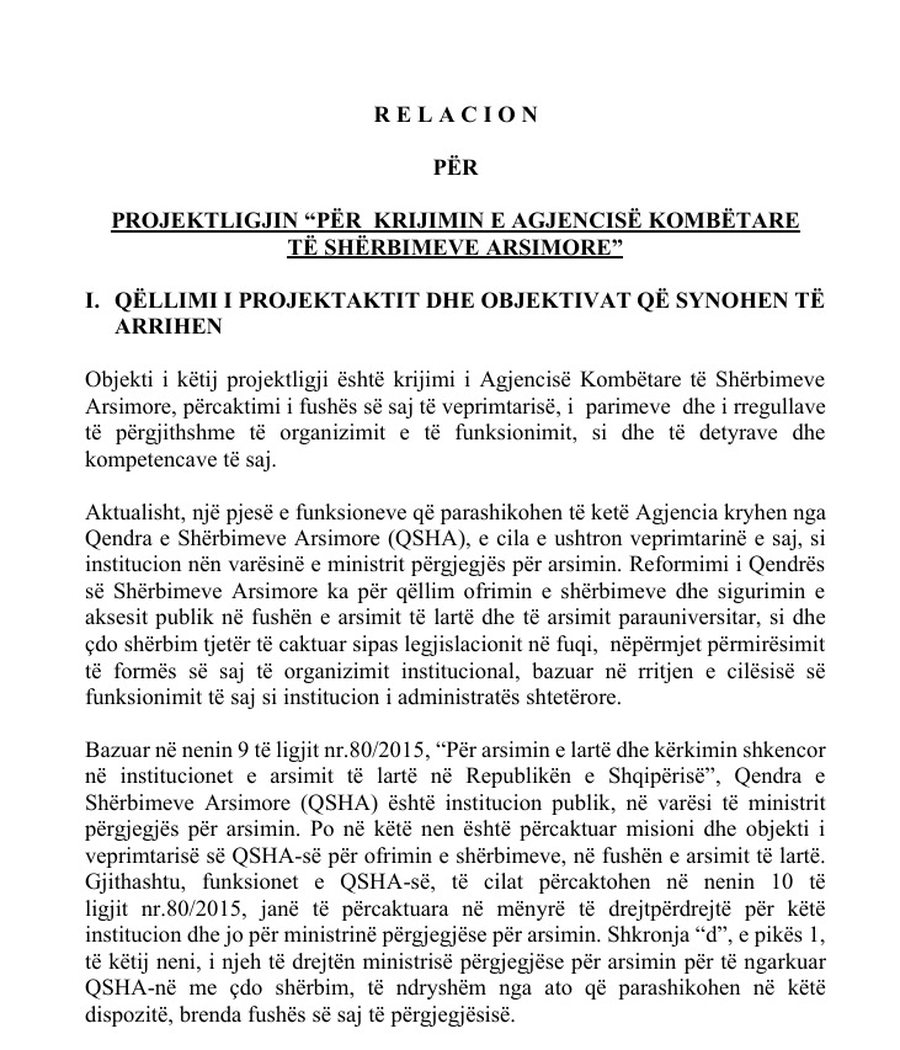
Faced with this collapse, the government does not propose an internal reform, but delegates the fate of the system to the AADF. The report clearly states:
"This bill was drafted in collaboration with the Albanian-American Development Foundation (AADF)... to propose a new administration model."
The Albanian state has neither the mind nor the means to test its own children, so it seeks the "salvation" of a hybrid entity. AADF is not coming simply as a donor, but as the architect of an agency that will be a "state within a state."
The report reveals that the new AKSHA will not be fully funded by our taxes, but will be a self-financing institution. Every certification, every foreign diploma that is recognized, and every licensing exam will have a cost that will be paid from the pockets of citizens to keep the new "machinery" running. By removing the agency from the Civil Service rules and placing it under the Labor Code, the government gives the board (where the AADF also sits) absolute power to appoint people and set salaries outside of any official administration tables.