


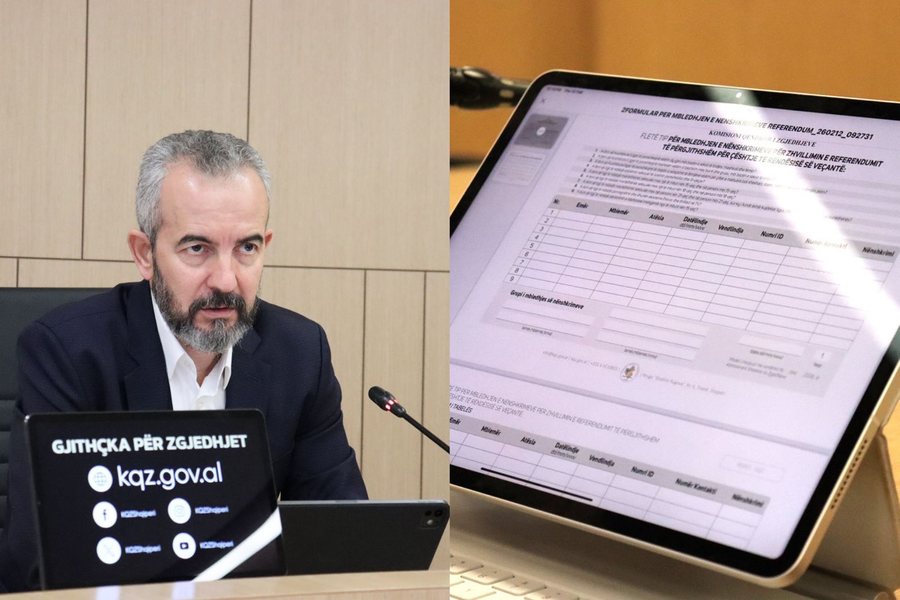
In a public session that, at first glance, seemed purely technical, the State Election Commissioner Ilirian Celibashi continued the review of the request for the provision of a standard form for collecting signatures for a general referendum on issues of special importance. At the end of the session, the Central Election Commission approved the request and the model form, paving the way for the phase of collecting signatures by the “Pro Familjes” initiative group.
The group, consisting of 16 members, has submitted the request to initiate referendum procedures with the argument of “family protection” as an issue of particular public importance. The CEC decision does not mean the automatic development of the referendum, but is the first formal step that allows the organizers to collect the necessary signatures to continue the process.
However, what makes this development more special is the legal context in which it takes place. Albania, paradoxically, does not have a specific law on referendums. The procedures rely on an unusual legal situation: the existence of two laws with the same title – the “Electoral Code of the Republic of Albania”.
The 2003 law, which once regulated the entire electoral process, has remained in force only for the chapter related to referendums. While the 2008 code replaced the rest of the electoral system, leaving only this old legal fragment alive. Thus, the referendum in Albania operates on a legal basis divided into two eras, where one part of the rules is modern, while the other remains the legacy of a code that practically no longer exists as a whole.
At the end of the day, for Ilirian Celibashi this is yet another process added to the Central Election Commission’s calendar — a procedure that brings institutional activity, administrative commitment and, naturally, the need for additional resources and funding for its administration. On a formal level, everything seems in order: forms, deadlines, public hearings and a process that proceeds according to procedure. But the reality remains more complicated: the terrain where this referendum is taking place is legally unclear, based on a fragment left over from an old code and not on a special, unified law on referendums. Thus, as the institution functions and the process advances, the question that remains is whether procedural normality can hide the fact that the legal basis on which everything is based continues to be, in essence, a gray area — more of a practical compromise than legal certainty.