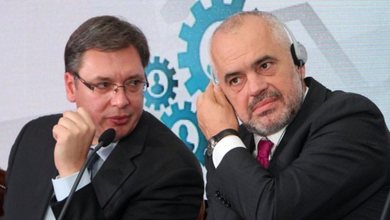



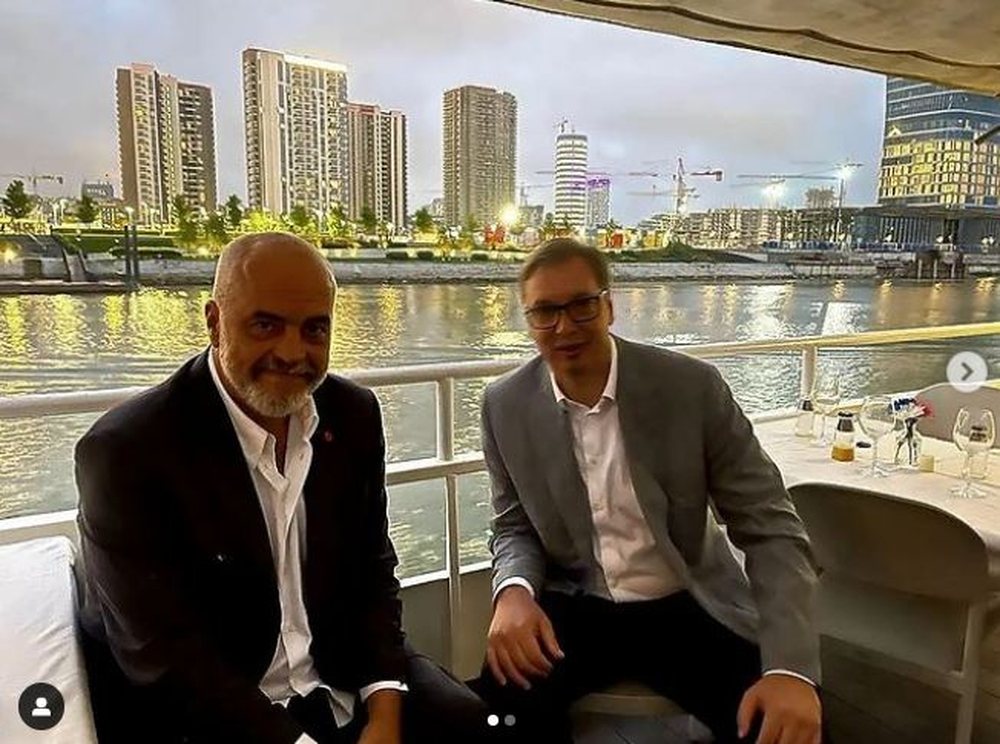
In a joint editorial published in the Frankfurter Allgemeine Zeitung (FAZ), Albanian Prime Minister Edi Rama and Serbian President Aleksandar Vučić propose a new strategic approach to advancing the European Union enlargement process.
Their proposal is based on the idea of an accelerated integration of prepared candidate countries into the EU internal market and the Schengen area, without violating the existing institutional balance of the Union. That is, without veto rights, without additional commissioners and without affecting decision-making structures.
For Prime Minister Rama and President Vučić, this formula would provide direct benefits for citizens, while simultaneously strengthening the EU's economic and geopolitical position.
FULL EDITORIAL
"We understand the concerns. But enlargement is in everyone's interest."
Since the fall of the Berlin Wall, hardly anything has changed the European Union as much as its enlargement. By expanding its institutions, rules and markets to new members, the EU helped anchor democracy, stability and prosperity in large parts of the continent.
No other political instrument has changed Europe more profoundly or more peacefully. But since 2013, no new member has joined the EU. While this does not necessarily reflect a lack of commitment, but a more complex environment – internal reforms, geopolitical tensions, institutional constraints and legitimate concerns in member states – the harsh truth remains: this sad and discouraging reality has persisted for far too long.
The achievements of the European project are undeniable.
No generation of Europeans has experienced such peace, mobility and prosperity. Enlargement played a central role in this by expanding a community based on democracy, the rule of law and economic exchange.
In our part of Europe, the Western Balkans – a region geographically surrounded by the EU and historically linked to the fate of Europe – the prospect of membership remains the strongest engine for reform, investment and reconciliation.
The EU continues to be strongly engaged through financial support, political dialogue and sectoral integration.
We are grateful for this. But the transformative effect of full membership has not yet been realized. It is high time for the EU to realize that there is a new front line for investing in EU strength in the Western Balkans.
Many Europeans are wondering whether the EU can still function effectively with many more members. Concerns about decision-making, institutional balance, and political cohesion are legitimate.
Leading politicians in Paris, Berlin and elsewhere have stressed that internal EU reforms may be necessary to ensure that an enlarged EU remains capable of decisive action.
We are not naive.
These arguments carry weight. We have learned – often the hard way – how difficult it is to convince all member states to accelerate our accession processes and how easily progress can be blocked, often for reasons rooted in the internal political considerations of member states.
However, telling future members that they must wait for EU reforms before joining would be tantamount to closing the door: yet more solemn speeches reaffirming a commitment to admitting new members, while in fact little or nothing happens.
This would be wrong, counterproductive and even dangerous in these times. We are fully aware that the path to membership requires deep and often painful reforms, compliance with EU standards in almost every area of public life.
This is costly and politically difficult – but it is undertaken because the goal is worth it.
Our two countries and the entire region – with all their differences and shared challenges – have changed in ways that would have been unimaginable a decade ago.
However, reforms and progress cannot be based on trust alone. In parts of the Western Balkans, enthusiasm for the EU persists despite painful disappointments.
Albanians are and remain optimistic.
Serbs are more skeptical.
But, there is a common denominator in the region: people need to see that the process is credible and membership is achievable within a reasonable time.
We have written this article together because we recognize that Europe today pursues two equally legitimate goals: candidate countries are seeking a realistic path to full membership.
Member states want to preserve the EU's capability and unity.
This tension does not necessarily have to be a zero-sum dilemma. With imagination and political will, it can – and should – become a strategic opportunity.
This is why we are calling for an accelerated integration of the prepared candidate countries into the internal market and the Schengen area.
This could bring tangible benefits to citizens, while simultaneously strengthening the EU's economic and geopolitical position without burdening the EU's decision-making architecture and without changing its institutional balance.
This would mean neither veto rights, nor additional commissioners, members of the European Parliament, nor changes to voting structures.
We are convinced that this would ease the concerns of those member states that are reluctant to expand to a larger enlargement – not all because it would be much easier for them to present the process convincingly to their public.
EU enlargement has never been an act of charity.
It was a mutually beneficial investment. The EU gained markets, talent, strategic depth and political stability. The new members gained prosperity, security and a voice in shaping Europe.
Above all, peace on our continent has continued to gain ground – on a scale never before seen in European history.
Europe's opponents live with narratives of decline and division. Europe's strength has always come from its ability to transform crises into integration and diversity into unity.
The next chapter of this story has not yet been written. With careful design, mutual trust, and new political courage, this could become a new European success story – not just for the Western Balkans, but for Europe as a whole.