



By Muriel
Friedrich Nietzsche once warned that “whoever fights monsters must be careful not to become a monster himself in the process.” This quote is no longer a warning, but an accurate diagnosis for the members of the Special Appeals Chamber (SAC). What is being played out in the offices of the Supreme Court and in the corridors of embassies is not an administrative procedure, but an attempt to kill the last breath of morality in the New Justice.
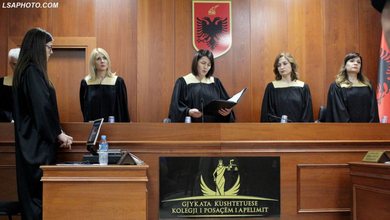
The story began with the profile of the purple-clad “Inquisitors,” when in 2016 a group of lawyers, most of whom were outside the magistrate system, were selected to be the “swords” of vetting. They were clothed with an almost divine power: they were the final instance that sealed the fate, honor, and bread of hundreds of judges and prosecutors. For nine years in a row, the KPA functioned as an untouchable island, where standards varied according to the name of the subject and where the “brotherhood” over people’s careers was carried out with surgical coldness. They have dismissed magistrates for 100 euros undeclared two decades ago and have destroyed professional lives for “inappropriate contacts” with people the subjects did not even remember. But today, as the sand in their hourglass runs out, these “Veting Gods” are discovering that they are terrified of the same process they imposed on others.
This horror is producing the scandal of the private “elevator” to the Court of Appeal, where members of the KPA are seeking to be automatically appointed to the Courts of Appeal without passing any filter. This demand resembles our old popular expression: “Do as I say, but not as I do.” They are seeking to become magistrates without ever sitting on the benches of the Magistrates’ School and to sit in the chairs of the Court of Appeal without being subject to the vetting of wealth and image, just as those who are in the system today were forced to do. This is neither a legal process nor a career transition; this is a pure end-of-term bargain. An agreement where the underlying message is clear: “We served the mission, now give us eternal immunity and the comfort of the armchair without anyone checking us.”
At this point, the psychology of power and the fear of equality come into play, as this demand for privilege demonstrates a deformation of integrity that psychologist Erich Fromm would analyze thus:
"The right to be free also means the obligation not to demand for oneself what one cannot grant to others."
The fact that the members of the KPA refuse their competition and vetting shows that they see themselves as a “caste” above the law. Those who have integrity do not seek protection from the law through diplomatic pressure letters, but seek protection through equality before it. The thirst for status has overcome their professional morality, turning the end of their mandate into a battle for private survival at the expense of the public interest.
Justice is not enough to be just; it must also APPEAR to be so, as the renowned US Supreme Court Justice Felix Frankfurter demanded. He said that “justice must satisfy the appearance of justice,” meaning that it is not enough for a decision to be technically legal; it must be so pure that no one doubts its honesty. If the Supreme Court bows down and accepts the members of the KPA without vetting, the reform will no longer seem like “justice,” but like a national fraud. With what morality can an Appellate Judge hold an ordinary citizen accountable when he himself won the seat through a bargain that violated the Constitution? If this happens, the reform dies and turns into a mere “changing of the guard,” where the old caste is replaced by a new one that does not serve the state, but the backroom staff that gave him the position.
Faced with this epilogue of a reform where merit should be a requirement or standard departure, the integrity of the New Justice no longer accepts a middle ground: either a triumphant entry through merit, or an inglorious departure under the shadow of hypocrisy. There can be no “islands of immunity” in a system that was designed precisely to collapse castes. The path remains clear and non-negotiable: an absolute vetting under the same blade that cut the careers of their colleagues, a magistrate status acquired through legal means, and an appointment to the Appeals Court that passes exclusively through the sieve of competition. If the professionalism of the members of the KPA is as solid as their rhetoric claims, let them prove it in open competition, winning the seat with the dignity of one who is not afraid of equality. Any other space, any “elevator” concocted behind the scenes, would be nothing more than the final capitulation of justice before the bargain. Their mandate cannot and should not be a privileged "exit ticket," but a testament to service to a people who no longer accept anything less than absolute equality before the law.