

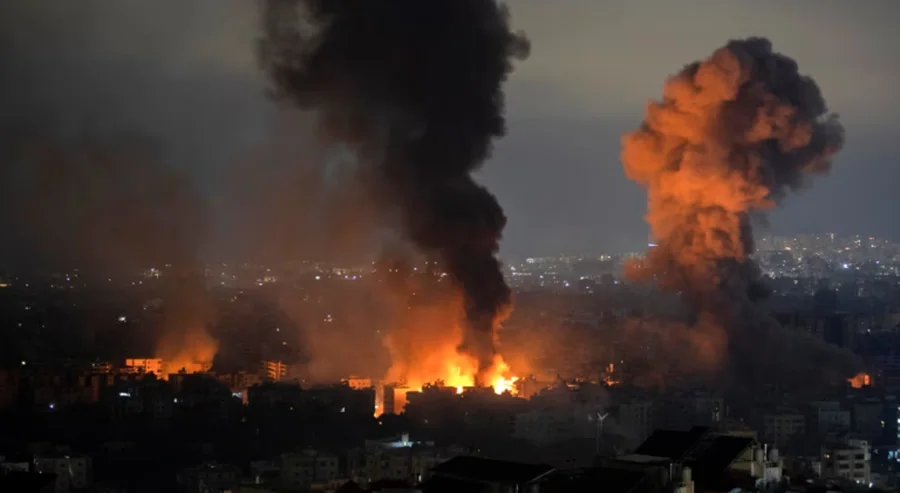
The escalating security situation in the Middle East has tested the response of governments in the region to protect their citizens abroad. Two announcements published today – one from the Ministry of Foreign Affairs of Montenegro and the other from the Ministry for Europe and Foreign Affairs of Albania – reveal two very different approaches to the same crisis.
Montenegro has immediately moved from warning to concrete action: it has organized an evacuation flight with Air Montenegro from Sharm el-Sheikh, Egypt, with a set departure time and a clear list of diplomatic contacts for the registration of citizens. The call is operational, with a request for the submission of accurate data and with the promise that logistical details will be communicated directly to registered passengers.
On the contrary, the Albanian side's announcement remains at the advisory level: avoid travel, follow reliable sources, contact embassies, keep documents ready. A correct communication in formal terms, but which does not offer any concrete instrument to resolve the situation of dozens of Albanian citizens who are currently stranded in Dubai, according to information from Ekofin.al and in other countries in the region, for several days, due to flight cancellations and uncertainty.
The essential difference is not in the tone of the statements, but in the level of intervention. Montenegro, a country with a significantly smaller population and budget than Albania, has immediately activated state capacities to guarantee the return of its citizens. Organizing a dedicated evacuation flight is a decision that has financial costs and logistical implications, but above all it sends a political message: the state is present.
Albania has so far chosen a more cautious approach, limiting its response to advice and monitoring of the situation. In theory, this can be justified by the fact that airspace has not been completely closed and that commercial flights continue to operate in some segments. But in practice, for citizens who have been stranded, between unexpected cancellations and the lack of safe alternatives, advice is not enough.
The comparison between the two countries is inevitable, especially at a time when both aspire to membership in the European Union. Montenegro is considered ahead in the negotiation process, but in terms of financial resources and the size of the economy, Albania has no reason to justify itself with a lack of capacity.
Organizing an evacuation flight is not just a matter of funds. It is a matter of coordination between ministries, airlines and diplomatic missions, as well as rapid decision-making at the political level. In such cases, time is the critical factor. Every day of waiting increases the uncertainty and costs for the citizens left behind.
The current crisis highlights the importance of consular diplomacy, an often underestimated dimension of foreign policy. Opening embassies or being present in international forums is not enough; the real test comes when citizens seek concrete support.
In this context, Montenegro's response sets a regional precedent. It shows that even a small state can intervene quickly to ensure the safety of its citizens. Albania, on the other hand, faces a legitimate public question: will it move from the phase of advice to the phase of action?
European Union standards are not measured only by legislative harmonization or institutional reforms. They are also measured by how a state protects its citizens, both within and outside its territory.
The question that arises today is not whether the situation is difficult – it is difficult for everyone. The question is whether the Albanian state will take concrete steps to guarantee the return of its citizens, if the situation deteriorates further.
For now, the difference between Podgorica and Tirana is obvious: one has raised the plane, the other has raised the advisory. And for the citizens waiting amidst anxiety and uncertainty, this difference is not just symbolic./Ekofin.al/