



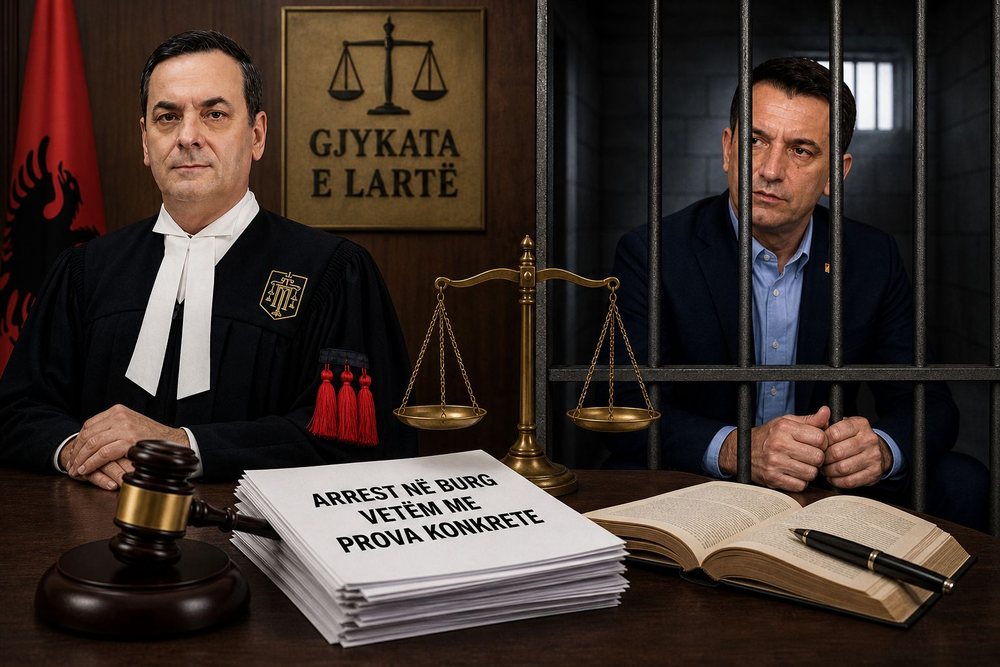
The decision of the Joint Panels of the Supreme Court has brought some clear innovations in the way the measure of "prison arrest" is imposed, aiming to make it more reasoned and less automatic.
First, the prosecution, when going to court to request detention in prison, must argue not only that this measure is appropriate, but also that milder measures are inappropriate for the specific case.
Secondly, the court, when deciding on the measure of arrest in prison or other security measures, must argue with specific data the dangerousness of the person and the concrete dangerousness of the criminal offense — and not simply start from the name of the offense or the measure of punishment provided by law.
Third, the burden of proof for ordering detention in prison lies with the prosecution. The defendant may present evidence, not simply to challenge the detention, but to justify the imposition of a more lenient measure.
However, the question that arises is whether this new standard will have an impact on high-profile cases, such as that of Erion Veliaj. The answer is not straightforward.
The implementation of this decision requires, first, that there be a request from the interested party to the Special Court against Corruption and Organized Crime. Second, it remains to be seen whether this court will apply this standard in practice, since the interpretation and concrete application of the decision are never automatic.
If the decision is not taken into account, the case may follow the path of appeal and then return to the Supreme Court — ultimately leaving it up to the judges themselves to decide on the actual application of the standard they themselves have set.
But there is something even more important to say.
This decision today was not a decision that overturned the unifying decision of 2011 — on the contrary, it confirmed its fundamental basis. And there was no way to change it. That decision of 2011 had done nothing more than convert — into a more narrative and simpler language — the text of the European Convention on Human Rights, the Albanian Constitution and the Code of Criminal Procedure. Today’s decision has not brought about any radical change, but only a natural development of the practice.
The rules that the High Court has “albanized” today have long been present in the decisions of the ECHR and in the decisions of the Constitutional Court — which are mandatory for implementation by the entire Albanian judicial system. It is possible that some district courts, in matters of determining measures, have derogated from these standards. But this is not the case of SPAK and GJKKO, and for a very simple reason: the High Court — the same court — has reviewed most of the previous decisions of SPAK+GJKKO and found them right. So, the standard of SPAK+GJKKO has been such that, even without this current linguistic elaboration, it has long met the requirements of the European Convention, the Constitution and the Code of Criminal Procedure.
Therefore, no surprises and no change in attitude should be expected — at least not on the legal level.
If today's decision — which brings practically no innovation — will serve as a justification for turning the Supreme Court into a prison release mechanism, then it will be clear that this has not happened because of the counting decision, but because of a changed subjectivity of its members — for completely extra-legal reasons. We are not prejudging anything at this moment. We are simply turning on the lights before the important tests that this court will have ahead — by asserting that the Albanian public cannot and should not be treated as a blind tribe of ignorant people, isolated from knowledge of the law.