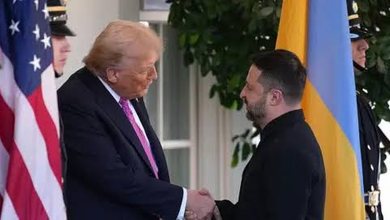
With the proposed summit between US President Donald Trump and his Russian counterpart Vladimir Putin in Budapest seemingly postponed, European states are once again trying to make themselves important in any possible resolution of the war in Ukraine.
One of the latest efforts is a 12-point plan, seen by Radio Free Europe, initiated by Finland. The plan has been circulating in European capitals in recent weeks. The document is not a ready-made peace agreement, as its tentative title makes clear: “Elements for Peace in Ukraine.”
This plan has also not been discussed at the highest levels of the EU and has not been officially supported by any country. Instead, it is something that has been worked on in the Coalition of the Willing – a group of more than 20 countries that support Ukraine – since the spring.
The twelve points are structured in two phases: the first “ceasefire” and the second “negotiations.” The “ceasefire first” approach is something that most European states have been calling for since the Trump administration began talking to the Kremlin. The document states that such a ceasefire “will begin 24 hours after the parties have accepted this plan” and that a hotline “will be established at the moment the ceasefire begins.”
First phase
Acknowledging the US's leading role in the talks, the plan also suggests that monitoring of the ceasefire begin "immediately under US leadership, using satellites, drones and other technological means."
Also, during the ceasefire phase, the plan is for Ukraine and Russia to agree on a "non-aggression" pact, meaning that while Moscow will stop attacks on Ukraine, Kiev must also refrain from trying to retake territories under Russian control in Ukrainian regions such as Crimea, Donbass, Kherson, and Zaporizhia through military means.
Regarding the nuclear power plant located in Zaporizhia, the idea has been proposed to transfer it from Russian control to an unidentified third party, and to initiate negotiations to return it back to Ukrainian control.
The plan also includes “confidence-building measures,” which would see “certain symbolic sanctions lifted after a ceasefire has lasted a certain number of days.” Another idea is that Russia would be welcomed back into international organizations. Although this is not explicitly specified, it could be implied that this includes the Council of Europe, from which Russia was expelled in 2022, as well as the International Olympic Committee.
It is also proposed that during the ceasefire phase, a "Peace Board" be created, to be chaired by Trump, to oversee the implementation of an eventual peace plan - an idea that seems to be taken from the 20-point plan for peace in Gaza.
Second phase
The second phase – negotiations – initially involves a ceasefire. The text states that “negotiations will begin on a final line of contact, which will remain in force until the parties agree on the permanent governance of the occupied territories.”
This phase also includes the creation of security zones around the contact line, where no military activities will be allowed, as well as monitoring by a multinational civilian mission on both sides of the line.
The security guarantees, which the Coalition of Will has been working on for months, are in point 8, although no other details are given.
Point 9 is the most controversial, as it concerns a high-level dialogue between Kiev and Moscow to "enhance mutual understanding and respect for linguistic, cultural and religious diversity."
Officials from eastern EU states contacted by Radio Free Europe believe that this point of the plan reinforces Russian claims, often dismissed as baseless, that Russian speakers in Ukraine have been discriminated against and need protection from Moscow.
The next point is also controversial for many European governments as it mentions “the launch of negotiations for the permanent governance of the occupied territories.” This contradicts the “maximalist” positions of many EU capitals, according to which Ukraine should not give up a single inch of territory and that its territorial integrity is key.
The penultimate point of the plan is related to reconstruction and envisages the creation of a fund for Ukraine. Frozen Russian assets could reportedly be used for this fund.
Finally, the document mentions the gradual lifting of sanctions against Russia, in line with the implementation of the plan. It states that Ukraine and Russia will begin a process to agree on compensation for war damages, with frozen Russian assets in the West worth over 200 billion euros, which could be returned once an agreement is reached between Kiev and Moscow. The plan also includes a mechanism that would automatically restore all sanctions and isolation measures if Ukraine is attacked again.
How likely is this plan to work? “Probably not very much,” admits a European official who spoke on condition of anonymity. And while some still think the US might be interested in at least some aspects of the proposals, few believe Russia will agree. As one European diplomat put it: “We can have a 12-point plan, but there will be no peace – that is Putin’s one-point plan.” /REL