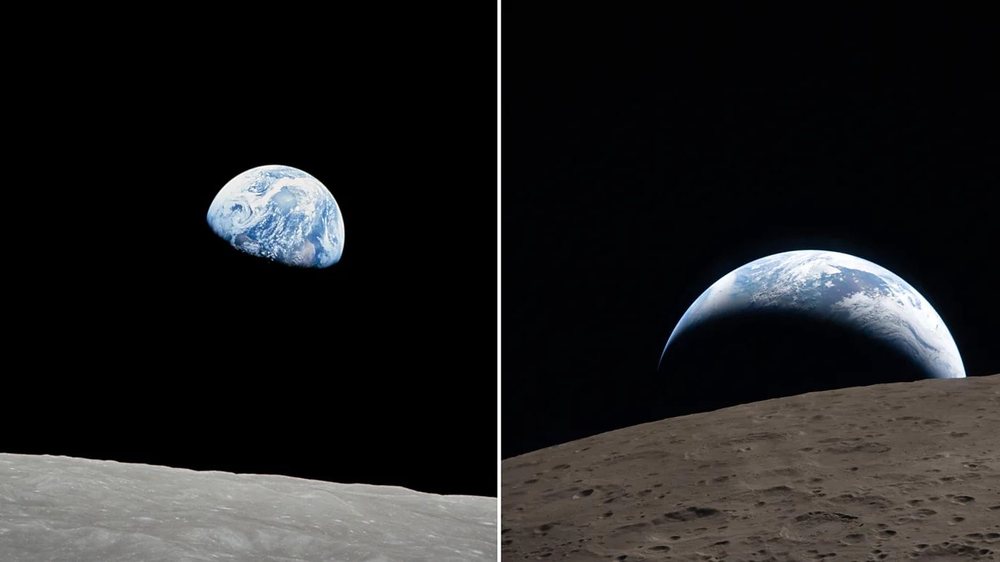
In 1968, during the historic Apollo 8 mission, NASA astronauts first photographed the Earth rising above the Moon's horizon. The iconic photograph, called "Earthrise," was taken by astronaut Bill Anders and became one of the most famous images in history, changing the way humanity sees its planet.
The mission commander, Frank Borman, remembered that the surface of the Moon appeared bleak, cratered, and colorless. But suddenly, as the spacecraft completed an orbit around the Moon, Earth appeared on the horizon—a colorful blue globe amidst the darkness of space.
This photograph became a symbol of the global environmental movement and inspired the creation of Earth Day in 1970.
Now, 58 years later, astronauts on the Artemis II mission have captured a similar new image, dubbed “Earthset,” during a flyby of the Moon in early April. In this image, the Earth appears to be sinking behind the Moon’s horizon, with endless space visible in the background.
The photo was taken from the window of the Orion spacecraft during a seven-hour flight around the Moon on April 6. According to NASA, the image clearly shows blue oceans and white clouds over the Oceania region, while parts of the planet are in darkness as they are on the night side.
Although half a century is a very short period on a geological scale, experts say that climate change has significantly transformed the Earth's surface over these decades. A comparison of the "Earthrise" and "Earthset" images shows that our planet remains beautiful, but also very fragile.
Unlike in 1968, today satellites photograph the Earth every day from space. However, images taken by astronauts have a special value because they bring a human and emotional perspective to our planet – a reminder that “that little blue dot is our only home.”