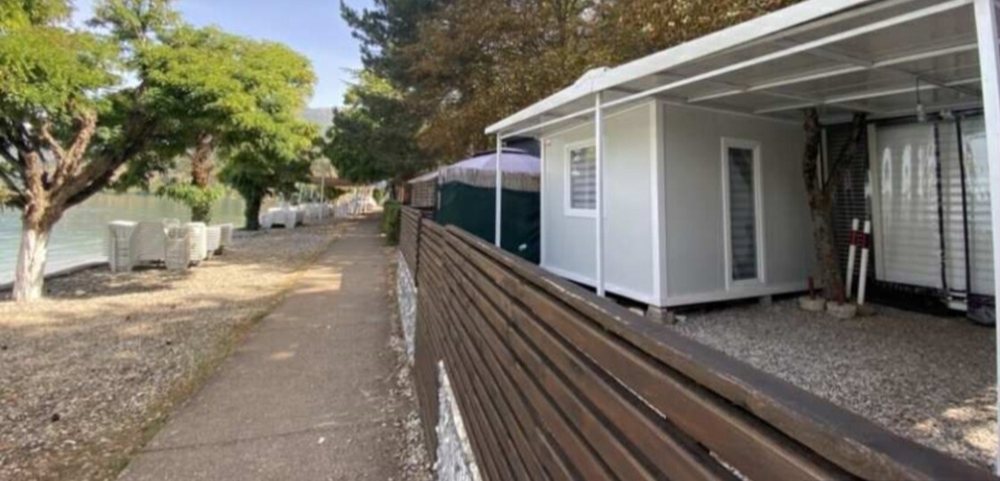
The location known as "Gradishte Campsite", one of the most popular spots on the shores of Lake Ohrid, is today quietly being transformed into an illegal construction site - in an area where, according to institutions, no established camp legally exists.
Although the land is in the process of denationalization and is subject to court proceedings, Gradishta has been functioning as a legal tourist complex for years, while an increasing number of temporary and mobile camp-houses are expanding and being converted into fixed and permanent facilities.
Some owners use these buildings for commercial purposes and rent them out as apartments during the season, and advertise them on online platforms.
Advertisements can be found online where it is seen that the advertised facilities are not campers, but solid structures with walls, windows, floors, and toilets.
Some photos showing buildings for rent in Gradishte for prices up to 120 euros.
An apartment advertised in July 2025 as a "bungalow" in Gradishte, with direct access to the beach, still appears online.
This accommodation is offered at a price of 85 to 120 euros per night, with a kitchen and toilet - features that indicate that it is a permanent construction.
This case is not isolated. Other advertisements offer a “camping house in Gradishte”, but the attached photos show spaces completely enclosed with metal structures, with added elements and a molded interior that has nothing to do with a mobile home.
Radio Free Europe/Radio Liberty has requested a statement from the Ministry of Culture and Tourism of North Macedonia regarding the situation in Gradishte, an institution that responded briefly, saying that this location does not officially exist as a campsite.
An advertisement offers a cabin for rent in Gradishte, but the published photos show that it is a concrete-based structure.
An advertisement offers a cabin for rent in Gradishte, but the published photos show that it is a concrete-based structure.
In its written response, the Ministry emphasized that "Gradishta is not established as a motor camp in accordance with the Law on Motor Camps. It is in the process of denationalization and judicial proceedings are underway."
For all questions related to construction activities, the Ministry of Culture and Tourism does not take responsibility and said that for further information, one should contact the Municipality of Ohrid.
This ministry did not answer questions about which company officially manages Gradishte and whether they have the legal right to manage the space while the denationalization process continues.
The question of which institution granted the concession or management permit, if one exists, also remained unanswered.
Regarding the Gradishte issue, the Municipality of Ohrid did not respond to REL either.
The process of denationalization
The location in Gradishte is in an extremely attractive position and is located right next to the archaeological museum, the ruins of the Roman fortress and the famous tourist attraction of the Bay of Bones, making it one of the most visited and popular spots on the Ohrid coast.
In the past, during the former Yugoslavia, this space was used as the "Gradishte Campsite", as part of the then activity of the "Inex-Gorica" company.
The land entered the denationalization process in 1997-1998, initially with the adoption of the Law on Privatization and then the Law on Denationalization, after which about 100 heirs from 36 families requested the return of part of the land.
Ohrid was declared a World Heritage Site in 1979, and in 2019 the status was also granted to the part of the lake on the Albanian side. Lake Ohrid is one of the oldest and deepest lakes in Europe.
Some of the property claimants say that even after five court decisions in their favor, they have not been able to return their property. At the same time, the land in Gradishte that was owned by the Macedonian Orthodox Church - Ohrid Archbishopric was returned to the Church in accordance with the same Law on denationalization, which, according to the property claimants, indicates a selective approach. The church land extends from Orevce beach and three other beaches to the location where the restaurant was previously located in the so-called “first part” of the camp.
Andrijana Bashoska, one of the people seeking the return of the land in Gradishte, says that this case is "a classic example of organized crime with the highest level of corruption."
According to her, today the company "Inex-Gorica" uses the space without legal basis and usurps about 100,000 square meters of land. REL also requested a position from "Inex-Gorica" on these claims, but until the publication of the text, this company has not responded.
Despite five final court decisions, Bashoska claims that the Denationalization Commission has not implemented them for years. Instead of returning the land that her father's family once owned, the Commission, she says, issues compensation decisions with bonds worth 180 denars per square meter. Because of this action, Bashoska says that she has filed lawsuits with the Administrative Court six times against the Denationalization Commission's decision.
"The law on denationalization is clear: where permanent facilities have been built, compensation can be made with bonds, but when there are assembly or temporary facilities on the land, the property must be returned to the condition in which it was taken. This is the case in Gradishte, the land must be returned," says Bashoska.
She claims that she has been encountering institutional obstacles for years, including around the implementation of the inheritance procedure after her father's death in 2016, which was supposed to allow her to formally become the owner of the land in Gradishte.
Septic tank and washing machine
While people seeking the return of their property are trapped in institutional labyrinths, the natural beauty of Gradishta is increasingly being drowned by concrete, while some of the building owners receive permission from the administration of the so-called auto camp to open improvised septic tanks.
This is evidenced by campers who have been vacationing in Gradishte for years. They told us that in the “first part” of the location, the administration allows some tenants of plots with an annual subscription, in addition to building solid buildings, to also open septic tanks next to their plots for a fee of 5,000 denars.
"People no longer have camp houses, but have built structures with plaster, metal materials and concrete blocks. They have toilets inside, and for a fee of 5,000 denars they can also bring washing machines," several people told REL, who asked to remain anonymous.
A building in Gradishte.
The non-governmental association "Ohrid SOS" tells REL that information about new constructions and that some of them are also being offered online.
"We know that this location is in the process of denationalization that has been going on for more than two decades. During this period, it must not be rented out or managed, while the camp management benefits from all these activities," the association's statement said.
Until the publication of this text, the Municipality of Ohrid did not respond to questions about whether it is informed about the situation in Gradishte and how it will react, whether such interventions with temporary constructions and septic tanks are allowed, and which companies manage this space.
In previous years, the Municipality of Ohrid has taken action to remove several buildings in Gradishte.
In 2021, a decision was made to remove temporary facilities in, as it was said, "the space known as the 'Gradishtë' auto-camp", after serious violations were found during an extraordinary inspection.
The inspection then found that some of the camp houses were placed on concrete foundations, with added metal roofs and completely enclosed structures made of sheet metal, wood, water-resistant gypsum boards, as well as unauthorized wooden and metal structures, temporary objects and connections to the water supply, sewage and electricity networks - interventions that are outside any approved project and legal regulation.
The Gradishte case is not an isolated incident, but another episode in the broader picture of systemic problems that have been destroying the Ohrid region for years – illegal construction, usurpation, uncontrolled urbanization, pollution…
The same phenomena are also the subject of UNESCO reports on Ohrid, which risks being declared a world natural and cultural heritage in danger - for which institutions either clash over competences or remain silent, while the space changes irreversibly and the public interest remains unprotected. /REL