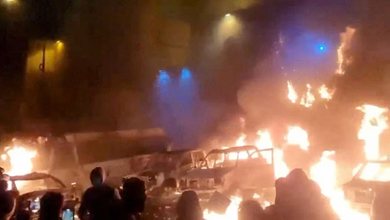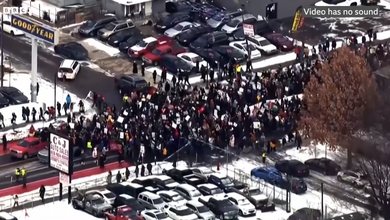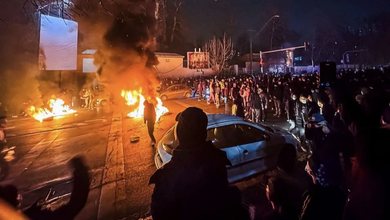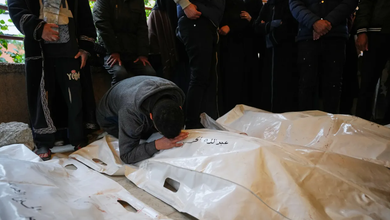
President Donald Trump is considering a range of possible military options in Iran following deadly protests in the country, two US officials told CNN, as he considers moving forward with recent threats to strike the Iranian regime if it uses deadly force against civilians.
According to officials, Trump has been briefed in recent days on various intervention plans, while violence in the country has resulted in dozens of deaths and arrests.
Some of the options presented to the president have focused on targeting Tehran's security services, which are being used to suppress the protests, U.S. officials said. But there are concerns within the administration that military strikes could backfire and undermine the protests. They say the strikes risk rallying the Iranian people around the government or prompting Iran to retaliate militarily.
Trump is also considering a range of options that target the Iranian regime without resorting to military strikes, while seeking to keep his promise to help protesters in the country.
These options include cyber operations against the Iranian military or regime targets, a step that could hinder efforts to suppress protests, one official said.
It also includes new sanctions on regime figures or sectors of the Iranian economy, such as energy and banking. The administration has also considered providing technologies like Starlink to improve internet connectivity in Iran, helping protesters bypass the information blockade. Similar assistance was offered by then-President Joe Biden during the last wave of street protests in 2022.
Several different agencies are involved in preparing options for the president, officials said. More formal briefings are expected next week, including Tuesday, when Trump is expected to convene top national security officials to discuss next steps.
Tehran has warned that it will treat US military and commercial bases as targets of retaliation if Washington intervenes militarily in Iran. The hard-line speaker of Iran's parliament, Mohammad Baqer Qalibaf, said:
"If the US takes military action against Iran or the occupied territories, US military and shipping centers will be considered legitimate targets."
"We are not limited to just reacting after an action," he added.
The president has not yet made a final decision on intervention, officials said, but is seriously considering action as the death toll in Iran continues to rise. The options under consideration do not include sending ground troops to Iran, a senior White House official told CNN.
At least 10,675 people have been arrested, including 169 children, during the past 15 days of anti-regime demonstrations in Iran, according to a detailed count provided to CNN by Skylar Thompson, deputy director of the Human Rights Activists in Iran (HRA).
The media arm of HRA is called the Human Rights Activists News Agency (HRANA).
According to the group's most recent update, at least 490 protesters have been killed in the same period. CNN has not been able to independently verify HRANA's casualty and arrest figures.
“Iran is looking at FREEDOM, perhaps like never before,” Trump wrote on social media on Saturday. “The US is ready to help!!!”
On Friday, Trump told reporters that if Tehran uses deadly violence against protesters, the US will "get involved."
“I have made it very clear that if they start killing people like they have in the past, we will get involved,” Trump said during a meeting with oil industry executives. “And that doesn’t mean troops on the ground, but it means hitting them very hard where it hurts.”
Secretary of State Marco Rubio and Israeli Prime Minister Benjamin Netanyahu spoke Saturday about the ongoing protests, two sources familiar with the conversation said. They also discussed the situation in Syria and Gaza.
The Israel Defense Forces (IDF) said on Sunday that it is "monitoring developments" in Iran, as the country enters its third week of anti-government protests.
"The protests are an internal matter for Iran. However, the IDF is defensively prepared and is continuously improving its capabilities and operational readiness," an IDF spokesman said.
Meanwhile, Netanyahu is expected to call a limited security consultation on Sunday evening, where developments in Iran and Lebanon will top the agenda, according to an Israeli source.