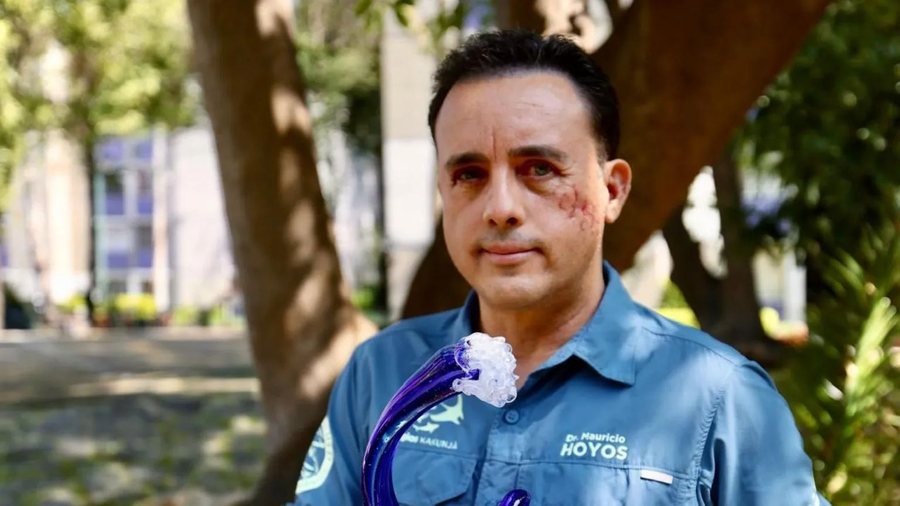
Mauricio Hoyos still remembers the pressure that the jaws of a female Galapagos shark, over 3 meters long, exerted on his skull.
The animal pounced on him with incredible speed, leaving him only a moment to lower his head, in a desperate attempt to protect his jugular vein.
"When she closed her jaws, I felt the pressure of the bite, and then, after about a second, she opened them again and let me go," Hoyos told BBC Mundo from his home in Baja California, Mexico, a little over a month after the incident.
Hoyos, a marine biologist with more than 30 years of experience studying sharks in their natural habitat, was on a research expedition in Costa Rica when he was attacked by the shark in September.
Less than two months later, still with scars from the attack on his face, he describes his recovery as “incredible” — and says he even hopes to meet the shark that bit him again.
⸻
"A battle sign that looks like shark gills"
For Hoyos, what happened that day in the waters near Cocos Island was normal behavior of an animal that felt threatened.
“In this case, the bite was like an instinctive reaction, like when an animal tries to defend its territory,” he says.
“It wasn’t an attack to kill me, it was more of a reaction to get me away.”
Hoyos and his colleagues usually attach acoustic tags to sharks to track where they mate or breed. That day, he was alerted by some tourists that a large shark was swimming about 40 meters below the surface.
"I told the ship's captain that I would only be submerged for five minutes," he recalls.
After entering the water, he began his slow descent into the depths.
The shark, a giant female between 3 and 3.5 meters long, swam beneath him, and Hoyos positioned himself to place the tracking device at the base of its upper fin.
But unlike other sharks he had previously tagged, this one did not quickly move away, but turned towards him and looked him in the eye.
"I saw her little eye look at me, and she turned very slowly, calmly," says Hoyos.
⸻
"I was inside her jaws – for a second"
He kept his gaze on her as she swam, but suddenly, out of nowhere, the shark turned and attacked with force.
"I instinctively sat down with my head down, and I felt her lower jaw pressing against my cheek and her upper jaw grabbing my head. I believe I was there, inside her jaws, for only a second, then she just opened her mouth and let me go."
The shark's bite, with its 29 saw-like teeth, left deep gashes on his face and head, and also severed his scuba diving equipment. He survived the attack, but his life was still in danger.
One of the teeth had also ripped through his diving mask, and the blood that gushed out had completely blurred his vision.
“When I realized I wasn’t getting air from the tube, I took out that backup – what we call an ‘octopus’ – but it wasn’t working properly either,” Hoyos says.
“I had to remember all my training and adjust my breathing with just my lips.”
⸻
A climb towards the light
Bleeding, nearly blind and running out of air, Hoyos calculated he had less than a minute to surface.
"I couldn't see anything anymore, so I followed the light that I knew was coming from the surface. I got up very slowly, with controlled movements, because I didn't want to make any erratic movements that might provoke the shark."
When he reached the surface, a young man pulled him onto the boat, while the captain immediately contacted national park rangers to report the incident.
"I didn't feel the pain right away – the adrenaline had taken over me. The bite didn't hurt that much, it was the impact that hurt more: imagine a 3-meter-long animal hitting you at that speed – it was like being hit by a car," he recounts.
⸻
A cure that surprised doctors
When they reached the port, a team of doctors was ready for emergency intervention. Hoyos was lucky: not only did he survive the attack and the ascent to the surface, but none of his wounds became infected. The healing process took less time than doctors had predicted.
"The doctors told me it was unbelievable: the attack happened on September 27, after a 34-hour journey they had me surgically cleaned, and just two days later they were considering whether they could do reconstructive surgery."
They told him his case was exceptional, as a young man who had survived a similar attack in the same area in 2017 had spent nearly a month in a hyperbaric chamber due to wound infections.
"The doctors told me they were very worried about infection, because being on the face, the wounds were very close to the brain," says Hoyos.
⸻
"The sign that proves that you spared my life"
Today, with a broad smile, Hoyos says he is planning to get back in the water and has already booked a dive on November 14th.
“Now that I’ve survived an attack like that, I have even more respect for sharks,” he says.
“A lot of people think the oceans would be safer without sharks, but they only say that because they don’t understand the vital role they play in maintaining the natural balance.”
Pointing to the large wound on his cheek, he adds:
"This is proof that that woman spared my life. I can't explain it any other way. And it allows me to continue to speak out for sharks and advocate for their conservation."
Meanwhile, the Galapagos shark that once held him in its jaws continues its life in the deep – and Hoyos hopes to meet him again.
Since he managed to tag him with a tracking device before he attacked, the possibility exists that he will find him again.
"In January I will go to Cocos Island again, from the 20th to the 27th. And of course I will dive right at Roca Sucia, where the attack took place," he says, without hesitation.