In 1999, NATO used depleted uranium munitions during the Kosovo War. Many soldiers developed cancer afterwards, and some received compensation. In Kosovo, the soil remains toxic to this day.
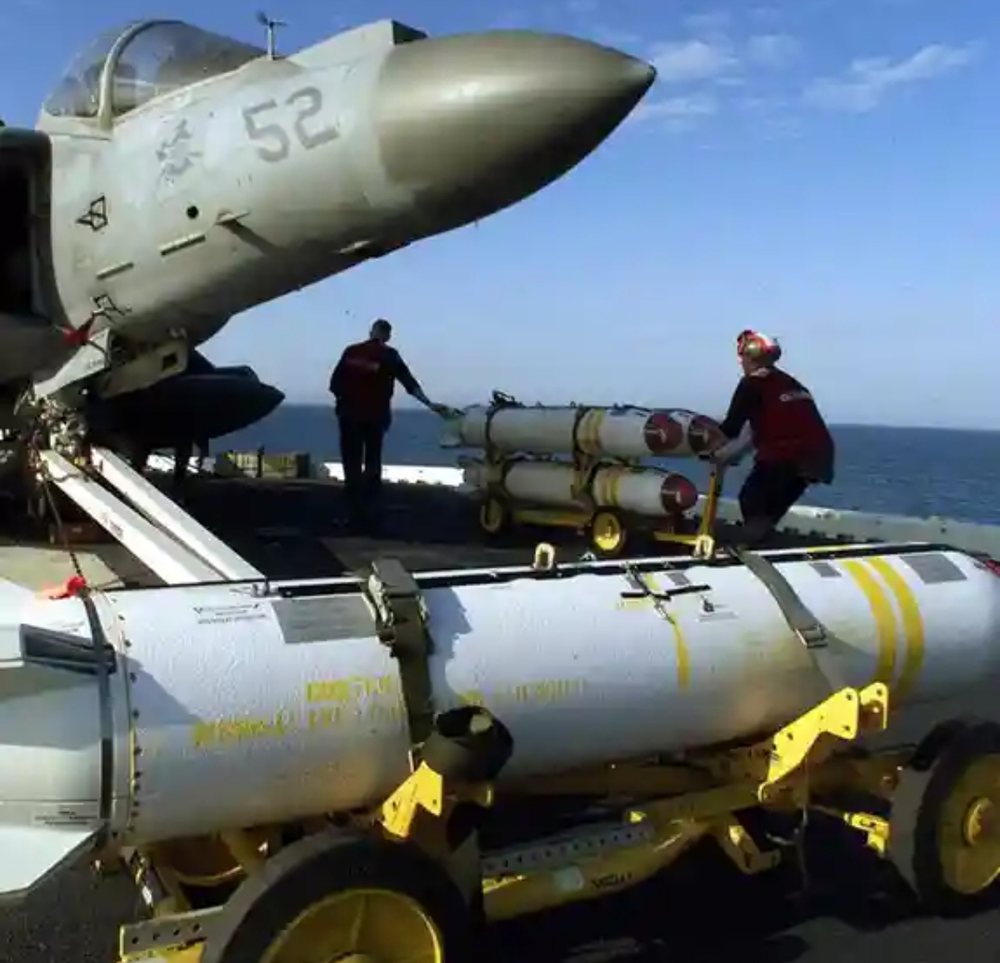
A cluster anti-tank bomb waiting to be loaded: US Marines were preparing to load the bombs into a Marine Corps Harrier fighter jet.
In March 1999, a US warplane dropped bombs containing depleted uranium off the coast of Albania, which were later used in Kosovo.
“I remember the last day very clearly,” said Emerico Maria Laccetti, former colonel of the military division of the Italian Red Cross.
During the Kosovo War in 1999, he was stationed in Albania, just a few hundred meters from the border with Kosovo. He was the commander of a field hospital for refugees from the province, which at the time belonged to Serbia.
“We would climb on top of containers and watch the bombing,” he said. “It was like a New Year’s fireworks display, but upside down and terrifying. Even from a distance, you could feel the shock of the air going through your body. But no, no one told us about the specific dangers of the weapons that were being used.”
NATO operation and the use of depleted uranium
In March 1999, NATO’s Operation Allied Force intervened in the years-long conflict between the Serbian state and the Albanian majority of Kosovo. For 78 days, the alliance carried out air missions with up to 1,000 aircraft against Serbian security forces. According to official figures, over 28,000 explosives were dropped, including controversial depleted uranium munitions, which are suspected of causing cancer.
These munitions contained a depleted uranium (DU) core, with high explosive power due to its high density – three times that of lead. They are mainly used against tanks and armored targets. Upon impact, very fine uranium dust can be created, which continues to emit radiation and can cause health problems if inhaled.
NATO denies cancer allegations
In response to questions about the health risks posed by DU munitions, NATO provided only a written statement:
“We take health and environmental issues very seriously,” it said.
In 2001, a committee on depleted uranium concluded that the use of DU in Kosovo “caused no lasting risk to the population,” based on independent findings.
NATO refers to UN reports from 2014: "This is scientific, credible evidence, and we stand by it," the statement said.
However, this contradicts Italian court rulings on lawsuits by around 500 Kosovo War veterans who developed cancer after contact with depleted uranium munitions.
The long-term illness of the Italian colonel
Laccetti says he knew his field hospital in Morina, Albania, was in a “hot zone” near the front line during NATO bombings – something that always means danger.
“What they never told us, however, was that some types of ammunition can pose a long-term risk, even if you are not hit directly – for example, by an unexploded shell nearby or by substances used in the manufacture of ammunition.”
When Laccetti returned home in July 1999, he was having difficulty breathing and went to the hospital for an examination. “The medical staff were suddenly alarmed,” he recalls.
Finally, a doctor showed him the image: “There was something in my lung measuring 24x12x14 centimeters.” He was diagnosed with a highly aggressive malignant tumor at the age of 36.
He was initially treated successfully, but in 2008 he fell ill with cancer again. Tissue analyses were shocking: “They found an incredible amount of round ceramic particles – as if I had been standing inside an industrial furnace.”
The conclusion was clear: “These particles had been embedded in my body for years and could cause new damage through inflammation or migration.”
Successful lawsuits in Italy
Laccetti learned of other soldiers of the same age, stationed near him, who had similar diagnoses. He contacted lawyer Angelo Tartaglia, who represented those affected.
Around 500 soldiers successfully sued the Italian state. Among them was Laccetti, whom a court in Rome recognized in 2009 as a victim of military duty and awarded him compensation.
After the war, an Italian Ministry of Defense commission investigated the possible link between DU exposure and cancer. It found a statistically significant increase in cases of non-Hodgkin lymphoma, a group of blood cancers, among affected soldiers.
However, other reports, such as the WHO one that same year, found no clear evidence of a direct link.
Difficult to prove link to cancer
For Wim Zwijnenburg, a member of the International Coalition to Ban Uranium Weapons (ICBUW), the point is clear:
“The court recognized that the Italian state had a duty of care, so they were awarded compensation,” he explained.
But he admits: “It is extremely difficult to make a definitive statement.”
Depleted uranium only affects the body when it enters, usually through inhalation of very fine particles. “But the exact amount that people inhale has never been properly measured. There are very few reliable long-term studies.”
The causes of cancer are often multiple – from lifestyle, genetic factors, to environmental influences.
“It’s hard to prove,” he says. “Did the victims touch a DU shell, or were they near a contaminated tank? Uranium can penetrate the skin for a year. Doctors can’t make claims without clear evidence. People look for a single cause, but the reality is much more complex.”
Did NATO do enough to clean up Kosovo?
In 2002, the United Nations passed a resolution obliging states to inform countries affected by the use of uranium munitions and to assist them in cleaning up contaminated areas.
It is not clear to what extent NATO implemented this obligation in Kosovo — the peacekeeping force KFOR, stationed since the end of the war, provides no information.
Field visits show that the population in many regions of Kosovo is not aware of the potential risks, and clean-up measures have not been undertaken, except for one location in the west of the country, in the village of Lugbunar near Gjakova.
“NATO can be criticized for using these weapons,” Zwijnenburg said, “but even more so for not doing the cleanup after the war. There are clear protection protocols for soldiers – but for civilians? Nothing. It is unacceptable to use toxic munitions and then turn your back.”
Officially, the material from which DU ammunition is made is classified as low- or intermediate-level radioactive waste. But, as Zwijnenburg says, “in humid climates like the Balkans, the shells can corrode and disintegrate, leaving behind hazardous residue.”
The danger does not diminish with time, as the half-life of uranium is almost infinite. For Zwijnenburg, this shows double standards from states:
"If such a shell were found in a park in the Netherlands, the area would be immediately isolated. Special units in protective gear would place it in a lead container for safekeeping. But when it comes to other populations, this precaution does not exist."
Laccetti is disappointed that his case and that of many other veterans did not bring about substantial change.
“Depleted uranium munitions are still legal. We have tried every possible way to ban them, just like cluster bombs or anti-personnel mines,” he said. “And we have failed.”
Source: DW