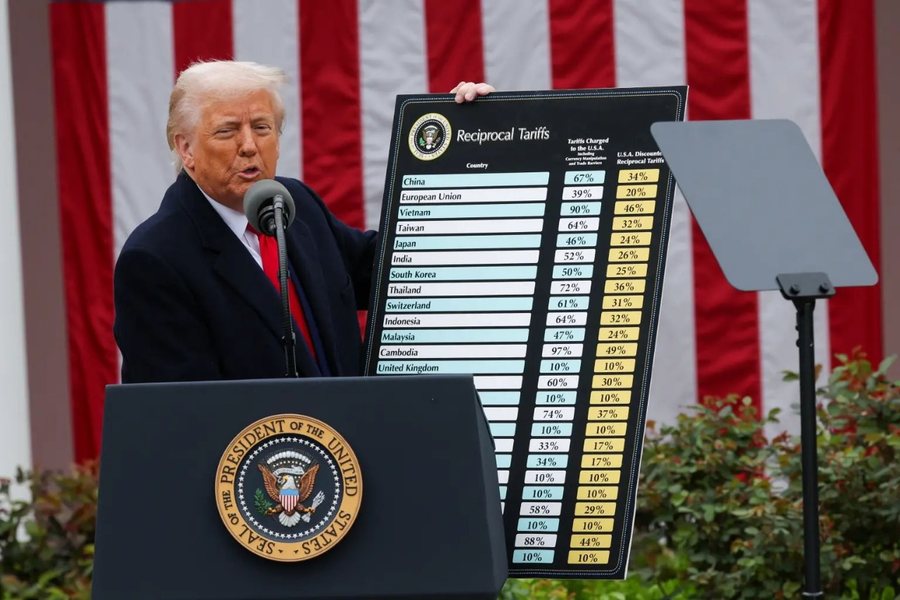
Trump vowed to press ahead with tariffs including a new global 10% tax after the Supreme Court ruled that his sweeping duties exceeded presidential authority.
US President Donald Trump said he would immediately impose a new global tariff of 10% and pursue alternative trade measures after the Supreme Court ruled on Friday that his sweeping tariffs exceeded executive authority.
"Today I will be signing an order to impose a global 10% tariff under Section 122, in addition to our normal tariffs that are already being applied," Trump said at a press conference.
The court, in a 6-3 decision on Friday, struck down the broad tariffs that Trump imposed under an emergency powers law, dealing him a major setback to a signature economic policy.
“To protect our country, a president can impose more tariffs than I was imposing… according to different tariff authorities,” he continued.
The ruling focuses on tariffs imposed using the International Emergency Economic Powers Act (IEEPA), a 1977 law commonly used for sanctions and other economic tools, which Trump had used to justify broad import taxes.
Other US presidents have used the statute many times, but Trump was the first to use it for tariffs.
Trump said he was not troubled by the ruling, saying the SCOTUS decision "simply invalidated a particular use of IEEPA."
"So we can use other statutes, other tariff authorities, which have also been confirmed and are fully permitted."
Trump has repeatedly called the dispute existential to his economic agenda, even though polls have shown that tariffs are not widely popular due to broader voter anxiety about affordability.
Vice President JD Vance responded to X to express his frustration with the "illegality" of the high court.
"Today, the Supreme Court ruled that Congress, despite giving the president the ability to 'regulate imports,' didn't actually mean it," he said in a post on the social media platform.
Congress vs. the executive branch
In its majority opinion, the court said the US Constitution “very clearly” gives Congress the power to impose taxes – including tariffs – and not the president.
Supreme Court Chief Justice John Roberts wrote that the framers of the constitution did not place the power of taxation in the executive branch.
The ruling does not prevent the White House from pursuing duties under other laws, although these avenues generally come with stricter procedural restrictions and limitations on speed and scope than the emergency powers approach that Trump initially attempted.
Administration officials have said they expect to keep the broader tariff framework in place by using other authorities.
“Therefore, effective immediately, all national security tariffs under Section 232 and existing Section 301 tariffs … remain in effect, in full force and effect,” he said.
"And we are also initiating several investigations under Section 301 and others to protect our country from unfair trade practices," Trump added.
What other legal remedies are still available?
Among the alternative legal tools available to the US president, Section 301 and Section 122 of the Trade Act of 1974 are essential to any future tariff plan.
Both provisions have significantly stricter restrictions than IEEPA, with the Trump administration facing a much narrower set of tools.
Section 301, officially part of Title III of the Trade Act of 1974 and entitled “Relief from Unfair Trade Practices,” gives the Office of the United States Trade Representative (USTR) the authority to “investigate and act against foreign trade practices that violate U.S. trade agreements or burden U.S. commerce.”
When USTR concludes that a foreign government's conduct is unjustifiable or discriminatory, it can impose retaliatory tariffs or withdraw trade concessions.
It is essential that investigations in cases not involving trade agreements must reach a conclusion within 12 months – meaning tariffs cannot be imposed quickly.
Section 301 would not allow, for example, a 50% tax on imports from Brazil.
On the other hand, Article 122 can be implemented more quickly, but is limited in time.
The provision authorizes the US president to impose temporary import surcharges of up to 15%, or quotas, for no more than 150 days, when the United States faces fundamental international payments problems – such as a serious balance of payments deficit or rapid depreciation of the dollar.
It was enacted after U.S. President Richard Nixon used the Trading with the Enemy Act to impose a temporary 10% import surcharge in 1971 and represents Congress's attempt to codify a narrower version of that emergency tariff authority.
No prior investigation is required, allowing for swift executive action – but the tariffs automatically expire after 150 days unless Congress votes to extend them.
The limitations of both provisions are of great importance to the administration's ambitions.
Despite Trump's seemingly strong stance on Friday, US Treasury Secretary Scott Bessent had previously acknowledged that these alternative methods "are not as effective or as robust" as IEEPA.
Lawsuit in progress by companies affected by tariffs
The case drew opposition from a group of mostly Democratic-leaning states and businesses ranging from small importers to large retailers, arguing that the emergency law does not authorize the tariffs and that Trump's move failed to pass established legal tests.
"I know the people who filed the lawsuit, and you know they are crooks, big crooks," Trump said.
"I don't think we'll ever give up MAGA, MAGA will always be with us."
Trump has repeatedly called the dispute existential to his economic agenda, even though polls have shown that tariffs are not widely popular due to broader voter anxiety about affordability.
He plans to find new ways to keep the tariffs in place.
"Some of them (tariffs) stay. Many of them stay. Some of them won't stay and will be replaced with other tariffs," he concluded.