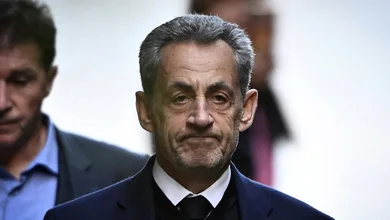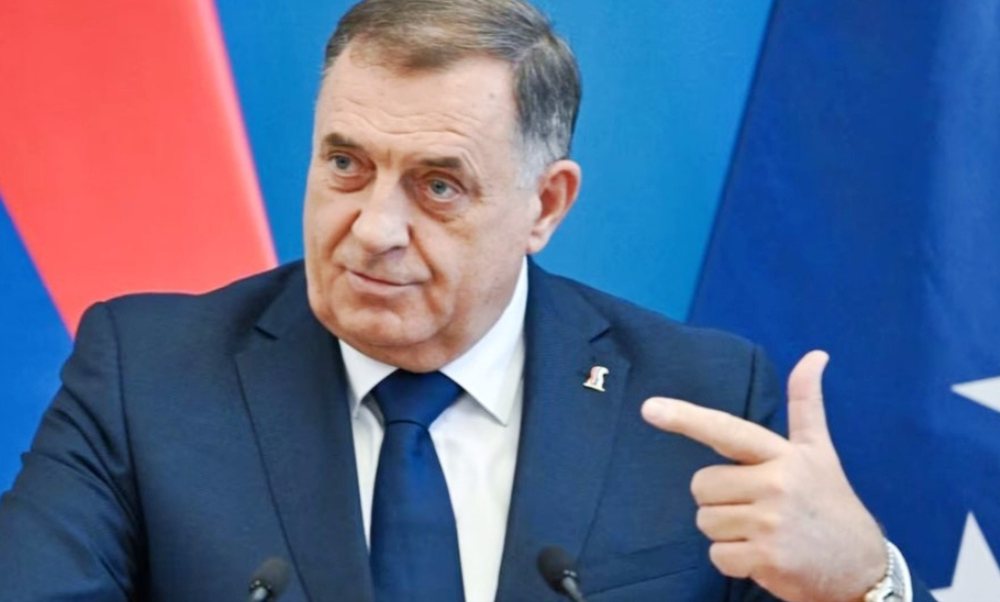
The US government lifted sanctions against former Bosnian Serb leader Milorad Dodik and dozens of individuals and companies linked to him, following an "agreement reached with Dodik," analysts tell Radio Free Europe/Radio Liberty's Balkan Service.
The US announced on Wednesday the lifting of sanctions against Dodik, his political allies, family members and companies linked to them.
The sanctions prohibited financial transactions with Dodik and all other sanctioned individuals.
Eric Gordy, professor of political sociology in the Department of Slavic and East European Studies at the University of London, told Radio Free Europe that "the US government has reached an agreement with Dodik and has done so outside of Europe, and I would say, outside of Bosnia and Herzegovina, but also Serbia."
Dodik, the president of the Alliance of Independent Social Democrats, was sanctioned twice for violating the Dayton Peace Agreement.
The US Treasury explained the reason why they were removed from the blacklist, while the State Department did not respond to Radio Free Europe's questions.
"The content of this agreement remains unclear, we do not know. But what I see as clear is that the Assembly has withdrawn the decisions from last year, which were declared unconstitutional," Gordy stressed, adding that "it is not impossible that there is now political pressure on the court to annul the decision, since Dodik has filed an appeal against that decision to stay (the court's decision)."
Last month, Dodik was stripped of his mandate as president of the Bosnian Serb entity after being sentenced to prison for disobeying the decisions of the High Representative in Bosnia, Christian Schmidt. He was also banned from holding office for six years.
"This is truly extraordinary. I don't remember a similar lifting of sanctions in the Balkans," said Daniel Serwer, a professor at Johns Hopkins University.
Serwer also told REL that an official explanation should be sought from US officials, but that he suspects this is "reward for Dodik's resignation from the Presidency."
The decision confirming Ana Trišić-Babić as acting president of Republika Srpska on October 18 officially confirmed for the first time that Dodik was no longer president of this entity.
That same day, the National Assembly of Republika Srpska annulled laws it had passed in the spring to prevent the work of state judicial and police bodies on the territory of the entity in response to Dodik's conviction.
The US State Department praised the National Assembly's decision to appoint Trišić-Babić as interim president of Republika Srpska and to withdraw separatist laws that had previously been annulled by the Bosnian Constitutional Court.
The statement said that this action was the result of efforts led by the United States of America to calm the political crisis in Bosnia.
Dodik has been a dominant political figure in Bosnia for the past 20 years, and through his Alliance of Independent Social Democrats (SNSD), he has dictated political trends in the country.
His policies have been repeatedly labeled as a threat to stability and peace in Bosnia, and the US Treasury Department has imposed sanctions on him, his closest associates, family members and companies that, as the US assessed at the time, "served for his personal enrichment".
"Many concerned people suggest that this is the result of lobbying supported by political contributions," Serwer said.
In the budget rebalancing for Republika Srpska in Bosnia for 2025, Serbia's Ministry for European Integration and International Cooperation has planned an increase of around 22 million euros, which "will be used mainly for Republika Srpska's representative offices abroad and for paying for professional services, REL reported in early July.
This amount represents more than 10 percent of the planned increase in the Republika Srpska budget.
Gordy also says it is too early to say whether this decision could affect the early presidential elections scheduled for November 23 in Republika Srpska.
Serwer said he hopes that the lifting of sanctions against Dodik and 48 individuals and legal entities will not mean a change in America's commitment to Bosnia's sovereignty and territorial integrity.
"They [President Trump's administration] should have asked Dodik to promise that he would not question Bosnia's sovereignty and territorial integrity in the future," Serwer said.
When asked how this decision could be understood in a broader context, given that Dodik is an openly pro-Russian politician who has met with Russian President Vladimir Putin 10 times since the start of the war in Ukraine in February 2022, Gordy said that "there is an ideological dimension that could be very significant in the region, if this is a sign of the direction in which American policy is going to go."/ REL