In its article, AFP lists some of the events that accompanied this year and which received the greatest attention from the public and the media.
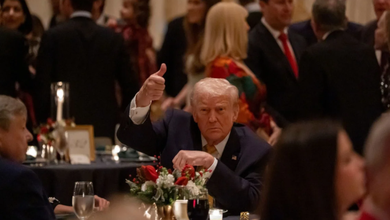
Donald Trump's sensational return to the White House
Protectionist attacks, mass deportations of illegal immigrants, dismantling entire parts of the federal government... After returning to the White House in January for a second term, Republican Donald Trump has launched a barrage of measures under his "America First" doctrine, making extensive use of executive orders, although the courts have blocked some of his decisions.
With what his opponents call a disregard for fundamental rights and other powers, he has targeted opponents, deployed the National Guard to major Democratic-led cities, sought to intimidate the media, and fought diversity and inclusion programs. He has also engaged in intense diplomatic activity, with varying degrees of success.
But polls show growing dissatisfaction among Americans with economic issues, particularly the cost of living. Big losses in local elections have put his party in a vulnerable position ahead of midterm elections in the fall of 2026.
The fragile ceasefire in Gaza
American pressure led to a ceasefire between Israel and Hamas, two years after the start of the devastating war in the Gaza Strip, which erupted after the Palestinian Islamist movement Hamas launched an attack on Israeli territory on October 7, 2023.
The ceasefire has allowed a partial withdrawal of Israeli troops from the Gaza Strip, the exchange of the last hostages held alive in Gaza for Palestinians imprisoned in Israel, and increased humanitarian aid to Gaza, although this aid is still significantly lower than what is needed, according to the UN and non-governmental organizations.
Israel is awaiting the return of the body of one of the last hostages before beginning talks on the second phase of the ceasefire, a phase that, under the terms of the U.N.-backed U.S. plan, should lead to the demilitarization of Gaza. Israeli Prime Minister Benjamin Netanyahu has said he hopes the second phase will begin “very soon,” but violence continues to rock the territory, with both sides accusing each other of violating the ceasefire.
Regional tensions continue with continued Israeli attacks on strongholds of the Shiite movement Hezbollah in Lebanon. Iran was also hit by Israeli and US strikes on its nuclear facilities during a 12-day war with Israel in June, which was triggered by an Israeli strike. In September, Israel targeted Hamas officials in an unprecedented attack in Qatar.
Peace efforts in Ukraine
Donald Trump's return to power marked the first serious efforts to end the Russian invasion of Ukraine, which began in February 2022.
The US president's praise and blame have oscillated between Vladimir Putin and Volodymyr Zelensky. In February, Donald Trump harshly attacked the Ukrainian president in front of cameras in the Oval Office, accusing him of being ungrateful to the United States.
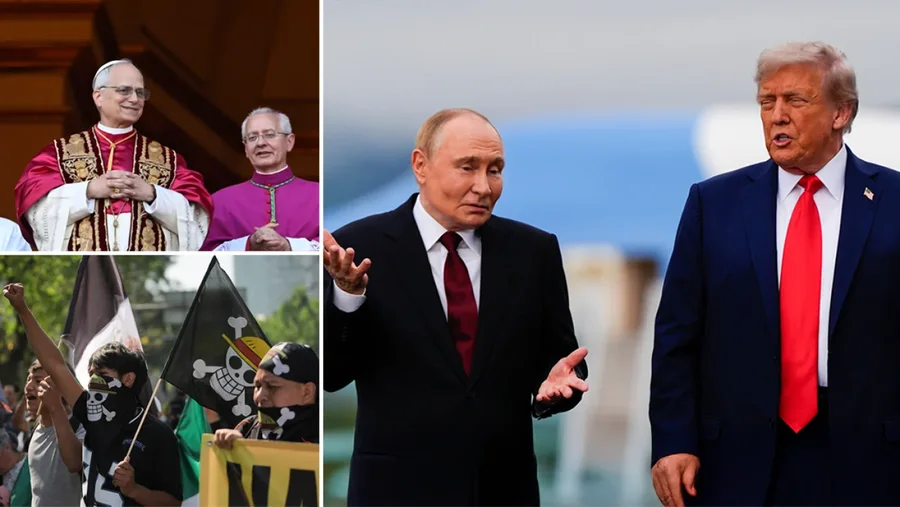
Direct talks between Russians and Ukrainians in Istanbul and a subsequent summit between Donald Trump and Vladimir Putin in Alaska have not resulted in any concrete progress towards peace, and Washington announced sanctions against the Russian oil sector in October.
International negotiations were held in late November on the basis of a US draft, the initial version of which was considered by Kiev and its European allies to be too favorable to Moscow. After a new round of talks with Trump’s envoys in December, Ukraine declared that “progress” had been made, although the issue of Ukrainian territories controlled by Russia remains deadlocked.
On the front lines, the Russian military has continued its slow advance in the eastern sector, after completely pushing Ukrainian forces from the Russian border region of Kursk in March. Moscow has stepped up attacks on Ukrainian energy infrastructure and the Ukrainian rail network, while Kiev is targeting oil facilities in Russia.
Global trade war
Citing trade practices that were unfavorable to his country, Donald Trump announced a series of additional tariffs on products imported into the United States, which varied according to the countries or regions of origin. He also imposed specific tariffs on sectors considered strategic (steel, aluminum or copper).
As targeted countries considered or implemented trade retaliation, fierce negotiations began, resulting in numerous agreements, such as with the European Union or, in late October, with China, marking the beginning of a ceasefire in a conflict that had rocked the global economy.
However, bilateral negotiations were suspended with Canada, following an advertisement that the US president found offensive.
Pressured to lower the cost of living for Americans, Donald Trump agreed in mid-November to cancel tariffs on certain foods, such as imported coffee and beef.
A new pope, Leo XIV
Robert Francis Prevost became the first American pope on May 8, at the age of 69, following the death of his predecessor, Francis, to whom he served as an advisor. White smoke announcing the election of the 267th head of the Catholic Church rose above the Sistine Chapel after a brief conclave of cardinals that lasted less than 24 hours.
Smiling and discreet, Prevost, born in Chicago and one of the moderate cardinals, took the name Leo XIV. The new pope, who spent almost 20 years as a missionary in Peru, continues the work of his predecessor with social actions in favor of the poor, immigrants and ecology.
At the same time, he appeased conservative circles by allowing a traditional service in the Vatican again after three years of restrictions. He ruled out in the short term the ordination of women as deacons or the recognition of same-sex marriage.
Generation Z Rebellions
In Asia, Africa and Latin America, young people of Generation Z have multiplied their mobilizations to improve living conditions and against social media blocking or elite corruption.
They marched in Peru against growing insecurity and the order of politicians or in Morocco, where authorities launched efforts in social sectors, as well as the prosecution of more than 2,000 people.
In other countries, demonstrations, which were violently suppressed, developed into a broader challenge to power; after unrest in Nepal, Maoist Prime Minister KP Sharma Oli had no choice but to resign. In Madagascar, mobilization led to the military overthrow of President Andry Rajoelina, who fled the country.
In Tanzania, young people participated en masse in post-election protests that were drowned in blood. The pirate flag from the manga One Piece (a skull and crossbones with a straw hat), often carried by protesters, became an international symbol of the fight against oppression on social media.
Colossal investments in artificial intelligence
Tech giants and specialized startups are spending increasingly colossal sums to fund the development of artificial intelligence. According to the American research and consulting firm Gartner, global spending on artificial intelligence is expected to reach about $1.5 trillion by 2025 (+50% in one year) and exceed $2 trillion next year.
The sector's astronomical valuations in the stock market, that of the giant American microprocessor company Nvidia once exceeded the unprecedented level of 5 trillion dollars, are, however, causing fear in the markets.
Concerns caused by artificial intelligence have also been fueled by numerous examples of misinformation, accusations of copyright infringement or massive job cuts, particularly at Amazon.
The parents of a California teen who committed suicide even accused OpenAI’s ChatGPT artificial intelligence assistant of encouraging their child to commit suicide with specific advice. The startup has since tightened parental controls, while California has passed legislation regulating so-called “chatbots.”
Spectacular theft at the Louvre
On October 19, thieves in workmen's vests entered the famous Louvre museum in Paris in broad daylight, using an elevator normally used for movement, after breaking a window. They then forced their way into display cases and stole royal jewels, worth an estimated 88 million euros, all in a span of eight minutes. As they fled on a scooter, they lost the crown of Empress Eugenie (wife of Napoleon III), which was found damaged.
This spectacular theft at the Louvre was commented on worldwide and brought to light the security shortcomings of the world's most famous museum.
Charges were filed against four men suspected of being part of the robbery gang, but the jewels have not yet been recovered.
American attacks in the Caribbean and the Pacific
Washington has deployed a significant military force to the coast of Venezuela since August, ostensibly to combat drug trafficking destined for the United States.
A series of attacks in recent weeks in the Caribbean and Pacific against suspected drug trafficking ships have killed nearly 100 people in operations whose legality is questioned by experts.
Caracas sees this as a pretext to overthrow President Nicolas Maduro and seize the country's oil reserves.
Following the seizure of an oil tanker carrying Venezuelan crude oil on December 10, Washington announced a “complete blockade” of “sanctioned oil tankers” entering or leaving Venezuela.
Washington accuses Nicolas Maduro of being the head of a cartel and is offering a $50 million reward for his capture.
Extreme weather events
Deadly floods, catastrophic storms... Extreme weather events have followed one another, due to climate disruption caused by human activity, according to scientists.
Cyclone Melissa, one of the most powerful ever to hit the Caribbean, devastated entire regions of Jamaica and flooded Haiti and Cuba.
In Southeast Asia, the Philippines was hit in less than two months by typhoons Ragasa, Kalmagi and Phung-wong. Vietnam suffered devastation from storms, floods and landslides, while two tropical storms killed hundreds of people at the end of the year in Sri Lanka and Indonesia.
As temperatures rise, forest fires have intensified in Europe and record hectares of forest have burned over the summer.
In the US, lightning-caused fires caused the closure of the northern part of the Grand Canyon in Arizona for the rest of the tourist season in mid-July.