


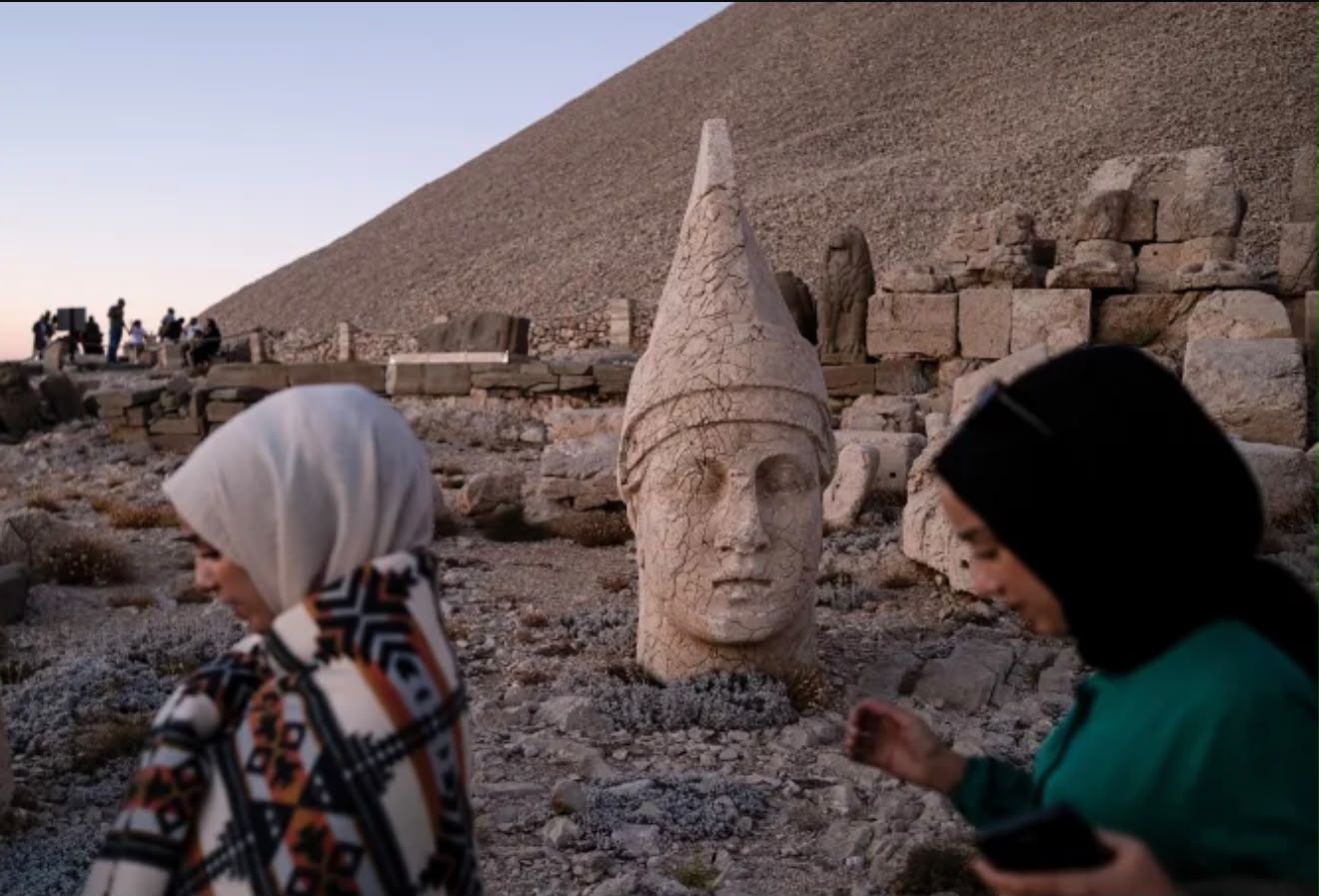
At the peak of Mount Nemrut, over 2,000 meters high in the Adıyaman province of southeastern Turkey, have stood for nearly 2,000 years some of the most mysterious monuments of the ancient world. Giant stone heads, severed from their bodies by earthquakes and time, continue to gaze at the horizon, guarding what is believed to be the tomb of King Antiochus I.
From a distance, Nemrut looks like an ordinary mountain in the Taurus Mountains. But as you approach the summit, colossal stone faces appear, smoothed by centuries, frost, and sun. To the locals, this place is known as the “Throne of the Gods.”
The monumental complex was built by King Antiochus I, ruler of the ancient kingdom of Commagene, a state that flourished about 2,000 years ago between Syria and the Euphrates River, after the collapse of Alexander the Great's empire. The kingdom was a meeting point of Greek, Persian, Assyrian and Armenian cultures.
Convinced that his power would continue after his death, Antiochus ordered the construction of a tomb on the summit of Mount Nemrut. Around it he placed giant statues representing deities from various traditions, while he himself was immortalized among them, as equal to the gods.
However, nature had its own plans. Earthquakes tore the monumental heads from the statues' bodies, but they remained in the same place, creating one of the most iconic and enigmatic sights in world archaeology.
In addition to the monuments, Mount Nemrut also offers spectacular panoramas over southeastern Turkey, especially at sunrise and sunset, when golden light envelops the stone statues.
The route to the summit passes by the Roman bridge of Septimius Severus over the Cendere River, the royal tumulus of Karakuş, dedicated to the women of the Commagene dynasty, and the ruins of Arsemia, a former royal center where one of the longest inscriptions in ancient Greek is located. There is also the famous relief depicting King Mithridates I shaking hands with Hercules, a scene known as the “shaking hands with the gods.”
Even today, after two millennia, Mount Nemrut remains one of the most extraordinary archaeological destinations in the world, where history, myth and landscape come together in a place that continues to hold the secrets of the king who sought immortality.