

In more than 100 days, the United States will co-host the soccer World Cup, to which Iran has qualified.
On Saturday, the US attacked Iran as part of a joint operation with Israel, sparking counterattacks across the Middle East. The question that arises is: what will this conflict mean for Iran, for the US and for a World Cup that was already expected to be highly politicized?
Will Iran play in the World Cup?
Iran are scheduled to play group matches against New Zealand and Belgium in Los Angeles, as well as Egypt in Seattle. This would be their fourth consecutive appearance. However, as BBC Sport writes, following the assassination of Supreme Leader Ali Khamenei and political instability, there are doubts whether the team will take part.
"With what happened... and with that attack from the United States, it is unlikely that we can look forward to the World Cup, but it is the sports leaders who should decide on this," Mehdi Taj, the president of the Football Federation of the Islamic Republic of Iran, was reported to have told Iranian television.
“For Tehran, this is not a short 12-day war or a limited round of escalation that can be stopped and reset,” said Dr. Sanam Vakil, director of the Middle East and North Africa Program at the Chatham House think tank.
"This new phase of the conflict is existential and clearly related to the survival of the regime. It is also unlikely to end soon."
FIFA has said it is monitoring the situation but so far expects Iran to be part of the tournament. If Iran withdraws, FIFA rules allow another team from the Asian Confederation to replace their country, such as Iraq or the United Arab Emirates.
Security and politics
At the 2022 World Cup in Qatar, Iran's matches took place amid massive protests against the Iranian government. Now, with the US attacks and new tensions, security is expected to be even tighter, especially as the tournament will coincide with the 250th anniversary of the US Declaration of Independence.
The conflict began just days after US officials warned of "catastrophic" security consequences if the 11 host cities do not receive funding frozen due to a partial government shutdown.
There have also been concerns about the role of ICE during the tournament and about cartel violence in Mexico, the tournament's co-host.
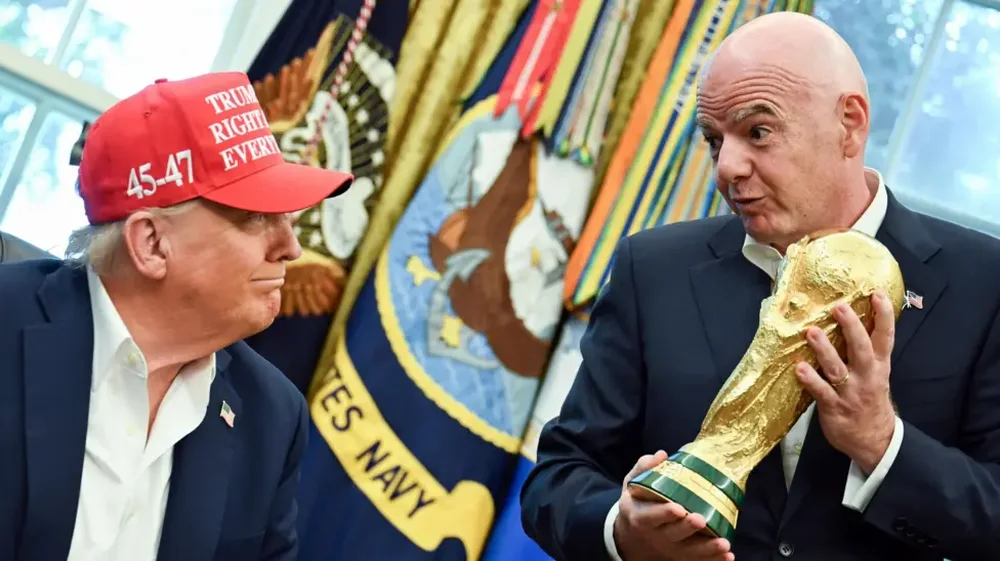
There has been criticism of FIFA for its close ties to President Trump, especially after he received a FIFA “Peace Prize” in December. Some politicians in Europe have even called for a boycott of the 2026 World Cup.
In the last 48 hours, the political landscape of the World Cup has become even more complicated. Iran's participation is uncertain, security is in the spotlight, and FIFA is under pressure for its political neutrality.