


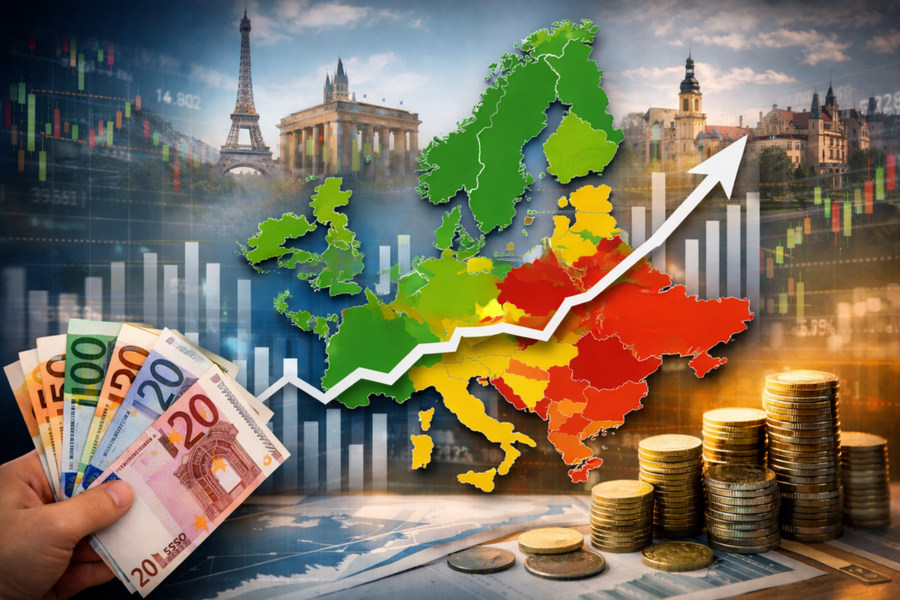
IMF projections show significant growth in GDP per capita in euros across Europe by 2030, but the rankings do not change significantly when measured by purchasing power parity.
GDP per capita remains one of the most widely used indicators to measure and compare the level of economic development between countries. In most of Europe, this indicator is expected to continue growing in the coming years.
However, increasing GDP per capita does not necessarily mean that a country is gaining ground on others, as other economies are also expanding at the same time. For this reason, more significant than the number itself is often the position a country occupies in the rankings compared to its neighbors and partners.
In this context, the question that arises is which European countries will be the richest by 2030 and whether noticeable changes are expected in the economic map of the continent.
To answer this, Euronews Business has analyzed the IMF's World Economic Outlook projections for 2025 and 2030, both for nominal GDP per capita and GDP according to purchasing power parity, which takes into account price changes from one country to another.
For Albania, projections show that the country still remains at the bottom of the European ranking, which underlines that, despite economic growth, the gap with the most developed countries on the continent is expected to remain large.
Ireland surpasses Luxembourg in purchasing power parity
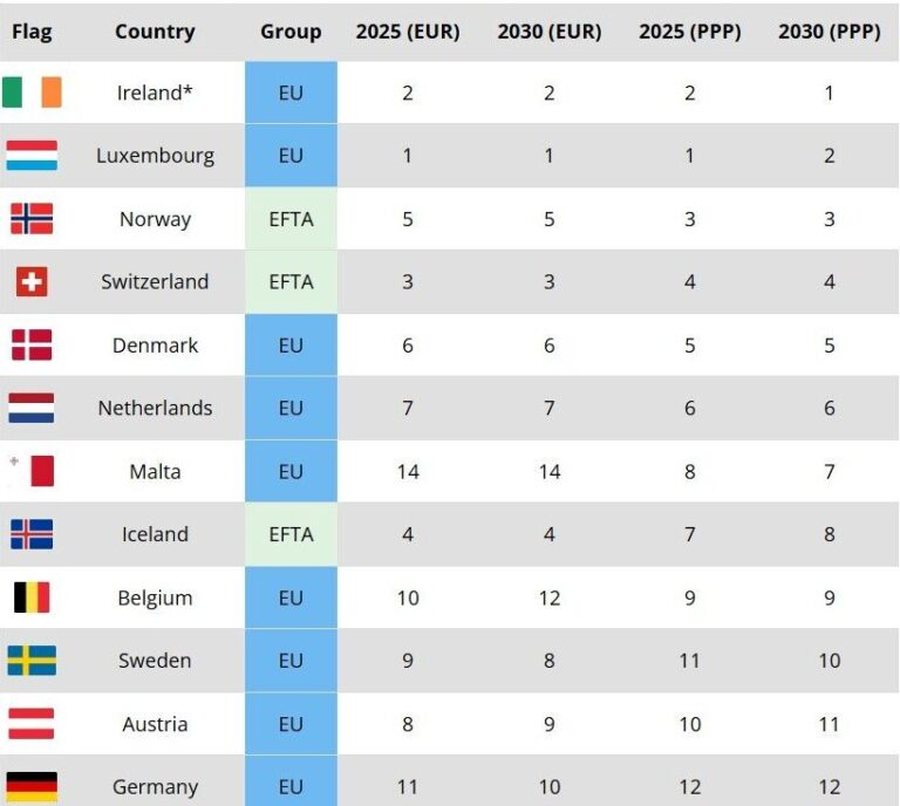
Among 41 European countries, which include EU members, candidate countries, EFTA members and the United Kingdom, Ireland is projected to top the GDP per capita table by purchasing power parity by 2030, replacing Luxembourg, which took the lead in 2025.
This headline figure comes with a significant caveat. Ireland's GDP is widely acknowledged to be artificially inflated by the very large presence of multinational corporations, and Alan Barrett, director of the Institute of Economic and Social Research, argues that gross national income is a much better indicator of the country's real economic output.
According to World Bank data on gross national income in 2024, Ireland would not rank among the top four countries at all.
Norway, Switzerland and Denmark are expected to complete the top five, with positions unchanged between 2025 and 2030.
Among Europe's five largest economies, Germany ranks highest, in 12th place, followed by France in 15th place and the United Kingdom in 16th. Italy stands in 18th place, while Spain is lowest among these five economies, in 22nd place.
The candidate countries are listed below, with one exception.
The bottom nine positions are dominated by EU candidate countries, with Ukraine, Kosovo and Moldova rounding out the table.
Turkey is the exception among them, as it is projected to rank 29th in 2030, above three EU member states: Bulgaria, Latvia, and Greece.
Data for the Western Balkan countries and other EU candidates show that the lower part of the European ranking is clearly dominated by these economies, with minimal movement until 2030. Serbia and Georgia remain relatively better positioned among them, ranking around 33–35 in both nominal and purchasing power parity terms. Montenegro and North Macedonia fluctuate in the range of 33–37, while Bosnia and Herzegovina, Moldova, Kosovo and Ukraine remain at the bottom of the table, with no significant changes in the medium term.
For Albania, the projections confirm a stable but low position in the European ranking. The country is expected to move from 35th place in 2025 to 36th in 2030 for nominal GDP per capita, while according to purchasing power parity it is in 37th place, in the same position in 2030. This shows that, although the economy is expected to grow, the pace of convergence with the most developed countries remains limited and the economic gap with the European average continues to be significant.
Fifteen countries are expected to maintain the same positions between 2025 and 2030. Greece records the largest decline, moving from 29th to 32nd place, while Cyprus records the largest increase, from 16th to 13th place.
No other country is projected to move by more than three seats.
The difference between the nominal and purchasing power parity rankings also tells a different story. Malta, Romania, Poland and Turkey rank significantly higher in purchasing power parity than in nominal euros, suggesting that their real purchasing power is higher than the gross figures suggest.
The opposite happens with Estonia, the United Kingdom, Iceland and Latvia, where the ranking by purchasing power lags significantly behind the nominal one.
At the top of the table, the differences are stark. Ireland and Luxembourg are special cases, far out of step with the others, with GDP per capita estimated at $182,000, or roughly €168,000, and $167,000, or roughly €154,000, respectively, in international dollars.
Norway and Switzerland come next, and both are expected to exceed $115,000, or about 106,000 euros, by 2030.
Excluding Ireland and Luxembourg, the differences within the EU remain stark. Denmark leads the remaining group with $100,000, or around €92,000, almost double the level of Greece at $54,000, or around €50,000, which is the lowest figure among EU member states.
Among large economies, Germany has the highest purchasing power at $86,000, or about 79,000 euros, while Spain is the weakest at $66,000, or about 61,000 euros, a difference of about 31%.
Outside the EU, the picture is even starker. Almost all candidate countries are projected to remain below $50,000, or about 46,000 euros, and some of them fall significantly lower, with figures below $30,000, or about 28,000 euros, roughly half the level of Greece. The gap between the EU and the countries waiting to join it remains very large.
Compared to other countries at the bottom of the European rankings, Albania remains at a lower level than Serbia, Montenegro and North Macedonia for GDP per capita according to purchasing power, and ahead only of Bosnia and Herzegovina, Moldova, Kosovo and Ukraine.
According to projections, Albania is expected to reach $23,498 in 2025 and $32,096 in 2030, which shows gradual improvement, but not enough to significantly change its position in the ranking.
In other words, the country continues to remain in the group of economies with the lowest per capita income in Europe, although it maintains an advantage over several candidate countries that rank at the bottom of the table.
The difference widens in euro terms
In nominal euro terms, the gap is even wider. IMF projections put GDP per capita in the 41 countries at €7,276 in Ukraine to €152,417 in Luxembourg by 2030, a much wider gap than purchasing power parity comparisons suggest. Bulgaria ranks last among EU countries at €28,086.
Even if Luxembourg and Ireland with 137,819 euros are left aside, the range within the bloc remains considerable.
Denmark ranks third among EU countries with 84,128 euros, followed by the Netherlands with 79,613 euros, Sweden with 73,104 euros and Austria with 67,406 euros.
Germany, with 65,924 euros, ranks 10th overall, being the only one of Europe's five largest economies to make the top 10. The United Kingdom follows closely in 11th place with 64,360 euros.
Outside the EU, Switzerland with 127,846 euros, Iceland with 108,366 euros and Norway with 93,046 euros all rank in the top five overall, between Luxembourg and Ireland at the top of the table.
The broader trend remains the same: Northern and Western European countries rank at the top, while Eastern Europe and especially EU candidate countries lag significantly behind. /Euronews/