


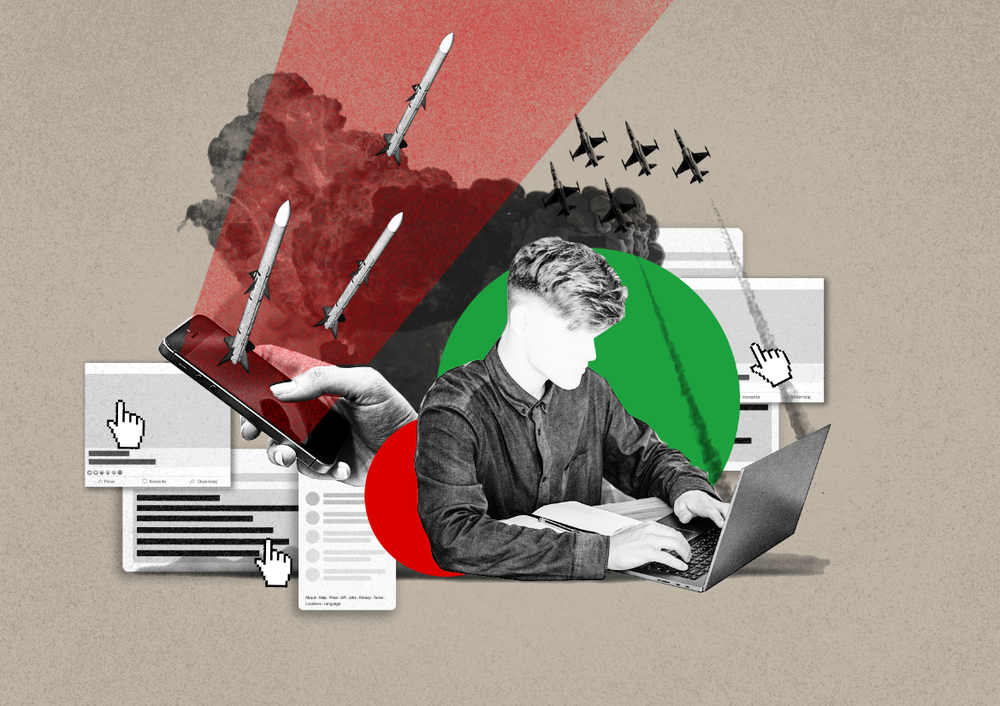
Exaggerating war headlines about super-missiles or bombs, often untrue or inaccurate, is not uncommon in Albanian online media that follow clicks. The recent war between the US and Israel against Iran, like previous clashes in Ukraine, has brought back these inflated headlines, often accompanied by fake videos produced with artificial intelligence, AI.
A BIRN survey of online media and social media posts found a dozen instances of AI-generated videos being shared, mostly as “illustrations” of Iranian strikes on Israel, but also vice versa. In addition to the false data, stories circulated on social media accompanied by images or videos from other past events, presented as actual bombings.
Online media in Albania have a tradition of copying material from social media without verification. A BIRN study on disinformation in the first months after Russia invaded Ukraine noted that the lack of editorial structures paved the way for false publications.
“Albanian media outlets generally have weak editorial structures, while editorial structures in newly created digital media outlets are almost non-existent, which explains the large amount of fake news that is translated and republished in them,” the report stressed.
The use of artificial intelligence has made the problem even more acute.
The conflict between Iran and the United States' alliance with Israel escalated in late February 2026, following a series of US-Israeli airstrikes on Iranian military bases and strategic facilities. Iran responded by bombing neighboring countries where US bases are located, spreading the conflict to other countries.
Artificial intelligence video
The escalation of the situation in the Middle East is being followed with dramatic notes and unverified information by the Albanian media.
“Iran has reportedly dropped thermobaric bombs that can hit areas up to 100 meters in one minute in Israel,” a portal wrote in a post shared on Facebook and Instagram. A video titled “Iran strikes with superbomb” was shared with the text and shows a giant explosion, which according to the text is in the port of Haifa in Israel. But the video was produced with artificial intelligence, using elements from the catastrophic explosion in the port of Beirut in 2020 and adding images that made it look current. The fake news was published by a Kosovo-based portal and a number of social media pages.
BIRN analyzed the video, which before reaching Albanian, was massively distributed on social networks in Turkish, Arabic and English, and found false elements that were distinguishable with the naked eye.
For example, cars on a two-lane road do not move and stand facing each other. Despite the giant explosion, a clothesline hanging on the balcony from which the footage is supposedly being filmed does not move despite the camera shaking from the force. Buildings that appear very close to the explosion do not suffer any damage. Meanwhile, checking the footage with open tools such as the “DEEPFAKE-O-METER” of the University of Buffalo in New York showed that the probability that the video was artificial was 96%.
Also, examination of the cut footage through image-examination software such as Forensically showed that parts of it had been copied over original material. For example, the Israeli flag seen in one part of the video flutters in the wind, but the rope or trees on it do not move. Examination with Forensically found that the flag had been edited, had a different visual quality, and had different lighting than the rest of the video.
The voices in the video, shouting in Hebrew, also sounded artificial.
The BBC, which exposed a series of videos and images produced in the same form, wrote 6 days ago that some of them were produced to earn money from views by social media users who have monetized their pages.
Iranian propaganda
The recent war between the US and Israel against Iran is seen by experts as an unjustified violation of international law, with serious consequences for the world order and thousands of casualties.
In this situation, AI-generated videos and images for clicks and material gain are not the only false information circulating. A good portion of the materials distributed on Albanian-language social networks, from sources that mainly share Tehran's propaganda, aim to propagate that Iran is winning the war or causing extraordinary damage to Israel, the US, or other neighboring states.
One of the distributors of these materials is historian Olsi Jazexhi, who, in addition to being present almost every night on television in Albania, is equally active on social networks where he occasionally shares pro-Iranian messages and "news" from Iranian attacks on Israel or American bases in the Middle East.
Jazexhi has a page with around 7 thousand followers, but the videos he posts receive hundreds of thousands of views and comments.
From February 28 to March 10, BIRN found at least seven posts claiming Iranian bombings against targets in Israel or US bases, which were either recycled material from old events in Ukraine or Israel or the products of artificial intelligence.
On the evening of February 28, Jazexhi published images that he claimed showed destruction at the US military base at Al Udeid in Qatar. The news was spread by a number of pro-Iranian sources, but was verified as false. Satellite images showed that the base had not been damaged.
Jazexhi also posted a video he claimed showed the destruction of an Israeli nuclear power plant. “Iran destroys Israeli nuclear power plant in Dimona,” he wrote. But a Google image search shows that the footage is from 2017 and shows an explosion at a weapons depot in Ukraine.
On March 3, he released a video, widely accepted as an artificial intelligence creation, that claimed to be a hail of rockets raining down on Tel Aviv. The video has 35,000 views.
Other posts are mostly images and photos taken out of context and time. An Iranian bombing that destroyed an apartment complex in Tel Aviv in June 2025 was presented as a March 4 event and received 115,000 views. A speech by a controversial American Protestant pastor, known for supporting US President Trump, that went viral in 2020 with no connection to the conflict was presented by Jazexhi as if she was praying for an attack on Iran.
In parallel, the online site called Dovleti i Naltsum, which mainly distributes messages in favor of Turkey and Turkish President Recep Tayyip Erdogan, has also published a series of fake images and videos from the conflict, including images of a possible bombing of the Burj Khalifa. The site regularly publishes materials produced with artificial intelligence that receive thousands of views. A video posted on Wednesday, March 11, which according to the poster shows American soldiers being captured and where the defects left by the AI are clearly visible, was shared 20 times and has over 15 thousand views. / Birn