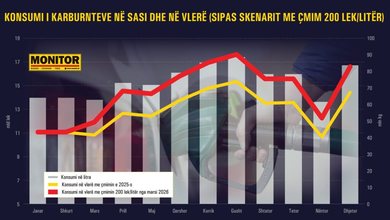



Fuel consumption in the country has seen continuous growth in recent years, influenced both by the increase in the number of vehicles in circulation and by tourism.
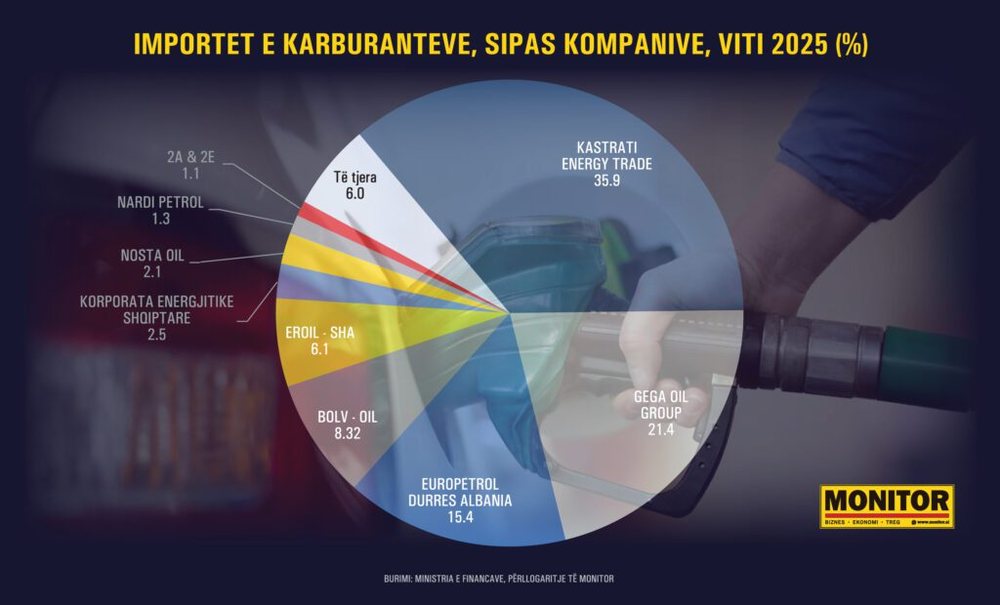
In 2025, a record of about 740 thousand tons of fuel were imported, according to the Ministry of Finance, with a 13% increase compared to 2024 and 85% more than in 2019.
But which companies supply the fuel that supplies over 1 million cars in circulation in the country?
According to detailed data from Customs, in 2025 there were 250 fuel companies that traded diesel wholesale (wholesale imports are carried out by joint-stock companies and retail trade by limited liability companies).
The largest player in the market is "Kastrati Energy Trade", which imported 265 thousand tons, or almost 36% of the total.
In second place is "Gega Oil", which imported 158 thousand tons or 21.4% of the total.
The third is "Europetrol Durrës Albania", with the brand "Eida", with 114 thousand tons, or 15.4% of the total.
These three operators accounted for 72.7% of total imports in 2025.
The fourth is "Bolv Oil", with 61 thousand tons of imports, or 8.3% of the total.
In the retail market, the dominance of large companies is much lower. According to data from the Association of Hydrocarbon Companies, out of about 1,400 gas stations in the country, 34% of them are owned by the top 3 wholesalers (Kastrati, Europetrol and Gega).
According to the Association, not only is there no monopoly or oligopoly in the market, but there are more operators than necessary, as by dividing such a small market into many hands, costs increase on average and consequently prices increase by 12 lek per liter due to operating expenses.
The increase in the price of oil on the stock exchange, which has exceeded $100 per barrel, following the start of the conflict in the Middle East, has caused oil in Albania to reach almost 200 lek per liter in the retail market.
Oil prices rise again, retail price reaches around 200 lek per liter; Increases by 6 lek
A few days ago, Prime Minister Rama announced that one of the government's objectives is to create a state factor in the oil market, a public force to create a capacity to ease the burden on citizens.
"We will create the public factor, we will introduce the power of the state into the oil market and we will deliver very soon. By making the state's capacity and guarantee available, it will become much easier to have agreements with companies that distribute oil to have long-term sustainability," the prime minister said.
The Hydrocarbons Association says that even if the State Entity is created, both the purchase price on international exchanges and taxes and other costs will be the same!
The Hydrocarbons Association says that the main reason for the high price is related to taxes paid on oil, which are currently over 100 lek per liter, making up half of the price.
According to the Association, if oil is purchased today, the price, including only the cost of purchase on the stock exchange and the main taxes (excise duty, turnover tax, carbon tax and VAT), is almost 189 lek per liter.
This does not include the profit rate, local taxes, labor costs, transportation from warehouses to the network, energy, legal fees, depreciation, bank loans, etc. For a gas station that sells 1,500 liters per day, the cost from tariffs and other taxes is 5.4 lek per liter. Adding salaries, insurance, electricity, the added cost is 18.8 lek per liter, bringing the price, excluding the profit rate, to about 208 lek per liter.
According to the Association, the increased price has clearly not yet been transferred to the points, as companies are still exploiting their position in the network. Furthermore, the Association says, even for oil that was purchased earlier at a lower price, taxes are calculated based on the Platts price on the day the oil is released to the market.
Asked if there are price abuses, Luigj Aliaj from the Association of Hydrocarbon Companies says: "I invite all those who pretend to be concerned about consumers to stop propaganda, as it is not fair to gain popularity by exploiting a crisis situation. First, I invite them to come to the wholesalers' warehouses to exercise control and if they find fuel with locked prices, first request its confiscation and then let them put it on the market for free. Second, to see if the price is reflected every day according to the international market and taxes. Third, to take the trouble to find out the cost of a liter of diesel from the exit of the free warehouse to the consumer and here it will be understood that many have no idea how the cost is calculated. So anyone who really wants to protect the public interest should honestly replace opinion with fact. I have no medicine for manipulators", says Aliaj./Monitor