


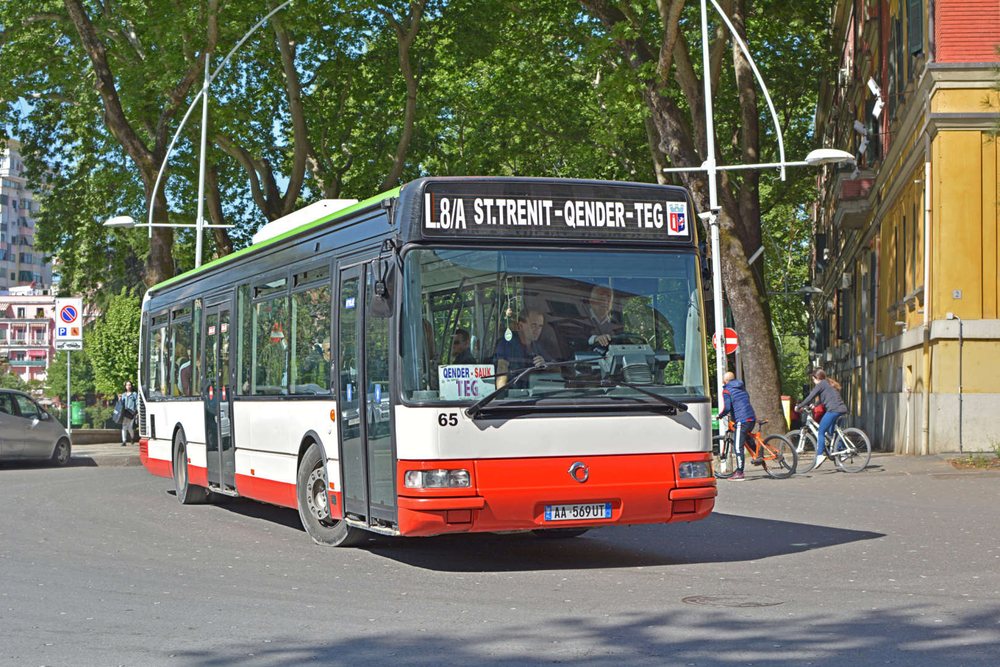
For the worst public transportation in Europe, Tirana is surpassed only by Rome, but unlike the latter, we do not have a metro, trams, or urban trains.
So while residents and tourists in the Italian capital have choices when buses are delayed, in Tirana, in addition to public transportation, you can use expensive taxis, or choose to walk.
The European Commission's Survey on the Quality of Life in European Cities asked over 71,000 people in 83 cities to rate their transport systems based on five key factors: affordability, safety, ease of use, frequency and reliability.
Public transport plays a major role in the level of satisfaction people feel with their life in a city. While some capital cities excel, others lag behind, showing a stark divide in how public transport serves residents across Europe, writes MSN.
According to the survey, only 29% of citizens in Rome are satisfied with public transport. Rome's metro system is limited for a capital city, with only three lines. While ground transport (cars, buses, trains) is often delayed due to traffic and strikes, contributing to this low level of satisfaction.
Rome has several types of public transport, including the metro, buses, trams and urban/regional trains. These together cover most of the city and are used for daily travel by residents and tourists.
Even in the Albanian capital, only 29% of citizens are satisfied with public transportation.
"Tirana has no metro or tram service and the existing bus system is often overcrowded and difficult to navigate. Infrastructure development is sorely needed."
According to Eurostat, Albania ranks among the countries with the highest number of buses per capita in Europe, but this is not a sign of a developed public transport, but a lack of other public transport alternatives. When it comes to fleet renewal , Albania remains below the European Union average, making bus modernization an urgent need.
According to Eurostat, out of 8,886 urban buses, intercity buses and electric buses in total in 2024, only 432 are new vehicles, representing about 4.9% of the fleet, below the EU average of 5.1%.
To conclude the top 5 capitals with the worst transportation in Europe, after Tirana, Podgorica, Belgrade, and Nicosia are ranked.
In Podgorica, only 37% of citizens are satisfied with public transportation.
The capital of Montenegro has no urban rail system and only a small, irregular bus network. Although served by intercity trains, use of local public transport is minimal, as most residents choose to walk or use cars.
In the Serbian capital, Belgrade, and in Nicosia, the capital of Cyprus, satisfaction reaches 44%.
"Belgrade has an extensive bus and tram system, but it is outdated and the city has no metro. The long-planned metro is still in the early stages of construction."
"Nicosia has no tram or metro system and relies entirely on buses. Service is limited and high car ownership affects the overall level of satisfaction."
Which capital city in Europe is most satisfied with public transportation?
Vienna's public transport is known for its punctuality, cleanliness and good integration. The U-Bahn (metro), trams and buses are affordable and well-connected, making it easy to move around the Austrian capital efficiently./Monitor