


The debate over social media manipulation in Albania has entered a new phase. In the face of weeks of protests, Prime Minister Edi Rama has chosen to publicly address the issue of fake profiles and the influence of algorithms, while a BIRN investigation raises allegations that at the same time there is a coordinated mechanism in favor of the government.
The paradox is obvious.
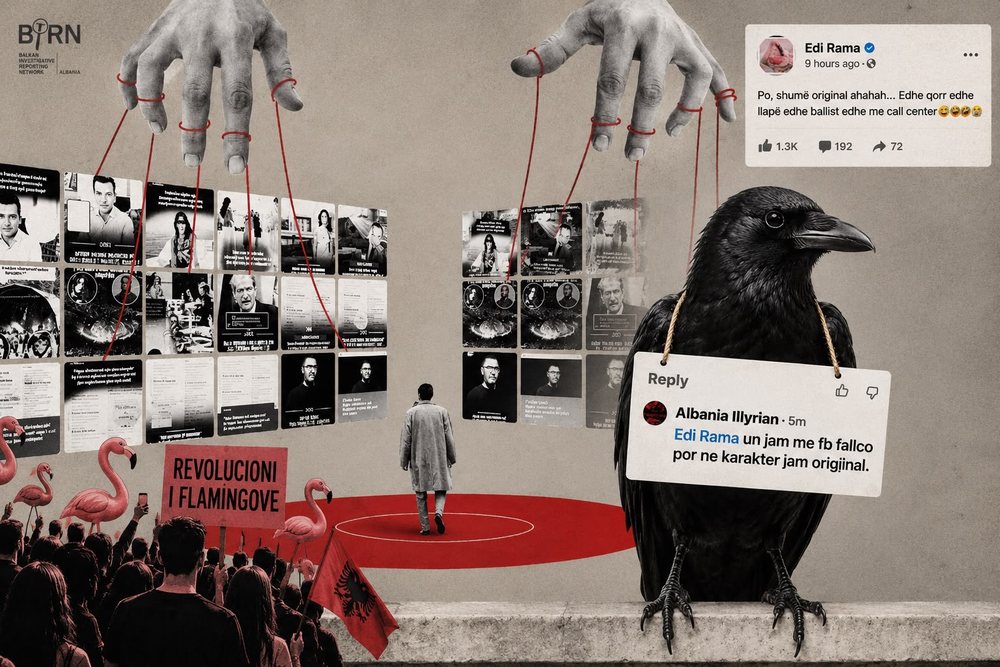
On the one hand, Rama mocks anonymous social media users. In his most recent reaction to a commenter with a fake profile, he responded with a photomontage of a raven and the comment: “Both blind, and a scoundrel, and a ballist, and with a call center.” This is not an isolated episode. For days now, he has been publishing profiles that he considers fake and has not hidden his cynicism towards two small parties, Agron Shehaj’s Mundësia Party and Arlind Qori’s Lëvizja Bashkë, which he has politically linked to the protest.
On the other hand, BIRN’s investigation presents a completely different picture. The article continues to use the term “Flamingo Revolution”, a term that was first spread by Reporter.al/BIRN and later widely adopted by international media. At the same time, it presents Agron Shehaj and Arlind Qori as figures who, according to the investigation, have been targeted by fake profiles due to their support for the protest.
According to data published by BIRN, hundreds of new profiles have been created on Facebook and Instagram during the weeks of protests, which are synchronously sharing content in support of the government and attacks on protesters. The article cites information technology experts and former administration employees, linking this phenomenon to what is known in the international literature as “coordinated inauthentic behavior.”
On the other hand, the Prime Minister's Office has categorically denied these claims, stating that there is no administration coordination for fake profiles or campaigns organized on social networks.
In the end, the issue is not just whether fake profiles exist. Today, few doubt that they are used by various political actors around the world.
The paradox is that both sides seem to fall into the same perception: each sees the algorithm as the opponent's weapon. The prime minister denounces fake profiles that, according to him, fuel the protest, while BIRN's investigation argues that a similar mechanism works in favor of the government and against the protest.
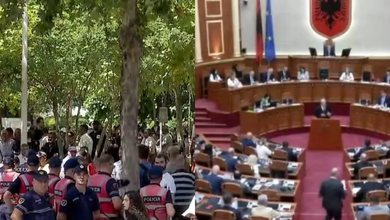
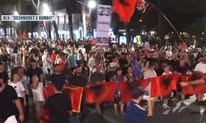
The truth is that the political battle no longer takes place only in the square or in Parliament. It has moved to a much less visible, but much more powerful space: social media algorithms. Today, influence is not measured only by the number of protesters or votes in Parliament, but also by the ability to dominate the narrative in the digital space.
In this sense, the greatest paradox is that while each side accuses the other of manipulating the algorithm, both acknowledge, indirectly, that the decisive arena of political conflict is no longer the square, but the phone screen. This is perhaps the only truth they agree on, without publicly admitting it.