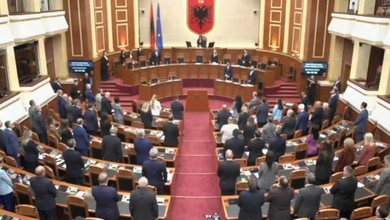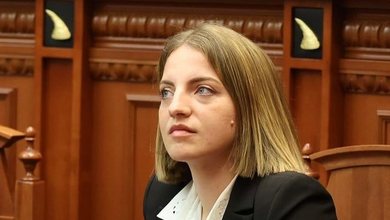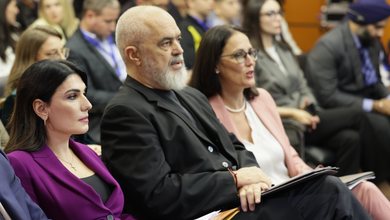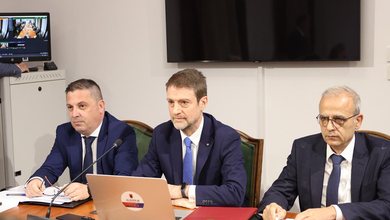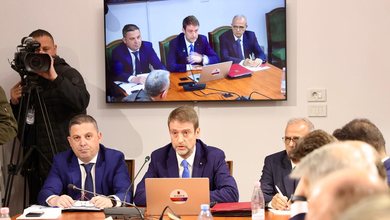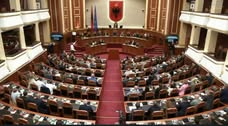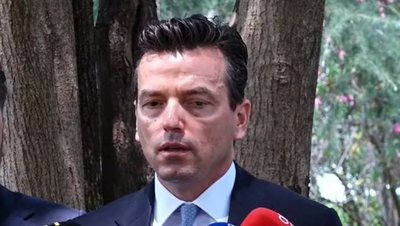


Foreign Minister Ferit Hoxha provided clarifications in Parliament on Monday on the progress of the integration process, assessing that the position of EU countries on this progress did not have a 'time limit'. Hoxha defended the idea proposed by Rama-Vučić for a conditional membership, but said it had had no impact.
The progress of Albania's accession process to the European Union appears to be at a standstill, while a decision is expected from member states to assess the reforms so far, a mechanism known as the Interim Standards Assessment Report (IBAR) or a kind of 'interim test' for the progress of the negotiations.
Minister for Europe and Foreign Affairs Ferit Hoxha said that the adoption of IBAR had no set deadlines, but he opposed the opposition's stance on blocking the integration process.
"There is no time limit," he said, adding that "there has never been a time when IBAR for Albania had to be completed in 6 weeks, otherwise Albania is behind schedule, it could take another 6 years."
According to the minister, "this exercise is being carried out for the first time by the EU and with this methodology for Albania, a standard will be set for other countries."
According to Hoxha, the reforms undertaken by Albania within the framework of the joint plan with the EU and the responses to dozens of identified gaps have been accepted by the European Commission in the report submitted to the Council.
Hoxha, elected minister two months ago, was met with criticism from opposition MPs for the lack of transparency and coherence of government institutions in the integration process and the blockage of this process with the rejection by the majority of the request of the Special Prosecution Office, SPAK, for the arrest of former Deputy Prime Minister Belinda Balluku.
Freedom Party MP Edmond Haxhinasto said there was a lack of transparency from the government about the process.
"The critical conditions and problems that exist today should be discussed here and not hidden," he addressed Hoxha, adding that "we have deteriorating indices of Albania's standards that do not allow you to be optimistic that we have fulfilled our tasks."
MP Erald Kapri from the "Mundësia" party also said that the progress of the process was being undermined by the ruling majority itself. "Blocking SPAK will have a cost for integration," he said, adding that reforms directly related to benefits for citizens, such as property registration, had not yet been implemented.
Opposition MPs also criticized Prime Minister Edi Rama's role in foreign policy as a protagonism that contradicted the official line of Albanian institutions and the integration strategy, citing as an example his joint article with Serbian President Aleksandar Vučić in the German newspaper "Frankfurter Allgemeine Zeitung", where they proposed a membership mechanism without veto rights for their countries.
"If a prime minister presents the concept of a new integration strategy, he should consult with the sovereign institutions of the countries and with the main EU states," said Haxhinasto.
Meanwhile, according to Democratic Party MP Tomor Alizoti, the article contradicted Albanian-Serbian bilateral relations.
"Albania cannot ignore Kosovo in its relations with Serbia. This is a fundamental national problem and we need to discuss it here and we are discussing it in very calm tones," he said, among other things.
The Foreign Minister defended the Rama-Vučić article as a political idea that was made public in a certain context of the geopolitics of the European Union and that did not undermine the strategy of full membership.
"This is not about giving up or relativizing, but rather proposing a more flexible path..." he said, among other things.
As for the opposition's concern about why the Albanian prime minister had joined the Serbian prime minister in this initiative, given the conflict over Kosovo, Hoxha insisted that this did not change Albania's positions towards Serbia over Kosovo, nor did it quell the countries' clashes over this issue.
"It should not be interpreted as a project or alliance. This idea shows that the countries of the region, despite their deep approaches, especially to Kosovo, manage to find common ground and show pragmatism and political maturity," the minister argued.
On the other hand, Hoxha stressed that the Rama-Vučić proposal had no impact on the integration process and was not taken into account by European institutions. /BIRN/