



By Muriel
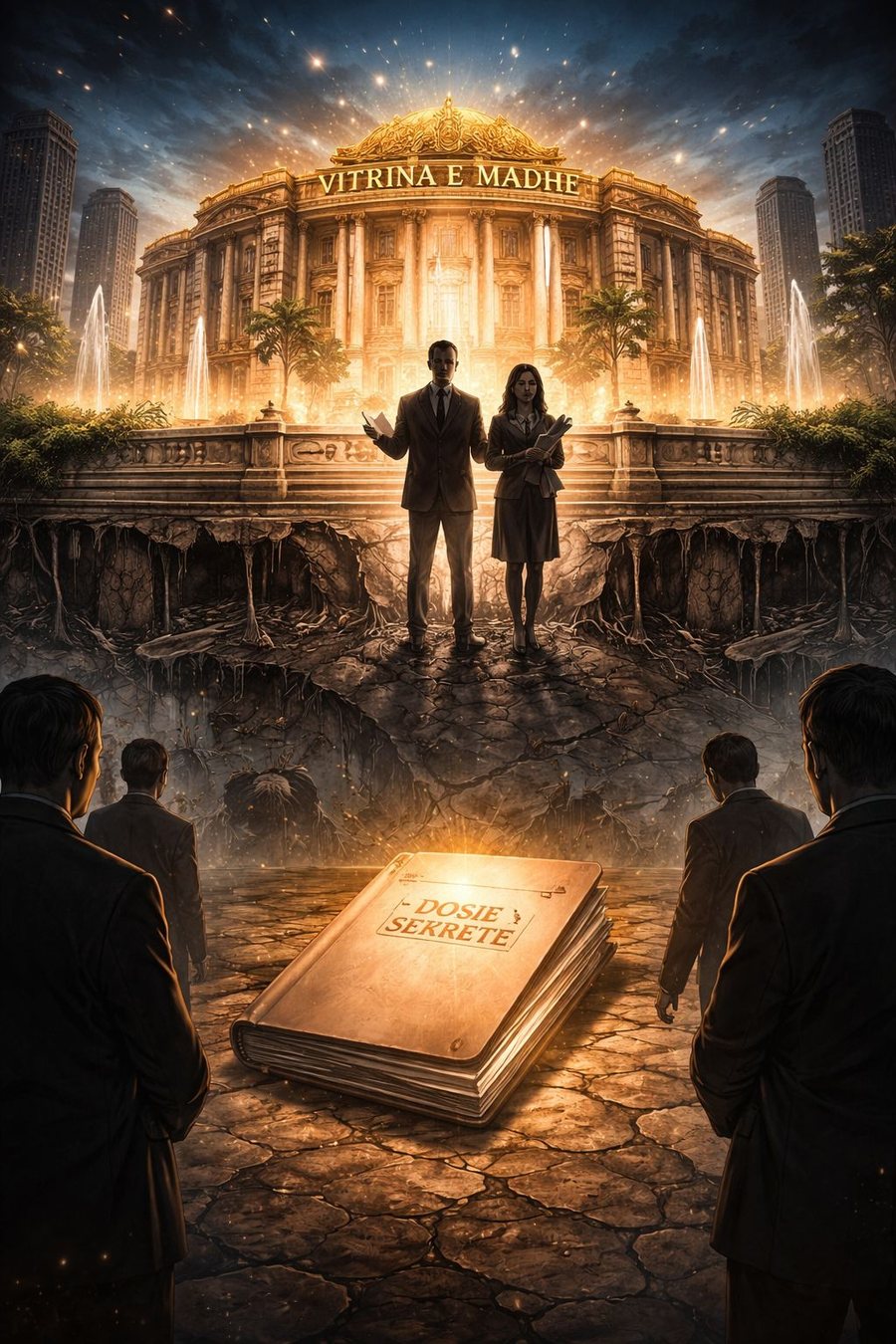
It is said that once upon a time, a long time ago, but also surprisingly very close to today, there existed a city called Vitrina e Madhe.
The elders said that the city was built on a single rule:
everything had to look beautiful, even when it was rotten.
In the Great Showcase, houses were often painted, but the foundations were never touched.
Roads were opened with ceremony, but closed with potholes.
Words were clean, but hands often were not.
At the head of the city ruled a man who did not call himself King.
Kingship, he said, was an old word.
He called himself the Builder of Dreams.
The builder spoke beautifully. So beautifully, that many people forgot to look around.
At his side was always the Lady of Roads and Stones, who opened roads, tunnels and bridges, and with each step said:
"The work is progressing."
And the people shook their heads.
Until one day, something was found in the city that had no voice but had weight:
a thick file.
There was no poetry in it.
There were no promises.
Just signatures, dates, and names.
The Dream Builder came out to the city and spoke at length, as he knew how.
He said it was all a misunderstanding.
He said it would be cleared up.
He said time would tell.
But the elders shook their heads differently.
They said,
"We have heard this tale before.
When the king talks a lot, the letters usually speak louder."
And so, generation after generation, a simple lesson was passed down:
You can lie to people for a while.
You can beautify the city for a few years.
You can build towers, bridges, and speeches.
But when the file comes out,
the tale ends.
At the end of the story, which was whispered today as yesterday:
The Builder of Dreams is called Edi Rama.
The Lady of Roads and Stones is called Belinda Balluku.
And the moral that children learn early:
Don't trust those who sell you light
when the window is closed.
Because justice comes slowly,
but when it comes,
you no longer hear fairy tales.