


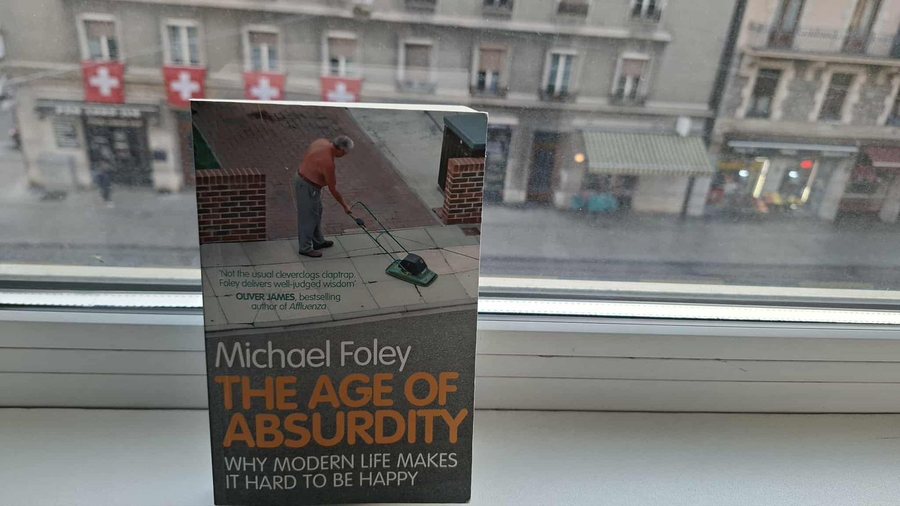
This week, expert Linda Baleta brings to the reader a profound reflection on the pace of change and modern absurdity, inspired by the book "The Age of Absurdity" by Michael Foley.
The pace of change in a world that spins without stopping
“The drive to make everything weightless is robbing us of the fundamental certainty of substance.”
— The Age of Absurdity, Michael Foley
What do we call it when the ground beneath our feet keeps slipping, but everyone around us insists we can walk straight without losing our balance? I pondered this question while reading Michael Foley's The Age of Absurdity, a book that aims to comfort you, despite its subtle humor. Instead, the book calmly names the absurd modern conditions that we have come to agree to call normal, including in our workplaces.
Change, constant change, even change for the sake of change, is one of these conditions. We talk about change so often that the word has lost its pulse. Transformation, transition, adaptation, terms that are thrown into the air to give the moment a flavor of optimism. But it is difficult to feel optimism when fatigue and uncertainty are constricting your throat.
Change comes like the weather: uninvited, uninterested in whether we are ready. It is up to us to absorb it, adapt to it, endure it, and move on, as a test of loyalty. In this age obsessed with quick fixes, easy interfaces, and demands to adapt in the blink of an eye, even change seems to have been reimagined to be experienced as light, weightless. No hassle, no friction. Just a few adjustments here and there, and everything will be fine. Theoretically.
But real change is not easy. It has dimensions, it requires carrying, and it has consequences. This is the new absurdity: not that change happens, but that we are expected to behave as if it happens without cost. We talk about embracing change at work, but what we really mean is: please embrace this without asking too many questions, without reminding us that you are made of feelings, not modular parts.
In our desire to make everything “user-friendly,” we have flattened the experience. Depth is made optional, context is discarded as unnecessary. The search for meaning is often seen as an inconvenience. We want change to be easy, immediate, and unanimously welcomed, a frictionless transition to a future that no one has had time to emotionally absorb.
If change is always easy, then nothing anchors us or transforms us. Weight is not the enemy, but rather evidence that something real is happening. We rarely acknowledge that change should be difficult, forcing us to rethink, to challenge, to question what we are leaving behind and where we are entering. When change is communicated as if it were simply a positive message, we are denied the ability to experience it honestly. We become actors of resistance, but not participants in resilience.
Foli writes: “Surrender to the task, but not to the task giver.” There is hope in this distinction. Even permission. Perhaps it is possible to adapt without erasing who we were before the announcement came. Perhaps our job is not to become fluent in every newly invented vocabulary, but to remain fluent in our very essence.
The time of absurdity gives you space for truths that feel uncomfortable to say out loud. That change is not always growth. That movement is not always progress. And that sometimes, the bravest and most honest sentence is this:
I am trying to remain human in a world that constantly asks me to hurry. And for now, maybe that is enough.