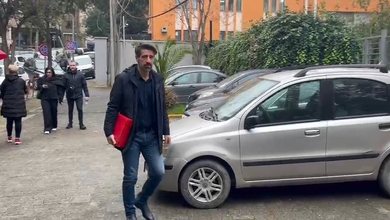
After six years of waiting, a group of people gathered on Thursday in front of the gate of the “Lasgush Poradeci” school in Kombinat. With their hands clutching application papers, nervous and gripped by anxiety, they keep their eyes on the official who reads the names one by one.
His voice rings out amidst the noise and the bodies pushing to get as close as possible to the gate.
As the list goes on, the residents of Kombinat hover between fear and hope, between what they can gain and everything they have lost during their years as homeless.
On December 4, the next draw was held for the 80 residents waiting to receive a house from the Reconstruction program, six years after the November 26, 2019 earthquake destroyed their homes.
The government has spent over 130 billion lek on the Reconstruction program and claims that over 90 percent of the projects have been completed, but hundreds of families are still left stranded. According to experts, this is the result of a process dominated by delays, lack of transparency and abuses.
Urban planner Doriana Musai attributes the delays to poorly planned and irregular reconstruction programs. According to her, the natural disaster was also misused for other purposes.
"Within a two-week period, without even burying the dead, we began to think about how to get through this moment. Such a quick, unstudied reaction led to the production of many acts, documents and VKMs, which over time, now after six years, have proven to be totally fictitious," Musai told BIRN.
"We have areas that were declared reconstruction zones without any connection to earthquake damage. One of them is the Kombinati and 5 Maji neighborhoods in Tirana, where it has been noted that reconstruction was used as an excuse to demolish buildings and build new structures, which are still either uninhabited or unbuilt today," she added.
In Kombinat, a group of residents rejected the decision of state authorities to demolish their buildings and took the case to court. Of the 67 buildings declared uninhabitable by the institutions, only 35 were demolished. In 22 cases, the citizens won the battle with the institutions and their buildings were not demolished, while most of them are still looking for a solution.
Edmond Çata, a resident of Kombinat, says that both categories of residents are already facing problems.
"If you have a building that is standing and you stayed or if you are waiting to get a new apartment, it is not clear and there is no transparency about how people affected by the earthquake are managed. Because I know, for example, that people who live in buildings that are standing and there are no decisions to demolish them, have been invited to take and have taken apartments in the new buildings," he said.
According to Çata, those who fought to keep the buildings from being demolished are now facing a lack of services, areas left to the mercy of nature, and concerns about the physical condition of the buildings.
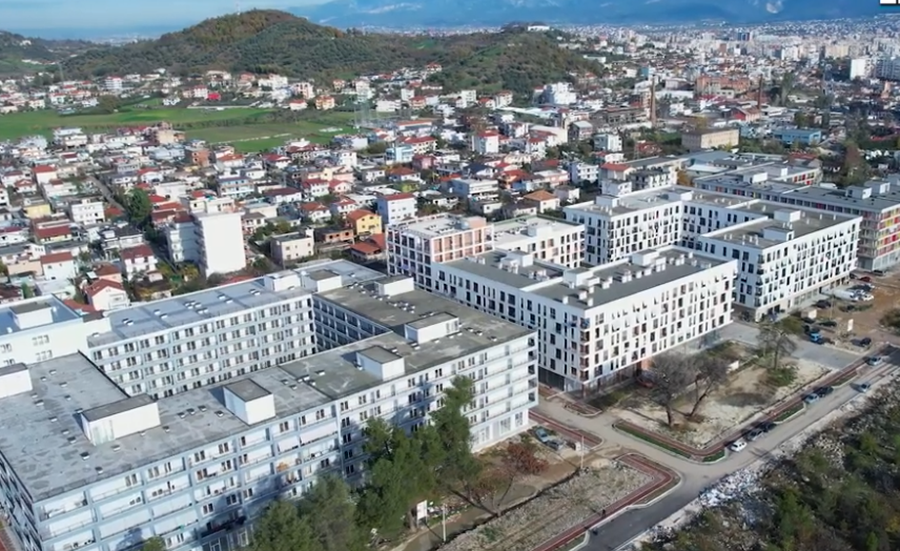
In this housing complex in Kombinat, many of the apartments are uninhabited, because the buildings are still unlicensed and there are problems with water, electricity and sewage. The situation is similar in the "5 maji" neighborhood, where some of the residents have refused to submit to the municipality's housing conditions and have rejected the spaces offered.
"Over time, some of the residents managed to get a minimal surface area, the rest are still roaming around Tirana today. This is because, firstly, the buildings were not built, and secondly, there was no agreement between the local government and the residents themselves regarding the surface area," stressed Musai.
Some residents, according to her, are unhappy with the areas they have taken, as they used to have 3-4-story buildings where three or four families lived together.
Expert Zef Preçi, director of the Albanian Center for Economic Research, criticizes the lack of transparency with the Reconstruction program, while emphasizing that the abuse of funds has left a significant portion of residents homeless.
“It was done in conditions of lack of transparency, mainly in contracts negotiated directly with the involvement of mayors, with a coordinating role but without a written letter from the minister responsible for Reconstruction, but which essentially leads to the diversion of public funds or the impairment of the quality of construction,” Preçi told BIRN.
"Some of the constructions resemble ghettos, they resemble Gaza much more than housing built with public money," he added.
The delays are not only found in Kombinat or the 5 Maji Neighborhood, but also in other areas damaged by the earthquake. In the Municipality of Vora, around 160 families are still waiting for a solution for the promised housing. The Municipality of Vora told BIRN that it was awaiting funds from the Ministry of Infrastructure and the Albanian Development Fund.
In Marqinet, just a few kilometers from Tirana, 70 families continue to live in rented accommodation, while the government has stopped the bonus for two years. Another 50 families are waiting for funds to build private houses in Vora, Preza and Bërxullë, as well as another 60 families who need to be housed in apartments, but they are still unfinished.
In the middle of Durrës, the city most damaged by the earthquake, a group of buildings declared uninhabitable still stand. The apartments are abandoned or have become havens for illegal activities.
But even in the blocks where construction has been completed, experts note poor quality and other infrastructure problems.
"Small residential blocks in miniature, which look more like temporary neighborhoods where people are temporarily settled, where the spaces do not exceed 50 or 60 square meters. They look more like beach cabins than permanent neighborhoods," said urban planner Musai, while emphasizing that some residents do not accept to live there due to displacement from the territory.
"In the reconstruction process, funds were diverted for the widely suspected illegal enrichment of officials responsible for low-quality constructions, some of which were uninhabitable. For constructions that are not harmonized with the infrastructure, especially with the sewage network and water supplies, etc., as in the case of Fushë-Krujë," said Preçi.
Six years after the earthquake, the Ministry of Infrastructure or other institutions still do not have a clear balance sheet for reconstruction, despite billions of lek spent. /BIRN/