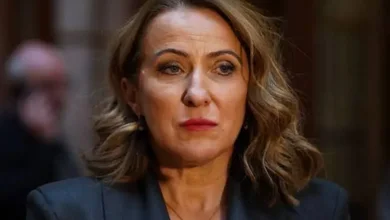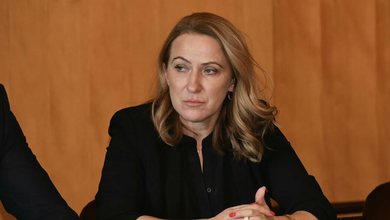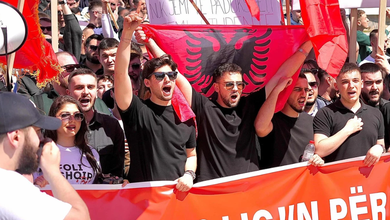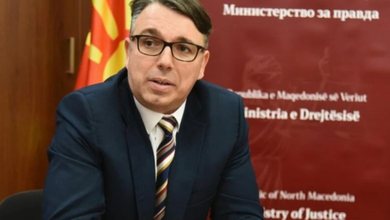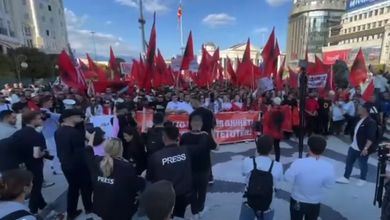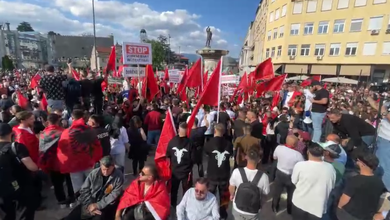


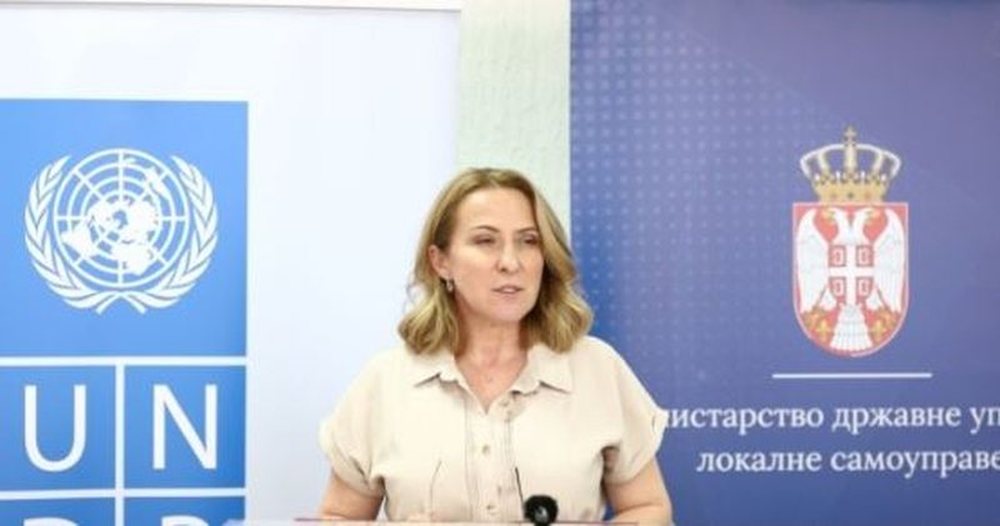
Kosovo has declared Serbian Minister Snezhana Paunovic an "undesirable" person and has permanently banned her from entering or transiting the country, after she said days ago that she would have "ethnically cleansed Kosovo" in 1998, Kosovo's acting Interior Minister, Xhelal Sveçla, announced on Tuesday.
Svečla announced late Tuesday on Facebook that he had signed the decision to permanently ban the Serbian Minister of Public Administration and Local Self-Government from entering or transiting Kosovo.
He said that with her statements, Paunović has "re-emphasized what Serbia has never given up on, the project of ethnic cleansing of Albanians."
"In our era, this was attempted by its former boss Slobodan Milosevic, also known as the Butcher of the Balkans," Sveçla wrote.
He added that "any attempt to revive ideologies of ethnic cleansing or to threaten the Republic of Kosovo will be met with a firm, legal and institutional response."
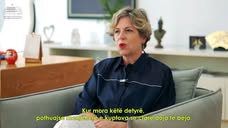
Paunovic declared on Saturday to Serbian television Kurir that, if he had been in Milosevic's place in 1998, he "would have ethnically cleansed Kosovo" - prompting reactions and condemnations in Kosovo and beyond.
Milosevic was president of the Federal Republic of Yugoslavia and indicted by the Hague Tribunal for war crimes.
"This is the harshest statement I have ever made in my life," Paunovic said.
She said that "she would not have liquidated the Albanians in the way they are trying to ethnically cleanse Kosovo, but in such a way that anyone who felt less of a citizen of the Federal Republic of Yugoslavia would leave and go to their mother country."
In another reaction on Tuesday, Paunović said he is not giving up on the politics of the Socialist Party of Serbia – of which he has been a part since 1992.
"We are the party that led Serbia in extremely difficult historical circumstances, the party that made great sacrifices – whose name was mentioned the most in The Hague," she wrote on social media.
Her statements were condemned both in the European Union and in Kosovo.
European Commission spokeswoman Anitta Hipper said the EU does not comment on individual statements, but stressed that there is no place in Europe for rhetoric that justifies or promotes ethnic cleansing.
"Such statements contradict the values of human dignity, reconciliation, accountability and good neighborly relations, on which the European Union is built," Hipper said, addressing reporters in Brussels.
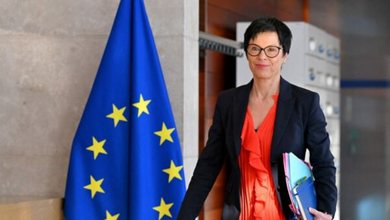
EU Enlargement Commissioner Marta Kos reacted similarly, saying she was shocked by Minister Paunović's statement.
She expressed the hope that this is an individual position, and not the position of the entire Government of Serbia.
"There can only be zero tolerance for such statements. There is no place in Europe for rhetoric that justifies, promotes or glorifies ethnic cleansing. Personally, I am truly horrified that at this time we still have to talk about such things," Kos said at a press conference.
Acting Deputy Prime Minister and Acting Foreign Minister, Glauk Konjufca, wrote in X that "such rhetoric glorifies war crimes, threatens regional stability and is completely contrary to European values, as well as the European future."
"Silence is not an option. Neither are weak responses," he added.
Belgzim Kamberi, from the Musine Kokalari Institute for Social Policy in Pristina, told Radio Free Europe that Minister Paunovic's statement shows the lack of a genuine confrontation with the past and, at the same time, speaks about current politics, and "perhaps even about her goals in the future."
"When ethnic cleansing is presented as a legitimate or desirable political solution, then it is no longer just about the interpretation of the past, but about a system of values and a political ideology," he says.
Kamberi estimates that if Paunović is not dismissed from office, the government in Serbia is proving that it does not want normalization of relations and reconciliation with Kosovo.
Even the director of the Center for Practical Politics in Serbia, Dragan Popović, believes that Paunović's statement has only "exposed" reality.
According to him, the authorities in Serbia have not given up on the policies of the '90s.
"The government celebrates the generals convicted by the Hague Tribunal and proclaims them heroes," Popovic tells Radio Free Europe.
During the war in Kosovo, in 1998-1999, over 13,000 civilians, mostly Albanians, were killed, while thousands more disappeared.
Over 1,500 people, mostly Albanians, continue to be missing.
Thousands of bodies were found over the years in mass graves in Serbia.
The International Criminal Tribunal for the Former Yugoslavia in The Hague identified the then leaders of the FRY as key participants in a “joint criminal enterprise” aimed at the forcible expulsion of hundreds of thousands of Albanian civilians from Kosovo from March to June 1999.
According to the verdicts, the goal was to “change the ethnic balance to maintain Serbian control over Kosovo.”
The main defendant, Slobodan Milosevic, died in custody before the trial ended, while former Serbian President Milan Milutinovic was found not guilty./REL