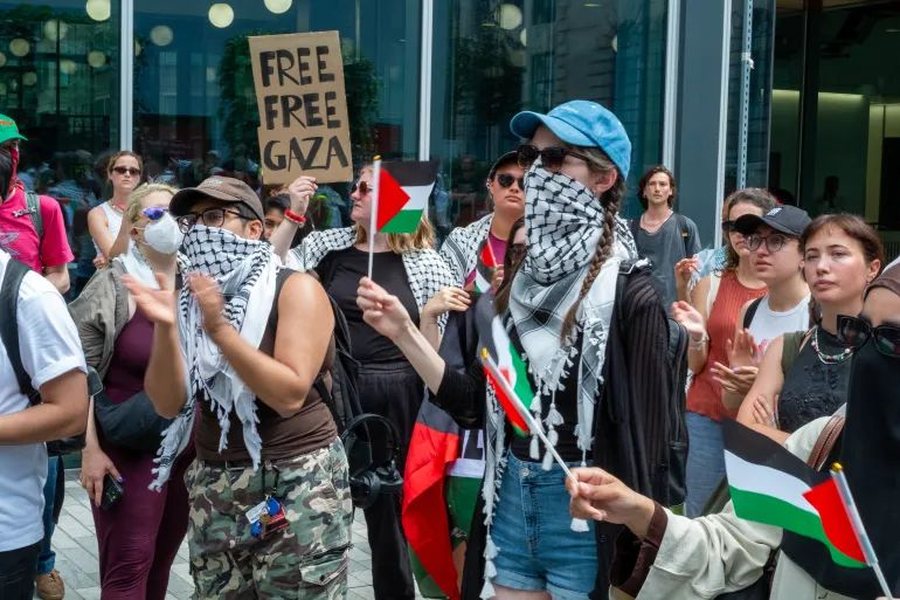
An investigation has revealed that 12 British universities paid a private security company, run by former military intelligence officers, to monitor protesting students and academics who have expressed solidarity with Palestine.
A joint investigation by Al Jazeera English and Liberty Investigates revealed that Horus Security Consultancy Limited monitored students' social media activity and conducted secret terrorist threat assessments on behalf of some of Britain's most prestigious universities.
According to internal documents, among the people monitored were a Palestinian academic invited to give a lecture at Manchester Metropolitan University and a pro-Gaza doctoral student at the London School of Economics (LSE).
The Horus company, which describes itself as a "leading intelligence" firm, has received at least £440,000 from British universities since 2022 for these services.
In October 2024, the University of Bristol sent the company a list of student groups it wanted notifications and monitoring for, which included pro-Palestinian activists and animal rights activists.
In total, 12 universities have paid the company to monitor protest activity on campus, including the University of Oxford, Imperial College London, University College London (UCL), King's College London, University of Sheffield, University of Leicester, University of Nottingham and Cardiff Metropolitan University.
There is no evidence that this activity is illegal.
These revelations came to light after Al Jazeera and Liberty Investigates sent public information requests to more than 150 universities in the UK.
Some universities have denied that it is conducting student surveillance. For example, Imperial College London said it uses Horus services only to identify potential security risks in the university community and that the information used comes from public sources.
Meanwhile, the University of Sheffield stated that it uses external services to monitor developments that may affect the university, such as major protests, and that this is not intended to hinder student activism.
However, experts and human rights organizations have expressed serious concerns. Gina Romero, the UN special rapporteur on freedom of peaceful assembly, said that using artificial intelligence to collect and analyze student data in this way raises deep legal concerns, as it could lead to the collection of vast amounts of data without public oversight.
According to her, this practice has created a "state of fear" among student activists in Britain, causing psychological trauma and mental fatigue in many of them.
One of the monitored students, Lizzie Hobbs, part of the pro-Palestine protests at LSE in 2024, said she was shocked to learn that her social media posts had been included in the company's reports.
"We knew there was some surveillance by the university, but it's shocking to see how systematized it is," she said.
Horus, founded in 2006 by former military intelligence officer Jonathan Whiteley, did not respond to Al Jazeera's questions about the matter. On its official website, it states that it always acts in accordance with the law and with the highest ethical standards.