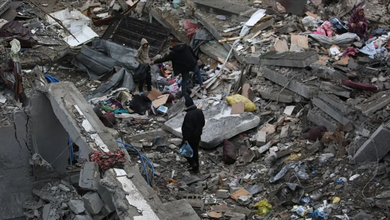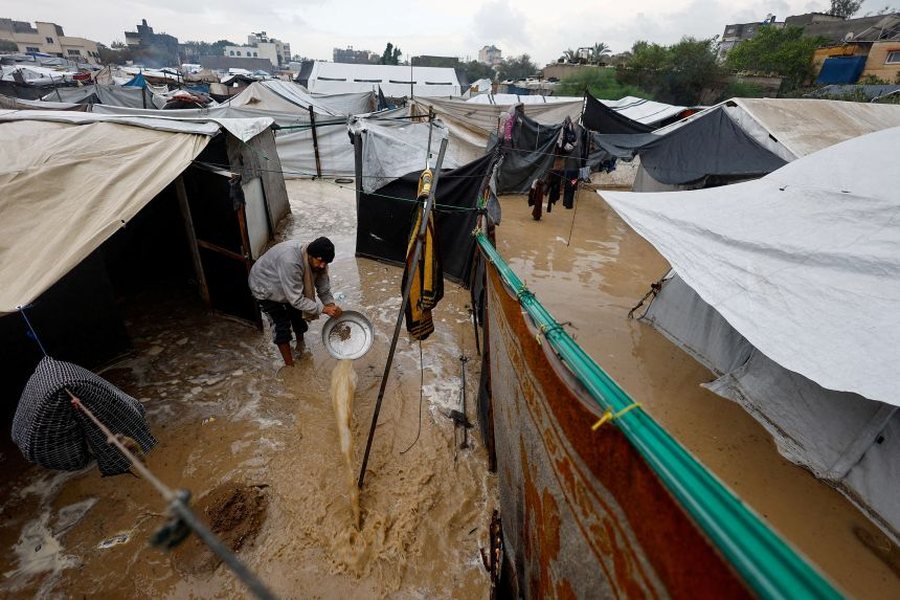
A heavy rainstorm swept through the Gaza Strip, flooding hundreds of tents, collapsing homes housing families displaced by more than two years of war and killing at least six people.
Doctors announced that five people, including two women and a girl, lost their lives after their homes collapsed near the beach in Gaza City, while a one-year-old boy died from extreme cold in a tent in Deir al-Balah, in central Gaza.
Tents were torn from their poles, some of which were blown dozens of meters by the wind before crashing to the ground. Others were destroyed and submerged in mud puddles as families rushed to salvage their most essential belongings.
Residents tried to rebuild the remaining shelters, re-stabbing loose pegs and placing sandbags around the edges to prevent floodwaters from entering.
"We didn't realize what was happening until the wall started to collapse, an eight-meter-high wall, a solid concrete wall. Because of the speed and strength of the wind, the wall fell on us, on three tents," said Bassel Hamuda, a man displaced in Gaza.
"An elderly man, 73 years old, was killed. His son's wife and his son's daughter were also killed," he told Reuters.
Three months after a ceasefire halted major fighting, Israeli forces have ordered the near-complete depopulation of about two-thirds of Gaza, forcing more than two million residents to move into a narrow strip of land near the coast. Most of them live in makeshift tents or damaged buildings.
Dozens of relatives gathered at the hospital morgue on Tuesday for special prayers over the bodies placed on medical stretchers, ahead of the funeral.
The media office of the Hamas-run Gaza government said at least 31 Palestinians have died since the start of the winter season due to exposure to the cold or the collapse of unsafe buildings damaged by previous Israeli attacks.
According to local authorities, around 7,000 tents have been damaged over the last 48 hours, while most of the affected families have no alternative shelter.
Municipal and civil defense officials said they were unable to fully respond to the situation due to a lack of fuel and damaged equipment. During the war, Israel destroyed hundreds of emergency vehicles, including bulldozers and water pumps.
In December, a UN report warned that 761 refugee camps, home to around 850,000 people, were at high risk of flooding, while thousands more had been displaced in advance due to expected heavy rains.
UN and Palestinian officials said at least 300,000 new tents are urgently needed for the estimated 1.5 million people still displaced. Most of the existing shelters are dilapidated or constructed of thin plastic and fragile fabrics.
“In Gaza, winter weather is adding to the suffering of families already pushed to the brink by more than two years of war,” UNRWA, the UN agency for Palestinian refugees, said in a post on the X platform.
“Flooding, low temperatures and damaged shelters are exposing displaced people to new risks, while humanitarian access remains very limited,” she added.
In a statement on Tuesday, Hamas called on mediators of the ceasefire agreement, which began in October, to pressure Israel to allow the unconditional flow of humanitarian aid, housing and reconstruction materials.
Israel, for its part, says hundreds of trucks enter Gaza every day with food, medical supplies and shelter equipment, but international aid organizations say these supplies remain insufficient.