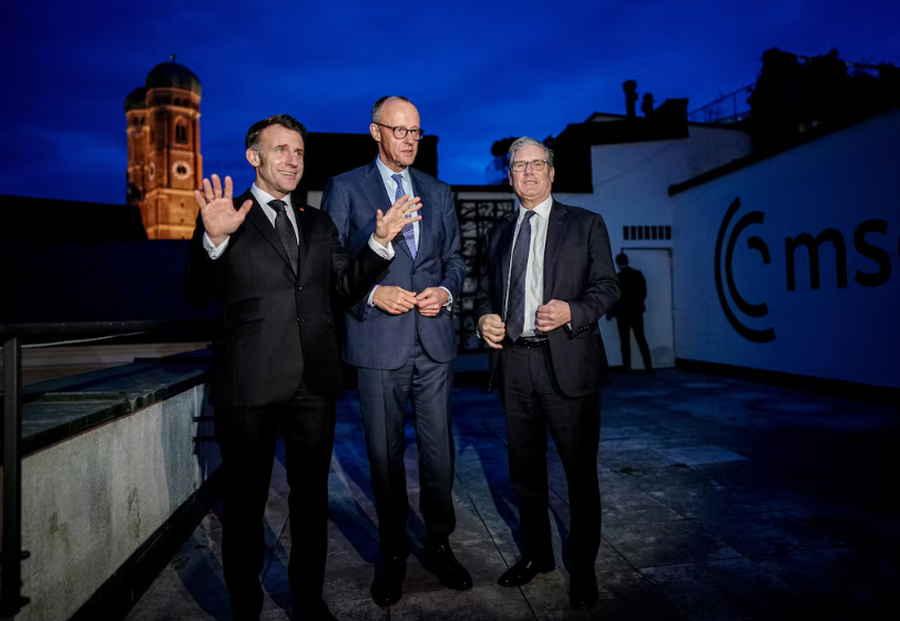
Last year, JD Vance shocked Europe with a speech that showed that the United States intended to follow a different path. This year, at the Munich Security Conference, the tone of the search for new alliances and strategic reorientation was set from the very beginning, as Europe is realizing that the gradual “detachment” from the United States can no longer remain just in theory, but must turn into practice.
Reinforcing the idea that the US is effectively "pushing" Europe towards new alliances, US Secretary of State Marco Rubio gave a clear signal about his stance by canceling at the last minute a meeting with European leaders and officials on peace efforts in the war in Ukraine.
This move was interpreted by some European capitals as a sign of Washington's declining interest in including Europe in American planning for resolving the conflict in Ukraine.
Rubio was scheduled to attend a meeting with the leaders of Germany, Poland, Finland and the European Commission in Munich on Friday afternoon. However, he canceled at the last minute due to "difficulties" in the agenda.
“The secretary will not attend the Ukraine meeting due to a large number of other commitments at the same time,” a US official said, noting that the US diplomat “is dealing with the Russian-Ukrainian issue in many of his meetings here in Munich.” A European official, speaking on condition of anonymity, described the cancellation as “scandalous.”
According to the Financial Times, which first reported the cancellation, the development comes at a time when Donald Trump's administration is increasingly distancing itself from European allies and seeking to pressure Ukraine into a deal with Russia. "The meeting no longer made sense without the participation of the US," another European official was quoted as saying to the British newspaper.
The message seemed to be received by German Chancellor Friedrich Merz, who opened the proceedings of the Summit, which he called a “seismograph of global developments.” Traditionally, the German Chancellor’s speech was given on the second day of the Conference, but Merz moved it to the opening to set the tone from the beginning.
We are living in a period of great change, Merz stressed, referring to Moscow's revisionist plans and China's increasingly large military role.
"The policy of the great powers is harsh and unpredictable," he said, stressing that the first task of Europeans is "to accept these realities without fatalism. We must believe in our strengths and respond to these challenges by defining our objectives and capacities. Above all, freedom is guaranteed by security."
However, he added, “we need to change our way of thinking.” Excessive power threatens freedom, but the lack of power does so in another way. It is not enough to react to the movements and wills of the great; we must set our own agenda. “Leadership together with partners, not hegemonic fantasies,” he emphasized of Germany’s approach.
As for the axis of the new approach, Merz mentioned the military strengthening of Germany with the aim of reducing dependence, strengthening the European idea, with a focus on the essence, reducing bureaucracy and excessive regulation, as well as building a new transatlantic relationship that will heal the rift with the US.
"Democracies need partners and allies. No one imposed on us dependence on the US. It was our choice, which we are now leaving behind," he stressed, adding that Europe aims for a new network of partners "with whom we may not be connected in everything, but we are connected in many things." He specifically mentioned Canada, India, Turkey, South Africa and Brazil.
Before Merz's speech, Deutsche Welle noted that, after the Greenland issue, another shock for the EU, "Europe has fully woken up and is clearly showing that it is now looking in all directions, not just towards the United States."
According to German media, the EU's trade agreements with the Mercosur group and India are evidence of Europe's newfound self-confidence. Berlin, the Greek edition of DW particularly emphasized, "openly declares that it is looking for new, stable and long-term alliances, as the old ones are faltering." The question remains when the EU's "heavy ship" will change course.
German media commented that Merz responded in his own way to Vance's speech last year, but at the same time preceded Rubio's expected speech. The question, according to some German analysts, is not only whether the Americans heard it, but whether "the Europeans will listen too."
After 8:00 PM, the speech of French President Emmanuel Macron began, which was awaited with great interest. He initially sent a "message of hope and determination. Europe can become stronger. We need a positive approach."
We must be proud as Europeans and promote our achievements, he emphasized, and after referring to the issue of Ukraine, he underlined that "there can be no peace without Europeans."
"Everything that has to do with Europeans should be decided by Europeans. We will continue to live next to Russia and we must define this neighborhood ourselves," he said.
"In this new framework, we must become stronger, more independent. I don't mean France. I don't mean Germany. I mean Europe as a whole. Let's see the power as Europeans. Let's free ourselves from dependencies in certain sectors. Let's set clear objectives," Macron added.
Voices in favor of secession
The EU High Representative for Foreign Policy, Kaja Kallas, set the tone for the Union's policy in a panel that, according to DW, turned into a cross-border Euro-American debate.
"What's the difference when Russia goes to war? It goes alone, because it has no allies, whereas when the US goes to war, we go with you and lose our people in that war. The difference between you and other powers is that you have allies," she emphasized.
Of particular interest was her call for the EU to consider taking on joint debt for defense spending, as happened during the pandemic, when it was deemed necessary to confront a common threat to all of Europe. According to her, the same logic applies today, so joint borrowing “makes sense,” although she respects the “sensitivities” of German public opinion.
A similar stance was expressed by the President of Finland, Alexander Stubb, who stressed that Europeans can provide for their own defense, adding that "we can also help the Americans, if they need it."
The message even comes from German industry: "Europe's defense must be planned and prepared, if necessary, even against Washington."