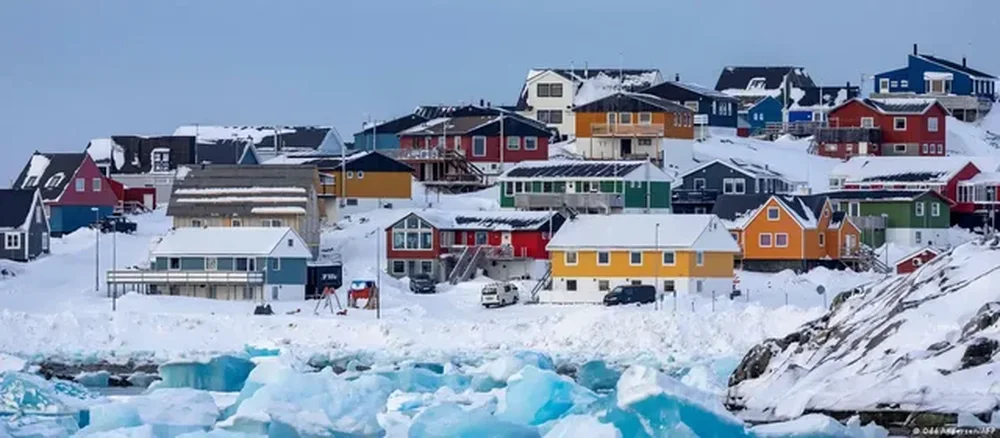
GREENLAND—Before Donald Trump expressed his interest in this island in the Arctic Circle, it wasn't exactly in the global spotlight. That all changed when the US president insisted: "We have to have Greenland." But this isn't the first time the world's largest island has been so coveted.
Early Migration and Red Eric
The first people settled in Greenland about 4,500 years ago. They came from the North American continent. In the 12th century, they were gradually displaced by Asian immigrants, the Thule people, who arrived on the island from Siberia via the Bering Strait. Their descendants are the Inuit, from whom most of the 56,000 Greenlanders today are descended.
The island owes its name to the Viking explorer Erik the Red. According to Icelandic sagas, he was banished from Iceland around 982 for manslaughter. He and his followers sailed west and reached the Arctic island. To encourage settlement, he named it Grœnland, or "green land." While most of Greenland is covered in ice, parts of the coastal areas were relatively green during that period.
Three years after his arrival, Egede baptized the first Inuit child. He founded a church and helped lay the foundation for what would later become Greenland's capital, Nuuk. A statue of Egede has stood there since 1922. Today, his influence is hotly debated, with many Inuit seeing him as an early symbol of Greenland's colonial past.
The Norwegian-Danish conflict: Who owns Greenland?
When Hans Egede arrived in Greenland in 1721, he raised the Danish flag, reflecting the political reality of the time: Denmark and Norway had been united under a single crown since 1380, a personal union that lasted until 1814. When this union ended, Greenland remained under Danish rule - a decision contested by Norway.
Tensions escalated in 1931, when Norway occupied parts of Greenland and declared the area "Eiric Raude's Land", after Eric the Red. Denmark opposed this move, and the dispute was brought before the Permanent Court of International Justice in The Hague. In 1933, the court ruled that sovereignty over all of Greenland belonged to Denmark, ending the territorial dispute.
How the US Entered the Scene
During the 19th century, the United States pursued an expansionist foreign policy. It purchased Louisiana from France in 1803, Florida from Spain in 1819, and Alaska from Russia in 1867.
Secretary of State William H. Seward, the architect of the Alaska Purchase, also expressed interest in purchasing Greenland, seeing it as strategically important in relation to Canada. However, Congress was reluctant to take on what it saw as the high costs of an ice-covered, sparsely populated territory. Instead, in 1916, the United States purchased the Danish West Indies—now the U.S. Virgin Islands—for $25 million. As part of the agreement, Washington formally recognized Danish sovereignty over Greenland.
When Nazi Germany invaded Denmark during World War II, Denmark's direct control over Greenland was effectively ended. In 1941, Denmark's ambassador to Washington, Henrik Kauffmann, signed an agreement with the United States. Under its terms, the US would supply and defend Greenland, while gaining the right to establish meteorological stations and military bases on the island.
The Inuit population of Greenland was not consulted.
In 1946, a year after the end of the war, the United States offered Denmark $100 million in gold to purchase Greenland, seeking to secure its strategic position at the start of the Cold War. The administration of President Harry S. Truman viewed the island as geopolitically important, given its location in North America and its importance for Arctic defense. This reflected the logic of the 19th-century Monroe Doctrine, which asserted U.S. opposition to new European influence in the Western Hemisphere. Greenland's mineral potential also added to its appeal.
Denmark rejected the offer. However, in 1951, the two countries reached an agreement that allowed the United States to establish and operate Thule Air Base, now known as Pituffik Space Base, which the United States still uses today.
Colonial injustice – and the desire for independence
In 1953, Greenland's status changed from a Danish colony to an integrated part of the Kingdom of Denmark. The island was given two seats in the Danish Parliament, but decision-making power remained largely in Copenhagen.
The Danish authorities pursued policies aimed at the rapid "modernization" of Greenland's hunting-fishing society. This included the promotion of the Danish language, education, and social norms. Nomadic lifestyles were discouraged, and many Inuit moved to larger cities.
One of the most controversial policies took place in the early 1950s, when 22 Inuit children were taken from their families and sent to Denmark. The goal was to raise them as "Danes" and later assume leadership positions in Greenland.
At the same time, Danish officials viewed Greenland's growing population as a financial burden. In the 1960s and 1970s, thousands of Inuit women and girls were provided with contraceptive devices - in some cases without informed consent.
In 1979, Greenland gained its own parliament and government, although with limited authority. A major step forward followed in 2009, when control over most internal affairs was handed over to Greenland. Denmark retained responsibility primarily for foreign and security policy.
Today, support for full independence from Denmark remains strong in Greenland. What Greenlanders overwhelmingly reject is union with the United States. Recent polls have shown that 85% of them oppose any US invasion. So far, this cold reception does not seem to be discouraging Donald Trump./ DW