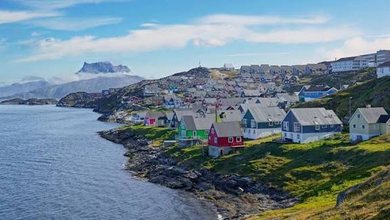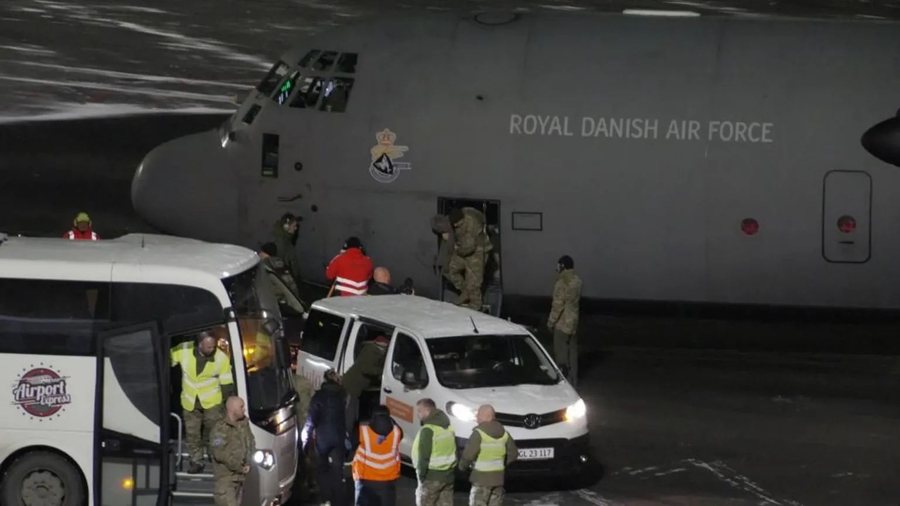
A contingent of 15 French soldiers has arrived in Greenland's capital, Nuuk, as several European countries have begun deploying troops to the Arctic island as part of a mission called "reconnaissance." In addition to France, Germany, Sweden, Norway, the Netherlands and the United Kingdom are also participating in this military presence.
The move comes at a time of heightened diplomatic tension, as US President Donald Trump continues to openly push his claim to bring Greenland under US control. Greenland is a semi-autonomous territory, part of the Kingdom of Denmark.
French President Emmanuel Macron said the initial contingent would soon be reinforced with land, air and naval capabilities. Meanwhile, senior French diplomat Olivier Poivre d'Arvor called the mission a strong political signal, stressing that "NATO is present" and that this is just a first exercise.
The troop deployment came shortly after the foreign ministers of Denmark and Greenland traveled to Washington for talks with US Vice President JD Vance. After the meeting, Danish Foreign Minister Lars Lokke Rasmussen acknowledged that the talks were constructive but stressed that there was a “fundamental disagreement” between the parties, openly criticizing Trump’s idea of buying Greenland.
For his part, Trump reiterated his stance, declaring from the Oval Office that “the United States needs Greenland for national security.” While he did not rule out the use of force, he said he believes a solution can be reached with Denmark.
In Europe, the reactions have been strong. Polish Prime Minister Donald Tusk warned that any US military intervention in Greenland would be a “political catastrophe,” stressing that a conflict between NATO member states would destroy the foundations of Euro-Atlantic security. On the other hand, Russia expressed “serious concern,” accusing NATO of militarizing the Arctic under the false pretext of threats from Moscow and Beijing.
Although the European military presence consists of only a few dozen troops and is part of the joint Danish exercise “Operation Arctic Endurance,” it is seen as a symbolic but clear political message to Washington. Danish officials have said the goal is a rotational, long-term military presence in Greenland, to strengthen NATO’s footprint in the Arctic.
Greenland's Prime Minister, Jens-Frederik Nielsen, has described the situation as a geopolitical crisis, stressing that if Greenlanders had to choose, they would stay with Denmark and not with the US. "Greenland does not want to be owned, governed or become part of the United States," he declared.
Meanwhile, the US already has a military base in Greenland with about 150 people, but recent developments show that the battle for influence in the Arctic has just entered a new phase, where military symbolism is increasingly turning into open political pressure.