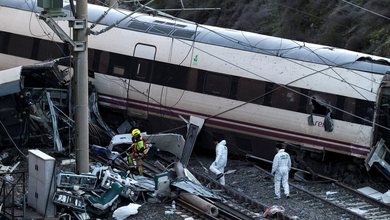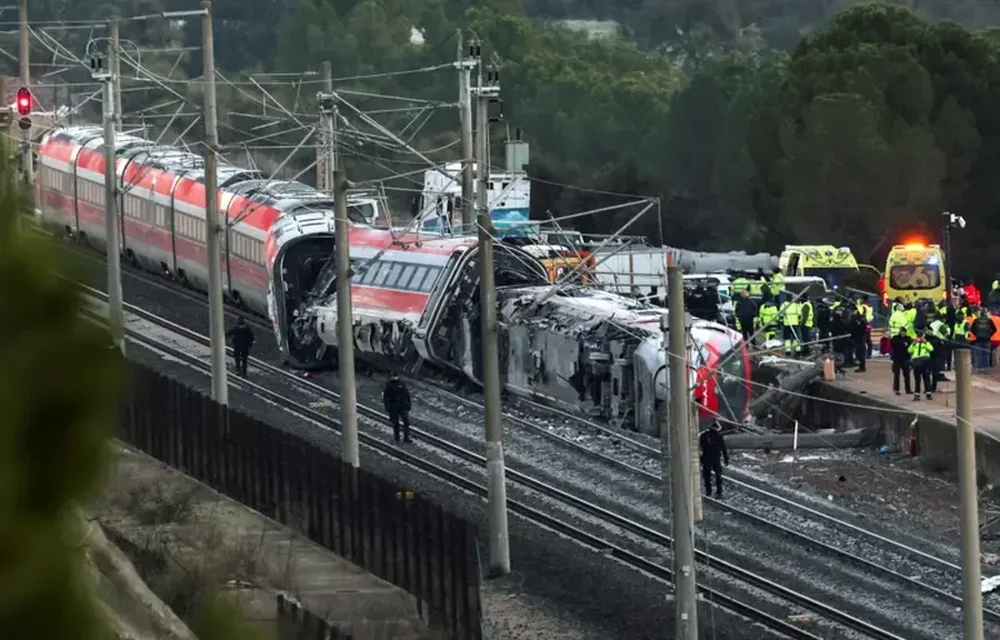
At least 39 people were killed and dozens more injured after two high-speed trains collided in southern Spain on Sunday evening, local officials described as the country's worst rail accident in more than a decade.
The incident occurred at around 7:45 p.m., an hour after one of the trains left Málaga for Madrid. According to the line's operator, Adif, the train derailed and crossed onto the opposite track, colliding with another train traveling from Madrid to Huelva. Transport Minister Óscar Puente said the collision forced the second train onto an embankment next to the tracks. Most of the dead and injured were in the front cars of the train heading to Huelva.
The cause of the derailment remains unclear. Initial investigations indicate that a damaged joint in the rails of the railway bed may have caused the collision. The trains involved were: the Iryo, travelling from Malaga to Madrid at 110 km/h, and another train bound for Huelva, travelling at 200 km/h.
Passengers travelling to Madrid described moments of terror during the collision. One passenger said the train “shook like an earthquake”, with windows breaking, luggage crashing and people thrown to the floor. Another passenger, Lucas Meriako, who was in the fifth carriage, said he felt “strong jolts and the train shaking”, adding that it felt like the train was going to fall apart.
A witness, Ana, told Reuters that the train “rolled to one side, everything went dark and I just heard screams.” She and her sister were rescued by passengers and firefighters.
Álvaro Fernández Heredia, president of state-owned operator Renfe, said it was unlikely that the accident was caused by speed or human error. He added that the train was equipped with systems to correct possible errors, and that both trains were traveling below the speed limit. Heredia suggested that a mechanical or infrastructure problem could have been the main cause.
The two trains were carrying about 400 passengers and staff. It is not yet known if there are people trapped inside the carriages, as warped metal has hampered rescue efforts. Cordoba fire chief Francisco Carmona said they often had to pull out victims to reach live passengers, making the operation complex and delicate.
The death toll, 39 people, has not yet been identified and could change as investigations are still ongoing. Local services reported that 112 people had received medical assistance, 43 of whom remained in hospital, four minors and one in intensive care, while twelve adults are also in intensive care.