


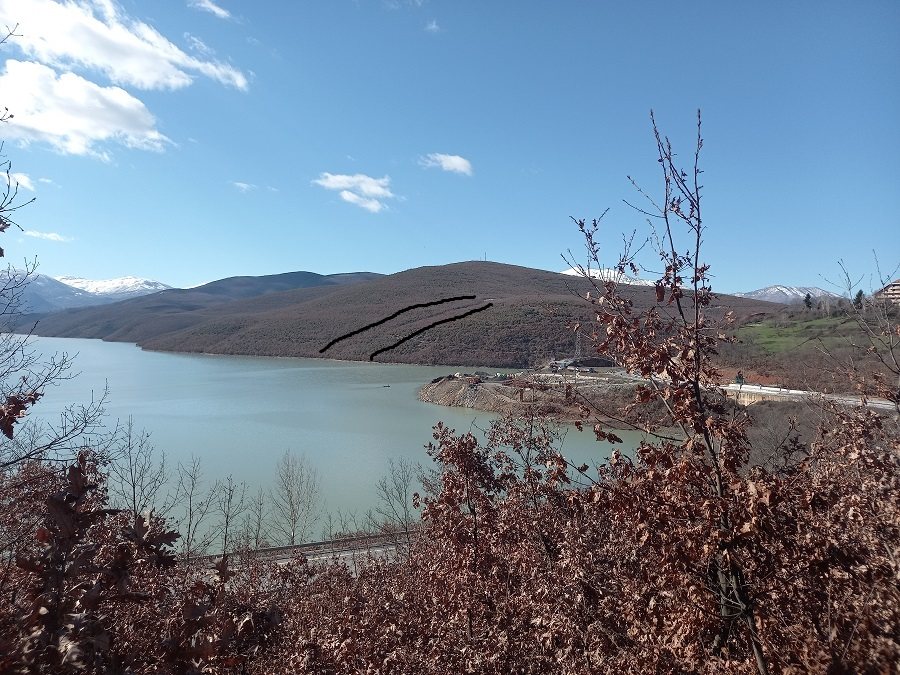
Amidst the greenery on the outskirts of Kukës, the area known as “Lama e Fluturës” is flooded with garbage. From the waste field, a black water channel flows for almost 300 meters steeply towards Lake Fierza.
The canal contains leachate – polluted, untreated water caused by the decomposition process of urban waste.
In the Municipality of Kukës, urban waste management has been in crisis for years, but for local officials, the problem has no end.
“The landfill is almost full,” says Liridon Mehmeti, director of services at the Municipality of Kukes. “We are maneuvering with difficulty, putting heavy tractors into operation to free up some space for waste disposal,” he adds.
Although it should have been closed and rehabilitated years ago, the Kukës Municipality waste field near the village of Myç-Mamëz continues to cause incalculable damage to the environment and the health of residents.
“The waste deposited in our village is destroying our lives,” says Ahmet Dulla, a 70-year-old resident of the area.
"In the summer, they are set on fire, which causes us many problems, including not being able to breathe. We don't even have anywhere to graze our livestock, as they end up in the garbage," he stressed.
The agony of the environmental crisis is, however, unclear, given that the Municipality of Kukës has a new landfill at its disposal that it does not use, while it is shelving an even more ambitious project for integrated regional urban waste management.
The Bozha landfill was completed in 2022 through an investment of 270 thousand euros financed by the Ministry of Environment, but it remains unused, even though the current landfill is beyond any parameters and capacity.
The municipality of Kukes did not respond to BIRN’s questions about the reasons for the non-use of the landfill in Bozhë and the delays in the implementation of the regional project for the treatment of urban waste by the time of publication of this article. The Ministry of Environment and the National Agency for Waste Management, AKEM, also did not respond to requests for comment. Since December 2020, the three municipalities of the Kukes district have a joint plan for the integrated treatment of urban waste, which foresees the construction of a landfill in the village of Pobreg, the construction of two transfer stations and the closure of six current landfills in Kukes, Has and Tropoja by 2030.
In September 2023, these plans were added to a project by the European Union and the French Development Agency, AFD, which envisages supporting the circular waste economy through funding of 19 million euros in the regions of Kukës and Gjirokastra.
The project envisages improving the living conditions of 190 thousand residents in Kukës and Gjirokastra through increased recycling, the establishment of landfills according to EU standards, and the facilitation of waste management to reduce pollution and greenhouse gas emissions.
In August 2025, Prime Minister Edi Rama and former Minister of Tourism, Mirela Kumbaro, promised that the construction of the landfill in the village of Pobreg would begin as soon as possible.
But the project is opposed by the village's residents, who complain that the decision was made without consulting them and poses a direct risk of pollution of their air, soil and water.
The headman of the village of Pobreg, Hamit Dida, told BIRN that the community is not against development, but is demanding transparency and guarantees for environmental protection.
“This project was decided without our knowledge and approval. It is a decision that does not take into account the interests of the residents and endangers life in this area,” Dida told BIRN.
"We seek guarantees that this project will not impact the environment and pollute land and water," he added.
The Pobregu sanitary landfill is expected to have a capacity of 250 thousand m3 of waste for 25 years. According to the feasibility study, two transfer stations with a storage capacity of 2-3 thousand tons per year will be built in Has and Tropoja as part of this project.
The mayor of Kukës, Albert Halilaj, tried to reassure residents last year by declaring that the landfill "would ensure safe and modern waste management."
However, other local government representatives are skeptical about the rapid implementation of the project.
“There is no development regarding this project, it is only in the realm of words,” Zenit Matmuja, head of the Tërthore administrative unit, which includes the village of Pobreg, told BIRN.
"As the head of the Administrative Unit, I am not informed about this problem, and I don't even know the location where the project will be implemented," he added.
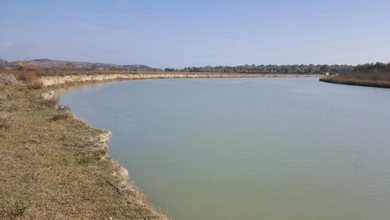
Waste flows from both rivers contribute to the pollution of the lake, not to mention the damage caused by the leachate flow from the waste field into the "Butterfly Lake".
The leachate spill into Lake Fierza is estimated to have severely damaged the fauna and biodiversity in this water basin, including the disappearance of fish.
Hysen Manga, a fisherman in the area for 40 years, says he has almost completely avoided casting hooks on the right side of the large bridge.
"In the entire area of the Lake, to the right of the big bridge, fishing is now very rare due to the significant reduction in fish in this area as a result of the discharge of polluted waters from the waste pit," he said.
At the mouth of the Luma River in Fierzë, Oljam Dervishi, an environmental engineer and head of the environmental organization, RESU, was monitoring the worsening situation. The Luma flows through the administrative units of Shishtavec, Zapod and Topojan, before flowing into Fierzë near the former copper plant.
“The situation is alarming, but a large part of our rivers are polluted in the same way,” Dervishi said. “This is like a funnel for waste, which then discharges into the sea,” he concluded./Reporter.al