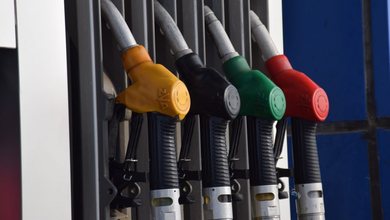



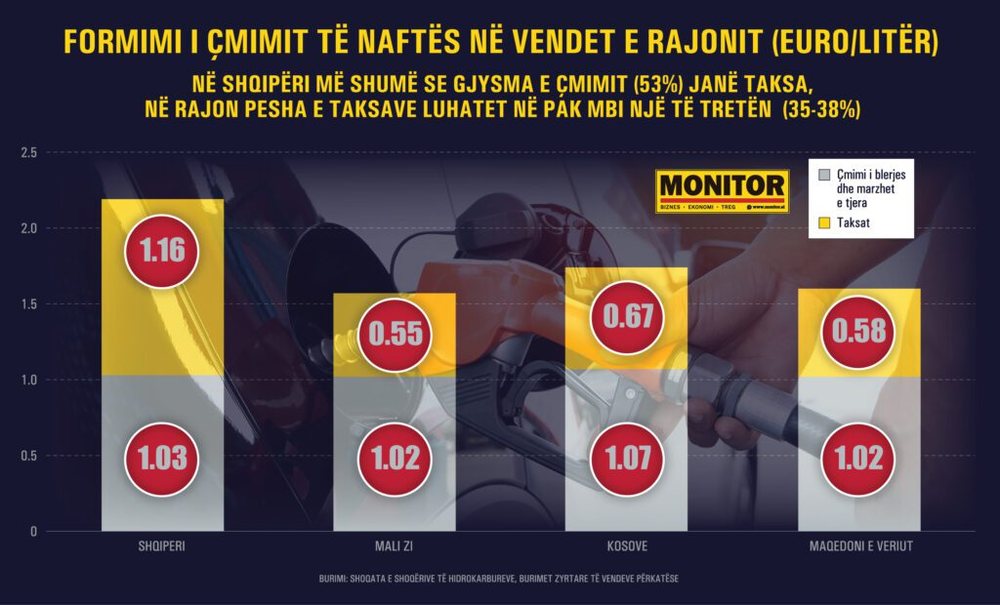
Today, a liter of diesel in the retail market is traded at 214 lek per liter, or about 2.2 euros according to the average exchange rate.
Oil in Albania is traded at the highest price in the region. The cheapest prices are in North Macedonia and Montenegro, where fuel is currently being traded at around 1.6 euros per liter. In Kosovo, the price recently increased to 1.7-1.8 euros/liter, but until two days ago it was around 1.6 euros/liter.
On average, a vehicle user in Albania pays a final price that is 25-40% more expensive than in other countries in the region.
How is this more expensive price explained?! If we look at the structure of how the price is built, in Albania it is a known fact that the tax burden is the highest in the region. But, how much are the taxes paid:
In Albania, the element that adds the most to the fiscal burden is the circulation tax of 27 lek per liter. The excise tax is fixed, 39.4 lek per liter and 3 lek is the carbon tax. On top of these, VAT is calculated, which is 20% on the final price (including other taxes), unlike the region that does not charge VAT on top of other taxes.
Montenegro only charges an excise tax on the price of oil, which was recently halved to 0.22 euros per liter, as a means of easing price increases. VAT in Montenegro is 21%.
North Macedonia only charges an excise tax of 0.42 lek per liter on diesel. Recently, the North Macedonian government reduced the VAT on diesel and gasoline from 18% to 10% as a temporary measure to cushion the price increase on the stock exchanges.
Kosovo has an excise tax of 0.37 euros per liter and a VAT of 18%.
In total, currently, an Albanian pays 1.16 euros in taxes on a liter of diesel (53% of the final price); a Macedonian citizen 0.58 euros per liter (36% of the final price); a Montenegrin 0.55 euros (35% of the final price); a Kosovo citizen 0.67 euros, or 38.5% of the final price.
In value, every time they buy a liter of fuel, every car user in Albania pays twice as much in taxes as residents of Kosovo, Montenegro, and North Macedonia.
If the main taxes are removed, the wholesale purchase price, adding retail margins and other activity costs (labor costs, transportation from warehouses to the network, energy, legal fees, depreciation, bank loans, etc.), in all countries in the region is more or less at the same levels at around 1-1.1 euros per liter.
The region is rushing to lower taxes, Albania is still waiting
The beginning of the crisis in the Middle East and the rapid increase in oil prices caused many countries to rush to take measures to protect consumers.
The Montenegrin government has decided to reduce the excise duty on Eurodiesel by 50% starting from 24 March 2026. At the same time, the excise duty on petrol has been reduced by 25%. The measure was taken to mitigate the effects of the increase in global oil prices due to the crisis in the Middle East.
The government of North Macedonia has also reduced the VAT on gasoline and diesel from 18% to 10%. The measure was taken to curb the increase in fuel prices, driven by the crisis in the Middle East. The decision comes into effect from March 23, 2026 and is temporary.
The Government of Kosovo has in force the Decision on the Net Profit Margin of 0.02 Euro/liter for the majority and 0.12 Euro/liter for the minority. Recently, there is a debate in Kosovo about interventions in excise duty and VAT.
Albania, which has the highest tax burden in the region, is moving more slowly. The Council of Ministers has announced that as part of measures to stabilize fuel prices, in addition to re-establishing the Transparency Board, it has reduced fuel excise duty by 20%.
This measure, according to importers, has not yet come into force. A 20% reduction in excise duty means that it will drop to 32 lek per liter excluding VAT, from around 40 today, meaning a saving for companies of 8 lek, which should automatically translate into a reduction in the price of fuel by at least 8-10 lek per liter, taking into account the effect of VAT.
Meanwhile, since the beginning of the conflict, oil has gone from 170-175 lek per liter to currently 214 lek per liter, or 40-45 lek more, which means that even if the excise tax is reduced by 20%, the price will still remain above 200 lek per liter, unless it becomes more expensive, if it increases on the stock exchange.
How is the price of oil formed, why is the increase immediately reflected and not the decrease?!
Have you noticed that the price of oil increases almost immediately when it rises on the stock market, but if the trend in international markets is downward, domestically they "delay" their decline and the profit rates of the benchmark companies increase.
Luigj Aliaj, from the Association of Hydrocarbon Companies, explains how the import and trading of oil in the country works:
"The procedure begins with contracting with international trading companies, usually with agreements concluded a year in advance. The aim is to select serious companies that guarantee supply, quality and offer a more competitive premium over the stock exchange price."
"Wholesale contracts, anywhere in the world, are concluded on the international Platts indicator (FOB), on the day of withdrawal from the free customs zone, plus a premium. So, the only competitive element between companies is the premium, while the base price is determined by the international market."
Platts is an international oil product price index, published by S&P Global, which is used as a global reference for trading prices. The price applied is that of the day the product is withdrawn.
Aliaj shpjegon se në bazë të kësaj kontrate, tregtuesi ndërkombëtar i zgjedhur nga kompania shqiptare paraqitet në doganën shqiptare dhe kompania pajiset me kod ML (magazinë e lirë). Sipas sasisë mujore të kontraktuar, anijet shkarkojnë naftën në këto magazina dhe produkti fizikisht kalon në pronësi dhe ruajtje të kompanisë shqiptare, ndërsa vlera financiare mbetet ende në ngarkim të furnitorit, që në këtë rast është kompania e njohur ndërkombëtare BP.
Çdo ditë, në varësi të kërkesës së tregut vendas apo kërkesës nga vendet fqinje për rieksport, kompania shqiptare i dërgon kërkesë furnitorit për lirimin e produktit për arsye të hedhjes së tij në treg. Furnitori, bazuar në çmimin Platts të ditës, mbyll çmimin për sasinë përkatëse, lëshon faturën dhe mbi këtë bazë kryhet pagesa. Më pas, subjekti importues shqiptar paraqitet në doganë, paguan detyrimet, po bazuar mbi Platts e asaj dite dhe produkti hidhet në treg.
“Në depozita, çmimi nuk mund të jetë i mbyllur (fiksuar), as për rezervat që kompanitë janë të detyruara të mbajnë. Ky do të ishte si një bast i rrezikshëm, pasi luhatjet e çmimeve janë të paparashikueshme. Mjafton një rënie prej disa dollarësh që produkti të bëhet menjëherë jokonkurrues në treg. Çdo mëngjes, tregtarët e pakicës informohen për çmimin Platts të ditës së mëparshme dhe kërkojnë nga shumica çmimin e ditës. Nëse çmimi është mbyllur një ditë më parë dhe ndërkohë ai ka rënë, kompania humbet konkurrueshmërinë”, thotë Aliaj.
Nga zonat e lira doganore, kompanitë e shumicës shesin çdo ditë duke reflektuar çmimin Platts të ditës dhe e korrigjojnë atë në mënyrë të vazhdueshme.
Si reflektohen këto lëvizje në tregun e pakicës. Aliaj pohon se në tregun e pakicës operojnë rreth 1,400 pika karburanti, me volume që variojnë nga 500 litra për pikat e vogla deri në 30 mijë litra në ditë për njësitë e mëdha. Furnizimi bëhet periodikisht, zakonisht me autobote prej rreth 30 mijë litrash, në varësi të konsumit.
“Si rezultat, çmimi në pakicë reflekton ndryshimet me një vonesë që mund të shkojë deri në 10 ditë. Pikat me qarkullim të lartë, që shesin rreth 30 mijë litra në ditë, e reflektojnë më shpejt ndryshimin, brenda 1-2 ditësh, ndërsa pikat më të vogla, me shitje 5-6 mijë litra në ditë, e ndjejnë efektin më vonë.
Edhe në situatën aktuale vihet re se çmimi në pakicë është ende më i ulët se kostoja aktuale e furnizimit, pasi rritja e Platts në ditët e fundit nuk është reflektuar plotësisht ende në të gjitha pikat e shitjes.”
Sipas të dhënave nga Shoqata e Shoqërive të Hidrokarbureve, në datën 18 mars, kur çmimi i naftës në vend me pakicë kërceu në 214 lekë, Platts në bursa ishte rreth 1300 dollarë për ton, që i korrespondonte një çmimi në doganë prej rreth 96 lekë për litër, të cilës i shtohen dhe rreth 100 lekë taksa e marzhe operacionale të tjera prej 3 lekë të shumicës dhe 14 lekë të pakicës.
On March 23, Platts increased to about $1,600 per ton, which in retail terms amounts to 230 lek per liter. This price has not yet been reflected in the market, but if it continues to increase in price on the stock exchanges, the increase in retail prices is not expected to be delayed.
But how is it explained that prices are decreasing more slowly, this is also confirmed by the increase in the profit rate of hydrocarbon companies in years when prices were stable or decreasing?! "When prices are low or stabilized, there is a higher profit rate, as expenses come down. There are never any profits in situations like the current one with a sudden increase in prices. At this moment, the fuel sector, instead of asking what support it can have to continue supplying the market, is being attacked without any analysis and without reason. Currently, it takes two to three times the capital to maintain the market, as a result of expensive prices, financing from banks is becoming more difficult, insurance is increasing and the first concern is whether the continuity of supply can be continued and then the price analysis can be clarified", says Aiaj.
Taken from Monitor