



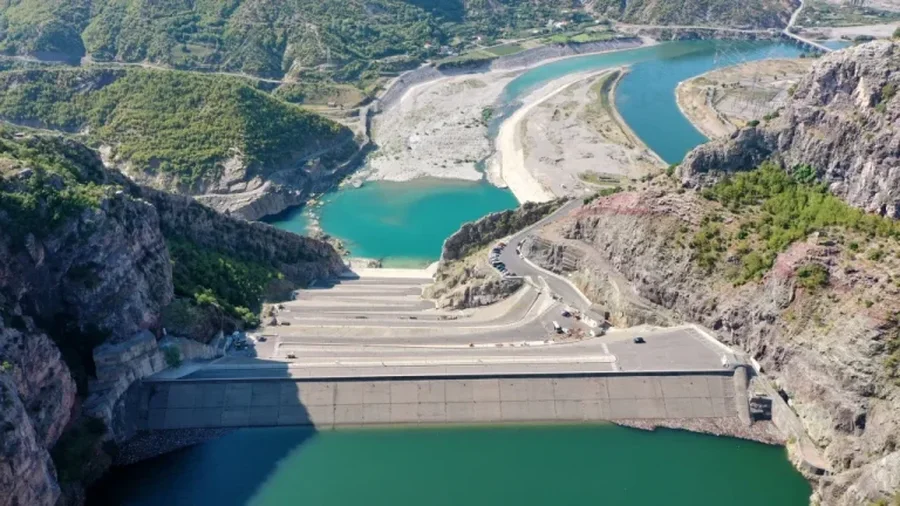
The audit of the Supreme State Audit Office highlights serious shortcomings in financial management, procurement procedures, and the disbursement of funds for the project to improve the safety of the dam at the Koman hydroelectric power plant.
The project was financed through a 12.7 million euro loan, ratified by law between the Republic of Albania and the European Bank for Reconstruction and Development (EBRD). However, during the implementation phase, the administrator of the Albanian Power Corporation (KESH SHA) at the time, Agron Hetoja, and the head of the Project Implementation Unit conducted procurement procedures and cooperation with the lender without prior approval of the funds by the Ministry of Finance, as the representative of the Albanian state in the loan agreements.
The procurement procedures were carried out from March 2016 to October 2017, in the amount of 12,340,903 euros for two lots, leading to the conclusion of the contract with the winning operator, while the financing had not yet been approved and ratified according to legal requirements. Although the project was implemented within the loan amount, the extension of the implementation deadlines and the failure to disburse the funds on time resulted in an additional cost of 316,624.52 euros, paid by the Ministry of Finance to the EBRD as a commitment fee.
Based on the loan agreement, a sub-loan agreement was also concluded between the Ministry of Finance and KESH SHA, according to which the financial obligations for the repayment of the loan were transferred to the corporation. However, the audit shows that KESH SHA made only minimal payments in 2014: 3,382 euros for interest and 99,739 euros for commissions. As a result, a carried liability of 9,820,643 euros was created towards the Ministry of Finance, transferring the financial burden onto the state budget and constituting an ineffective use of public funds.
Irregularities in disbursements, invoices and fiscal risk
The audit found serious violations in the disbursement and payment process. More specifically, the prepayment of 631,654.37 euros (10% of the contract) was approved at a time when the contract had not yet been concluded.
Meanwhile, the tax invoice for the prepayment was issued 6 months later, in violation of the VAT law. Furthermore, the invoices did not meet the requirements of the tax procedure law and were treated as “commercial invoices”, outside the legal format. The payment from the EBRD was made to an account outside Albania, while the tax invoices were issued by the branch in Albania.
These irregularities increase the risk of tax evasion by foreign contractors, the report highlights.
Financial burden on the state budget
From the dam safety loan until 31.12.2024, the Ministry of Finance has paid 949,029 euros in interest, 8,531,111 euros in principal, and 443,624 euros in commissions.
Meanwhile, KESH SHA has made only two minimum payments in 2014, creating a carried liability of 9,820,643 euros, which has been unfairly transferred to the state budget.
Due to the project's delay and non-disbursement on time, the Ministry of Finance has paid 316,624.52 euros in commitment fees to the EBRD, increasing the total cost of the project.
Regarding the process of handover of civil works and equipment, it was found that the handover by the Project Management Unit was carried out according to the contract, but KESH SHA did not formalize the handover of the assets in accordance with the requirements of Instruction No. 30/2011 on asset management in the public sector.
Overall, the project has met the technical objective of increasing the safety of the dam, but the manner of financial and institutional administration has produced negative consequences for public finances and has highlighted the need to strengthen control, planning and accountability in foreign-funded projects.
The Albanian Supreme Audit Office recommends initiating disciplinary proceedings against the head of the Project Management Unit for the violations found. No disciplinary measure is recommended for the former KESH administrator, as he is no longer in a working relationship with the institution./ekofin.al